![Home Paper Shredders Off Grid: Manual Cross Cut Guide[1][3][4]](/images/article/thumbnail/2dc1f8e8-14bf-4952-99cd-0b436a4a3e01.avif)
Manual Off Grid Cross Cut Paper Shredders for Secure Disposal
By Priya Nair • 7th Aug
Quick answer
Manual/off-grid product specifications must be verified product by product, and a hand crank does not prove secure output. Choose based on verified cut type, particle size or DIN level, and instructions that match the sensitivity of your records.
- Short answer: Fellowes maps strip-cut to P-1/P-2 and cross-cut to P-3/P-4. It identifies P-4 or P-5 for most confidential-document needs, but this is guidance—not a universal rule.
- Key distinction: “Cross-cut” is only a useful claim when the specific product’s documentation supports it. For manual models, verify output, paper limits, accepted materials, cleaning, and safety instructions rather than relying on listings or photos.
- Important caveat: The available evidence does not establish realistic throughput, durability, effort, or security levels for the manual products discussed.
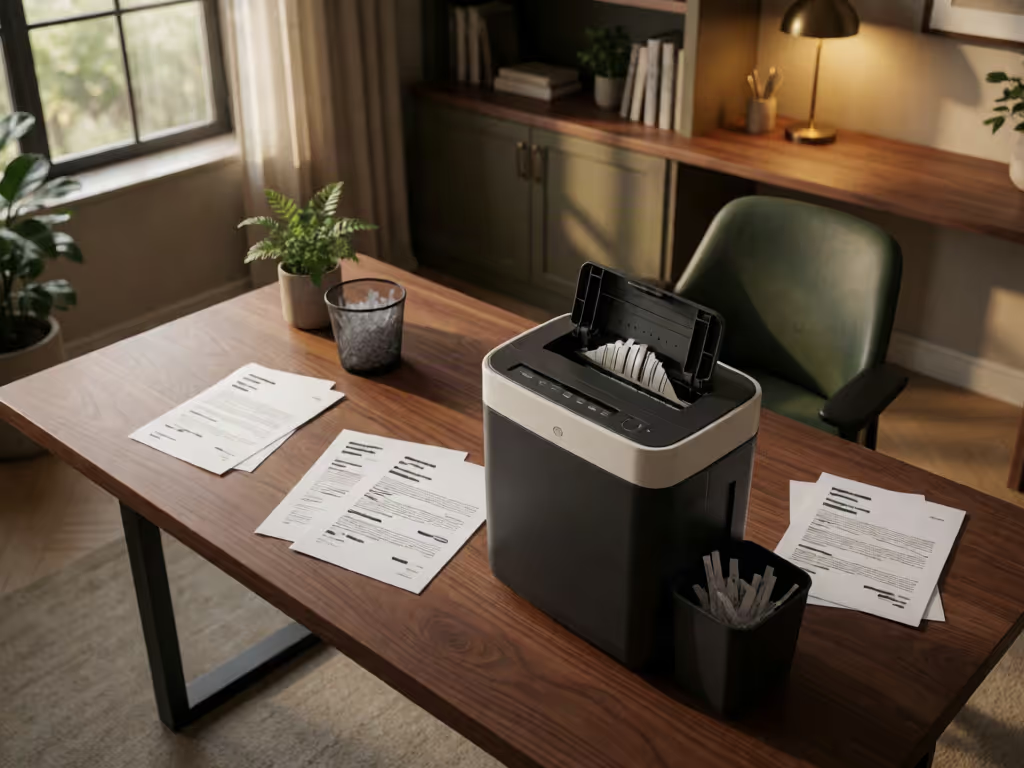
An office paper shredder machine should be chosen based on the sensitivity of the records, the documented output, and the instructions for the specific model. For readers exploring a cross-cut paper shredder for low-energy or potentially off-grid document disposal, the central question is simpler: can the machine's verified output match the sensitivity of the paper records you handle? Match the document risk to the shred, not the hype.
For hand-operated models, the available specifications must be checked model by model. A manual crank alone does not verify cut type, DIN level, capacity, accepted materials, safety features, or suitability for a particular setting. This guide is general paper-record guidance, not legal advice or a compliance guarantee.
What does "cross-cut" mean in practical terms?
"Shredder" is a broad category. The meaningful distinction is the output pattern and the security level that the manufacturer can substantiate.
Fellowes' explanatory guide describes the DIN 66399 paper-security framework as seven levels, from DIN level P-1 through DIN level P-7. In that guide, strip-cut aligns with P-1 and P-2, while cross-cut aligns with P-3 and P-4. It also places mini-cut at P-4 and micro-cut at P-5.
That mapping is useful as a starting point, not as a substitute for documentation. A listing that says "cross-cut" should not be treated as proof of a particular DIN level unless the product documentation provides particle-size details or other clear support for that claim.
The label on the carton is not a risk assessment. Verify the claimed output before assigning a DIN level to it.
The security rationale is straightforward: Fellowes explains that smaller particles are more difficult to piece back together and therefore provide greater data security. The U.S. Department of the Navy's CHIPS publication also characterizes use of a cross-cut shredder as a recommended best practice. Neither statement means every cross-cut product is appropriate for every record type or organizational requirement.

Is a cross-cut shredder good enough for confidential paper?
It can be, provided the product's documented DIN level fits the risk category. Fellowes recommends DIN level P-4 or DIN level P-5 for most confidential-document shredding needs. That is a manufacturer recommendation, not a universal rule and not a legal conclusion.
Use a plain-language risk category mapping before you shop:
| Paper-record risk category | Practical question | Starting point for evaluation |
|---|---|---|
| Routine, low-sensitivity paper | Would disclosure cause little meaningful harm? | Confirm whether a lower level is genuinely appropriate for your own policy. |
| Confidential documents | Do the documents require confidential handling? | Fellowes recommends P-4 or P-5 for most confidential-document shredding needs. |
| Highly sensitive paper | Would exposure create unusually serious harm or trigger stricter internal handling? | Establish the required outcome first; do not assume a generic "cross-cut" label is sufficient. |
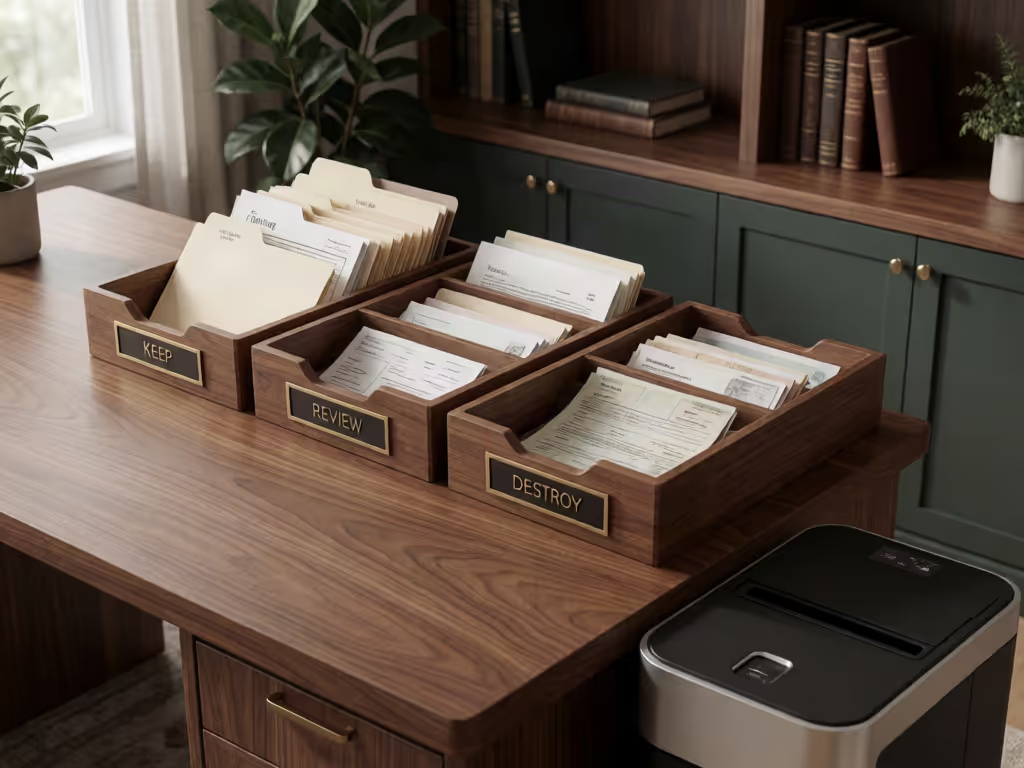
For a home policy, this can be as simple as separating ordinary paper from records containing personal or financial details. For an office policy, document categories should be mapped to the stated DIN level, and staff should know which bin receives which category. For broader guidance on how shredding supports legal obligations, see this guide to document destruction compliance requirements.
Privacy is a process, not a one-time event.
Can manual or "energy-free" shredding be a sensible option?
Manual or "energy-free" product specifications must be verified product by product. Do not treat a preference for non-electric operation as evidence about performance.
The evidence available for manual products is too limited to make general claims about realistic crank throughput, operator effort, jams, durability, or off-grid suitability. One online video title identifies a HOME-X item as a hand manual-crank document shredder, but that alone does not establish its actual output, DIN level, feed capacity, or materials it accepts. Comparable claims for other manual models likewise require their own manuals or specification sheets.
This creates a useful purchasing discipline. Before choosing among compact paper shredders or mobile paper shredders, obtain answers to these questions in writing:
- What cut type is documented? Look for strip-cut, cross-cut, mini-cut, or micro-cut (not just "secure").
- What DIN level or particle specification is documented? Do not infer it from product photos.
- What is the permitted paper load? Follow the model's stated limit rather than testing its boundaries.
- Which materials are explicitly accepted? Do not assume staples, paper clips, cards, or other materials are allowed.
- What are the use, cleaning, and safety instructions? These are part of the operating control, not fine print.
- What evidence supports your handling process? For an office, that may include bin labels, a disposal log, and a clear chain-of-custody reminder.
If those answers are unavailable, the model may still be of interest, but it is not a well-documented choice for a sensitivity-based disposal policy.
Is it worth buying a paper shredder for a home office or small office?
The decision should follow the workflow, rather than the attraction of owning a machine. A shredder can be worth considering when confidential paper arises regularly and you can consistently use a documented cut level that fits the risk. It is less persuasive when the intended use is occasional, the records are not sorted by sensitivity, or the equipment details cannot be verified.
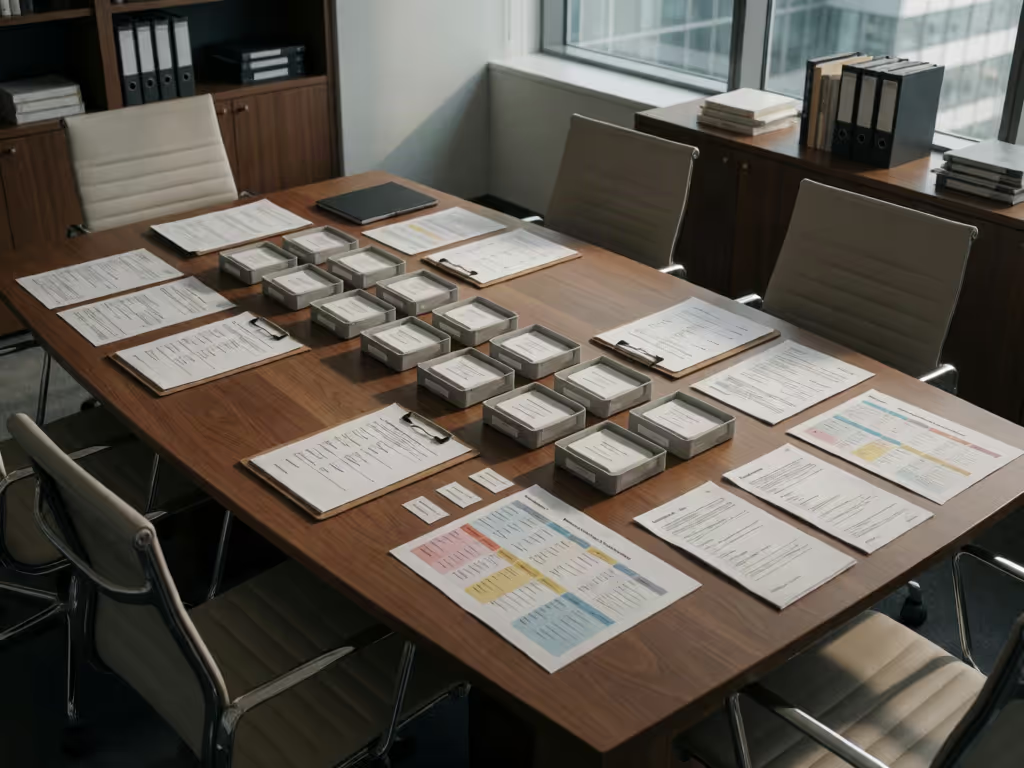
For a small office, the operational question is not merely "Can we shred?" It is: Can we show a consistent path from record category to disposal? A basic process might include:
- identifying which paper records require secure disposal;
- assigning the required DIN level in the written procedure;
- placing clearly labeled collection bins where records are created or reviewed;
- restricting access to accumulated paper; and
- recording handoffs or pickups when paper leaves the team's control.
These chain-of-custody reminders matter because security can fail before the cutting stage. A suitable shredder does not correct an unlabeled pile of client records left beside a desk.
For home use, keep the system proportionate. A small, defined collection point and a regular disposal routine can be more reliable than treating each piece of mail as an emergency. For an office, add accountability without creating needless paperwork. Good privacy practice should be boring: the right cut, used consistently, with simple proofs.
What safety and operating mistakes should buyers avoid?
Use the instructions for the exact model you own. The available safety evidence concerns specific electrically powered shredder manuals, not hand-crank products, so it should not be presented as a universal manual-shredder rulebook.
Still, those manuals illustrate sensible questions to ask of any product's directions. One manual warns users to keep fingers away from the feed slot and to keep children, pets, loose clothing, jewelry, and hair away. Another instructs users not to exceed the recommended sheet count and not to feed paper clips or staples into that particular model.
The practical lesson is limited but important: do not assume a feature or allowance from another shredder applies to yours. Confirm whether your specific unit permits particular materials, follow its feed limits, and use its stated cleaning and safety instructions. A small device is not automatically a low-risk device.
FAQ: Which is better, micro-cut or cross-cut?
"Better" depends on the documented security requirement. The micro-cut versus cross-cut comparison explains how Fellowes maps cross-cut to DIN level P-3 or P-4 and micro-cut to DIN level P-5, while also explaining that smaller particles are more difficult to reconstruct. That supports choosing the level that fits the document risk, not automatically choosing the highest-sounding label.
For many confidential-paper uses, Fellowes recommends P-4 or P-5. Verify the actual product's stated output before treating either term as proof of performance.
FAQ: What is the difference between a shredder and a cross-cut shredder?
A shredder is the general machine category. "Cross-cut" is a specific cut-type label. Fellowes' guide associates strip-cut with DIN levels P-1/P-2 and cross-cut with P-3/P-4. The label is informative only when the particular product documentation supports it.
FAQ: Are cross-cut shredders a good choice?
They can be a sound choice for confidential paper when their documented DIN level matches the records being destroyed. Cross-cut shredding is described as a recommended best practice in the Navy CHIPS article, while Fellowes identifies P-4 and P-5 as suitable for most confidential-document needs. The appropriate choice still depends on your records and the verified specification of the machine.
Further exploration: make the policy before the purchase
Before selecting a manual, compact, or conventional office paper shredder machine, list the paper categories you actually handle and assign each a risk category. Then request the model's cut-type evidence, DIN-level documentation, material limits, and operating instructions. If the documentation cannot answer those basics, keep looking.
The useful outcome is not the most dramatic disposal setup. It is a calm routine that puts every sensitive page through the right documented process, every time.
Related Articles