Home Paper Shredders Off Grid: Manual Cross Cut Guide[1][3][4]
By Linh Tran • 17th Sep
![Home Paper Shredders Off Grid: Manual Cross Cut Guide[1][3][4]](/images/article/thumbnail/2dc1f8e8-14bf-4952-99cd-0b436a4a3e01.avif)
Quick answer
Before choosing a manual unit for off-grid document disposal, confirm the exact model’s cut type, security information, material limits, power requirements, and operating instructions.
- Key distinction: Do not infer that a hand-crank shredder is cross-cut. Cross-cut means blades cut lengthwise and widthwise; it does not by itself establish particle size, DIN level, capacity, effort, or power requirements.
- Practical approach: When documentation does not state a unit’s capacity, effort, or operating limits, do not assign it a particular workload. Match security claims to the sensitivity of your papers.
- Disposal caveat: Do not treat burning as an easy off-grid substitute: guidance warns that open burning creates pollutants and says household waste should not be burned in indoor residential devices.
For people looking at manual cross-cut shredders without dependable mains power, the most important buying question is whether the specific unit actually makes a cross cut and states a usable security level. Do not infer that a hand-crank shredder is cross-cut; confirm the cut type in the product documentation. A listing or package is useful only when it identifies the mechanism and provides model-specific details such as capacity, cut size, material limits, and operating instructions.
That caution is not meant to slow down an off-grid plan. It is meant to make it calmer. A privacy routine only works when the tool suits the papers you keep, the space you have, and the people within earshot.
FAQ: What makes a cross-cut shredder different?
A cross-cut shredder uses two sets of blades: one cuts lengthwise and the other cuts widthwise. The result is pieces rather than long strips.
That mechanism is distinct from the way products are marketed. "Cross-cut" alone does not reliably tell you the size of the pieces, the applicable DIN security level, or a unit’s power requirements. A listing can use familiar language while leaving the details that matter (cut dimensions, material limits, and operating instructions) unclear.
If you are considering a shredder for off-grid document destruction, make the listing earn your trust. Look for all of the following in the manual or manufacturer specification:
- A clear statement of the unit’s power requirements.
- An explicit statement that it is cross-cut, plus cut dimensions or a stated DIN level.
- The paper format and number of sheets allowed per pass.
- Instructions for clearing a jam and for care of the cutting mechanism.
- Guidance on staples, clips, cards, envelopes, and any other materials you expect to use.
- Safety instructions specific to that design.
If any of those are absent, plan conservatively rather than filling in the blanks from photos, marketplace titles, or reviews.
FAQ: Is cross-cut good enough for home paperwork?
Often, the more useful question is: what does the product actually state about its security level and particle size? DIN 66399 is commonly described as a P-1 through P-7 security framework, with higher levels corresponding to smaller particles.
Manufacturer guidance shows why labels need close reading. Fellowes maps cross-cut products to P-3 and P-4 and describes that range as producing at least 300 particles from an A4 sheet. GBC, meanwhile, describes its cross-cut category as P-3 with 200 shreds per page, and reserves a smaller-piece "super cross-cut" category for P-4. The categories overlap in everyday language, but they are not interchangeable specifications.
So do not buy a security claim by cut-style name alone. For household statements, mail, and confidential work papers, first decide the sensitivity you need to address, then check the model's stated DIN level and cut dimensions. If you handle records subject to professional, contractual, or legal requirements, confirm the disposal expectation with the organization or adviser responsible for that obligation instead of assuming a generic "cross-cut" label satisfies it.
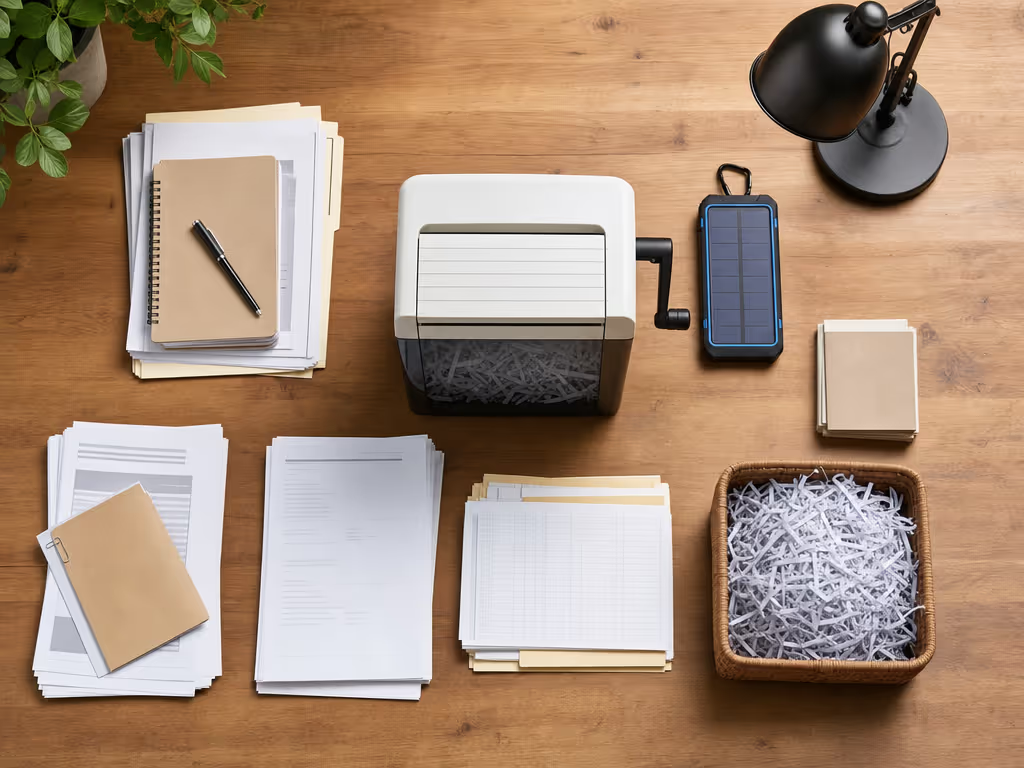
A cross-cut label describes a blade action; the stated particle specification is what lets you compare security claims.
FAQ: Can a manual shredder be called energy-free?
Avoid calling an unverified manual or hand-crank shredder energy-free. Confirm the exact model’s power requirements and operating instructions before relying on that description.
The available plug-in example illustrates why those instructions matter. One electrically powered cross-cut model requires a 220-240V AC supply and specifies a maximum-capacity duty cycle of two minutes running followed by 45 minutes off. That is an example of why every model's instructions matter, not a rule for all electric shredders or a comparison with manual units.
For guidance on keeping cutting mechanisms clear and reducing jams, see this shredder maintenance guide.
FAQ: How should I set up compact paper shredders in a shared home or office?
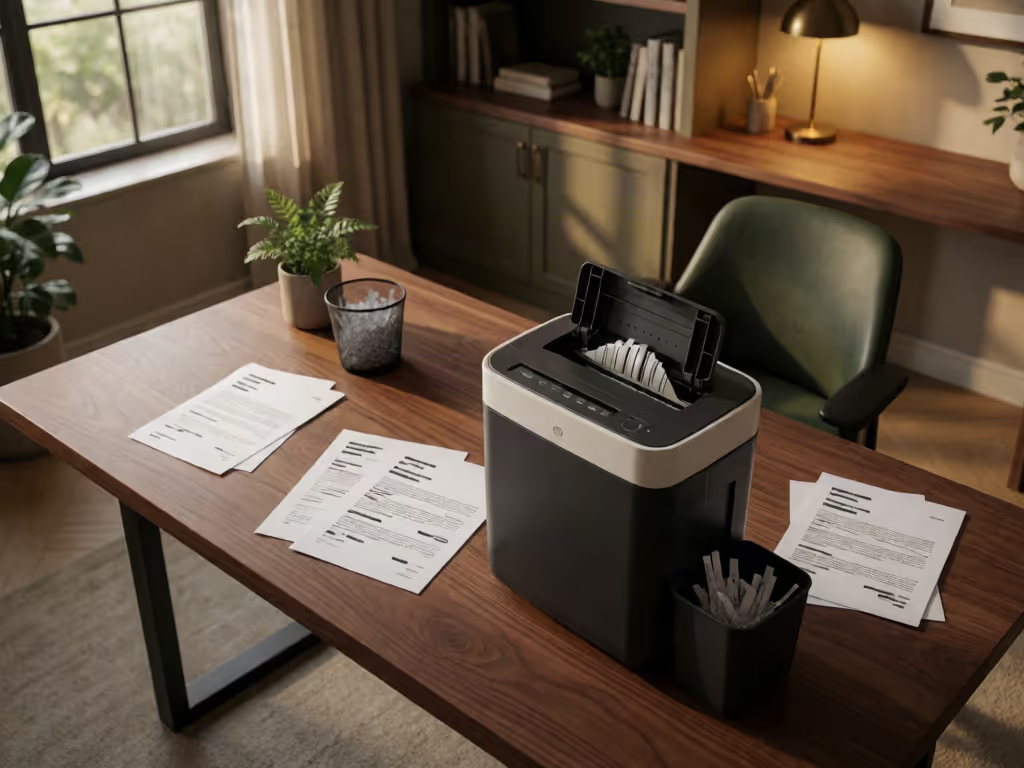
With compact paper shredders, placement is part of the purchase decision. Measure the destination before you choose the device: floor width, depth in front of it, clearance to remove the bin, and the route from desk to disposal point. These measurements also support better home office shredder placement, including safer clearances and more accessible workflows. Footprint-to-room mapping is simple: a tool used for incoming mail belongs near where mail is opened; a tool used for client paperwork belongs where authorized people can reach it without carrying loose pages across a shared room.
For a small workstation, think of the layout in words: desk on one wall, shredder beside (not directly under) the knee space, waste container beyond the shredder, and a clear turning zone in front. This keeps paper handling tidy and makes emptying less awkward.
Noise needs similar realism. Treat "quiet" as unverified unless the model documentation provides a sound measurement and the conditions under which it was measured.
If a model or seller publishes a sound figure, ask how it was measured: distance, paper load, and whether the unit sat on a hard desk or a separate surface. Note vibration/desk transfer too. A compact machine on a hollow desk can change the experience for the person in the next room.
Place it right, and half the battle is won. A stable surface, a little separation from seating, and a trial run at the time you expect to use it will tell you more about shared-space fit than an unqualified "low-noise" label.
After-hours suitability flag
For early mornings, evenings, or thin-walled apartments, consider a shredder suitable only after you know its real operating sound in your own placement. If that cannot be tested or returned easily, use a location and schedule that protects roommates, children, visitors, and neighbors from surprise noise.
FAQ: What safety and material rules should I follow?
Read the instructions for the exact machine before feeding anything beyond plain paper. The electric shredder example instructs users to keep hands, hair, clothing, and jewelry away from the feed opening, and to switch off or unplug before moving, cleaning, or emptying it. It also instructs users to remove paper clips and staples, even though it says staples can be cut.
These are instructions for that electric model, not established rules for every manual design. Still, they illustrate the right discipline: do not assume that a product accepts staples, clips, cards, or windowed mail unless its own instructions say so. A claim that a device can handle a material is not the same as a recommendation to make that material part of your routine.
For a manual or hand-operated device, follow the exact manufacturer safety instructions before use.
FAQ: Why not burn old documents instead?
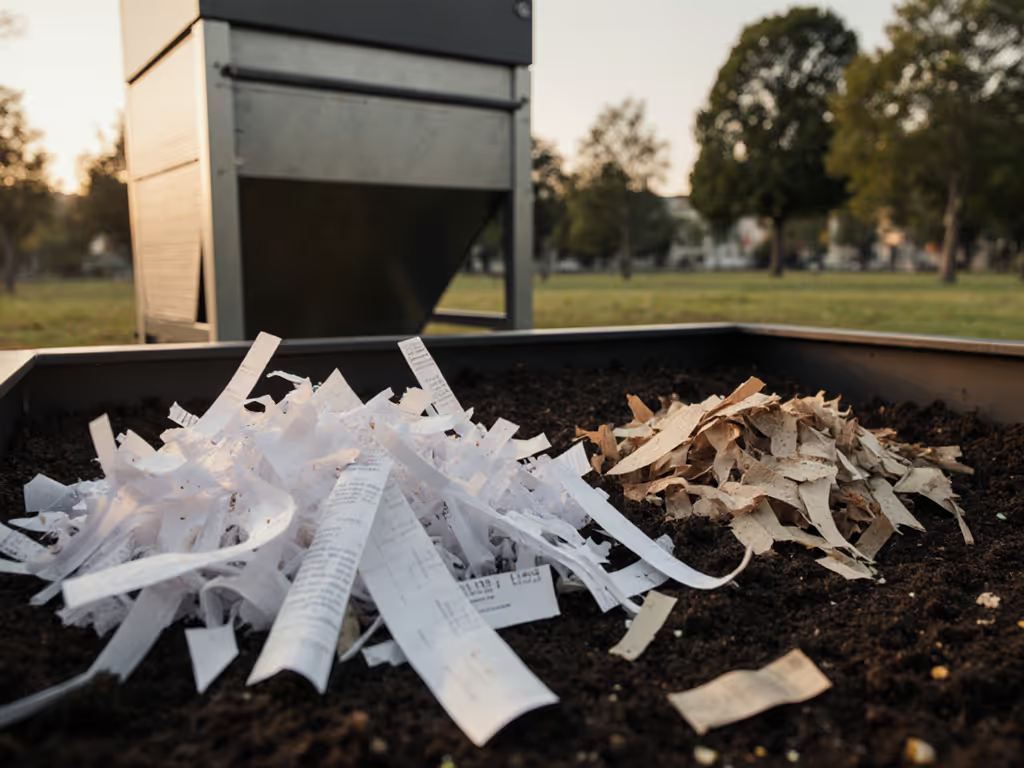
Burning is not a sensible default for home document disposal. Stockholm Convention guidance characterizes open burning of waste as environmentally unacceptable because incomplete combustion creates pollutants. The same guidance says household waste should not be burned in indoor residential devices such as stoves, fireplaces, or furnaces.
This is broad waste guidance rather than a paper-only security assessment. Still, it is a clear reason not to treat fire as the easy off-grid substitute. Check local waste guidance and this guide to eco-friendly shredded-paper disposal for handling options in your area.
Further exploration: build a low-friction destruction routine
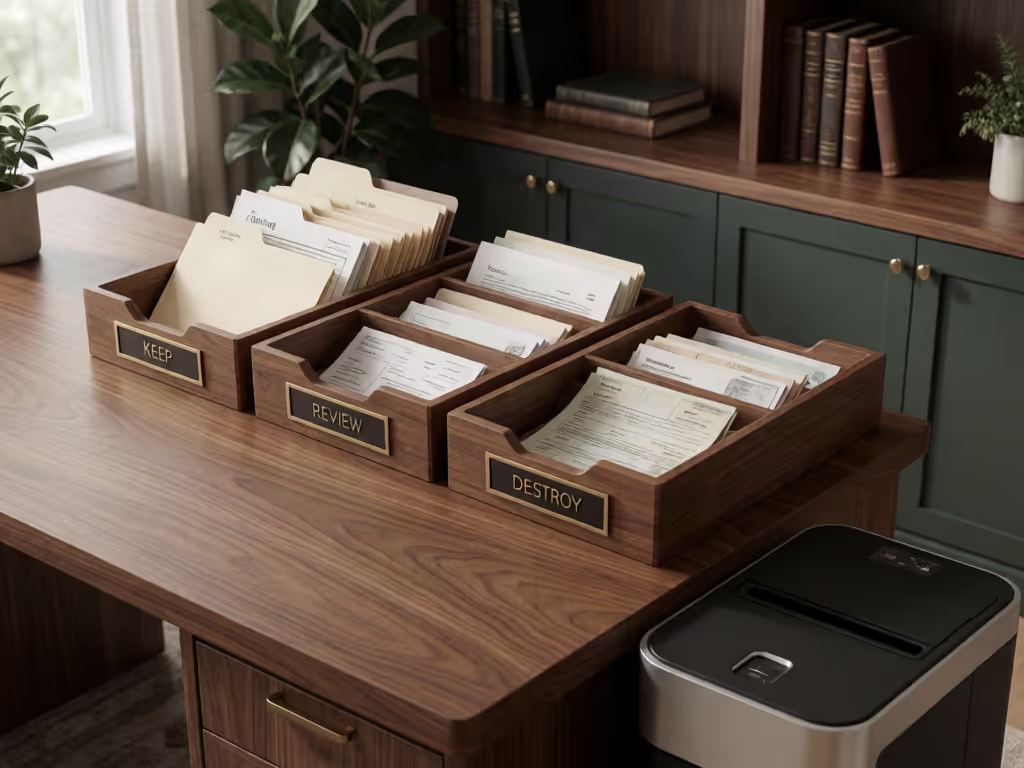
For an off-grid document-disposal plan, begin by confirming whether any candidate model’s documentation states its cut type, security information, power requirements, accepted materials, and operating limits. Start with a week of observation: how many pages arise, which papers truly need destruction, where the tool would live, and when it would be used. Then compare only models that state their cross-cut mechanism, security information, accepted materials, and operating limits.
A compact, appropriately placed tool can turn paper disposal from a noisy chore into a brief routine. The goal is not the most aggressive label or the biggest capacity claim. It is a setup that protects sensitive information while respecting the room, and the people sharing it.
Related Articles