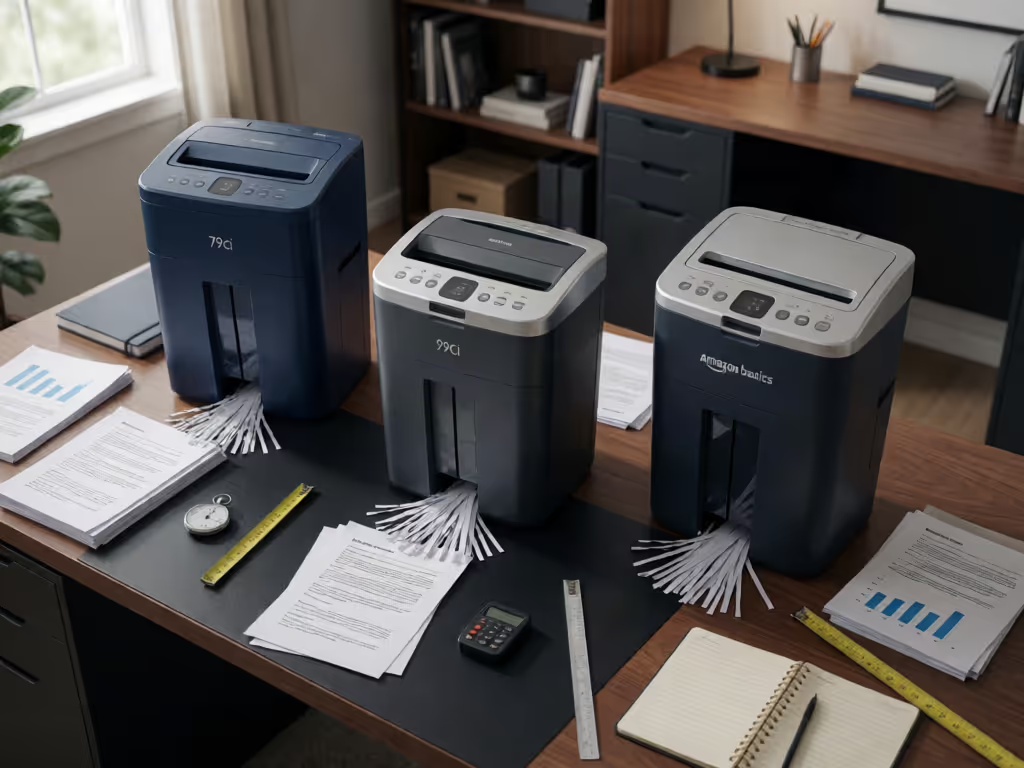
Manual vs Electric Paper Shredder: Off-Grid Energy Security
By Mateo Silva • 29th Sep
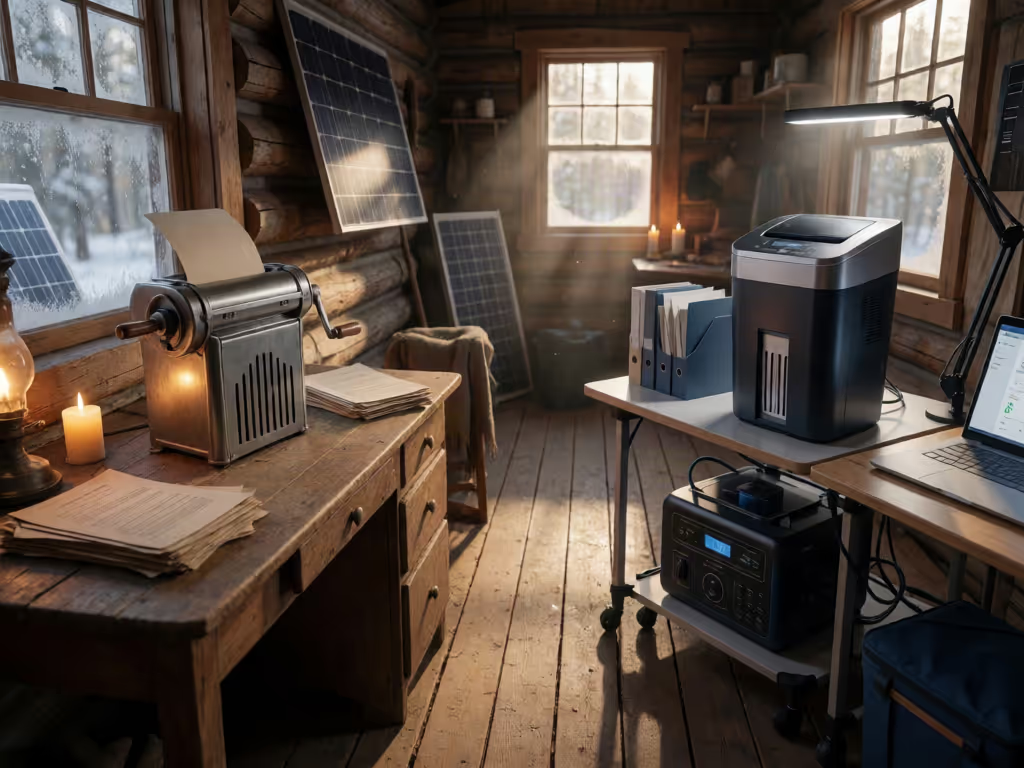
Quick verdict
The manual Nakabayashi is the better fit for off-grid continuity and occasional single-sheet shredding; the Amazon Basics electric model is the better fit for recurring batches with higher listed and tested capacity.
- Choose manual if: You need shredding without grid or battery power, handle only small amounts, or want a compact backup. It is listed for one Letter/A4 sheet at a time with a 3.3 L bin.
- Choose electric if: You regularly clear household or office batches.
- Main trade-off: The manual model’s energy independence comes with one-sheet feeding. The electric model is listed for a 25-minute run period followed by a 60-minute cool-down.
Important: Neither shredder has a collected DIN/P-level certification, and the electric model’s wattage or energy use was not established.
A manual vs electric paper shredder decision is really about what kind of reliability you need when privacy cannot wait. In this off-grid shredding comparison, the manual option operates without grid or battery electricity; the electric option offers a listed 24-sheet capacity and a tested maximum rate of 114 sheets per minute. The best choice is not the machine with the longest feature list, it is the one you will actually use consistently, without making document disposal another unfinished chore.
For a household, remote office, or small shared workspace, start with three questions: Will power sometimes be unavailable? How many sheets accumulate between shredding sessions? How small do the paper pieces need to be for your own risk tolerance? Those answers make the trade-off much clearer than marketing terms alone.
The short answer: choose continuity or throughput
| If your priority is… | Better fit | Why |
|---|---|---|
| Shredding during an outage, while traveling, or away from power | Manual | It operates without power. |
| A few documents at a time and a very small storage spot | Manual | The Nakabayashi handles one Letter/A4 sheet at a time and has a 3.3 L (0.87-gallon) bin. |
| Clearing mail, statements, and office batches | Electric | The Amazon Basics unit is listed for 24 sheets and achieved 114 sheets per minute in an independent test. |
| Fewer bin-emptying interruptions during a larger cleanout | Electric | Its pullout bin is 7 gallons. |
| Predictable high-volume sessions | Electric - with duty-cycle planning | It is listed for 25 minutes of continuous use, followed by a 60-minute cool-down. |
This is not a contest between "old-fashioned" and "modern." It is a capacity decision. One-sheet feeding can be entirely sensible for occasional sensitive pages. For a monthly pile of records, consider whether that workflow matches the volume you need to handle.
Buy once, buy right, skip the fluff: capacity you never use is waste, but so is a shredder that makes you postpone secure disposal.
Manual shredder: the practical off-grid choice
The Nakabayashi 3 Ways Manual Shredder is the cleanest match for someone whose primary requirement is no-power operation. Its listing describes a cross-cut mechanism that accepts one Letter/A4 sheet at a time, produces pieces listed at 0.12 × 0.78 inches, and uses a 3.3 L / 0.87-gallon bin. The listing title identifies it for paper, card, and CD/DVD media.
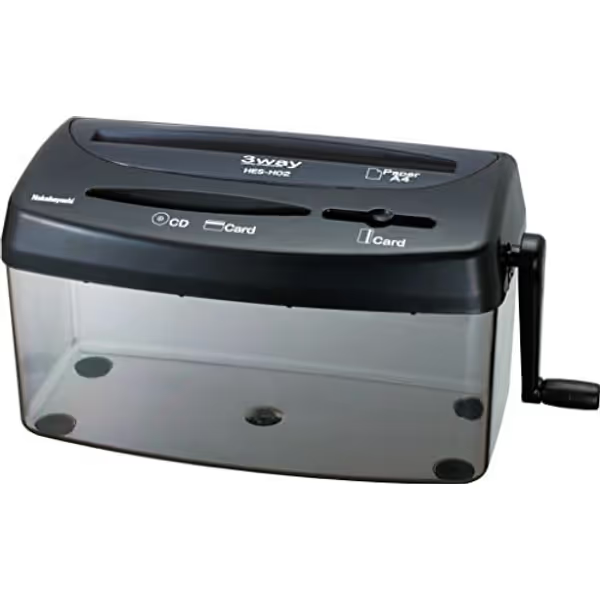
Nakabayashi 3-Way Manual Shredder
Compact, manual crosscut shredder for personal documents and media.
Security LevelCrosscut (0.12" x 0.78")
Security LevelCrosscut (0.12" x 0.78")
Pros
Shreds paper, cards, CDs/DVDs (one at a time)
No power needed, quiet operation
Space-saving design fits anywhere
Cons
Manual operation, one sheet at a time
Small 0.87-gallon bin
That specification profile tells you exactly where it belongs: a compact backup tool, a low-volume personal shredder, or an off-grid privacy station where having some dependable document destruction matters more than speed. For a deeper look at hand-crank capacity, ergonomics, and security limits, see our manual off-grid shredder guide. If you keep a small amount of sensitive mail, account paperwork, or outdated notes, the absence of a cord removes a failure point. You can use it when a battery system is reserved for more important loads, when an outlet is inconvenient, or when an outage has made normal office gear irrelevant.
The retailer characterizes its operation as producing "little noise," but treat that as a listing claim rather than a measured comparison. There is no shared decibel test for these two machines, so it would be misleading to call the manual unit definitively quieter than the electric one.
What manual operation costs you
The trade is simple: the Nakabayashi is listed for one sheet at a time. Its throughput, cranking effort, and fatigue resistance have not been measured here, so there is no honest way to translate that into pages per minute. But the workflow implication is still clear. Every multi-page statement requires several feeding cycles. A small bin also reaches capacity sooner.
That does not make it a bad buy. It makes it a poor match for bulk work. I have seen workplaces buy specialty floor units for every small nook, only to find most sat idle while people still queued at the machines that could handle the real pile. Consolidating to fewer capable tools usually costs less and creates fewer jams, and fewer annoyed people. The same logic applies at home: do not buy an electric high-capacity machine merely for an occasional envelope, and do not buy a tiny manual unit for a recurring archive purge.
Electric shredder: documented batch capacity
For regular batches, the Amazon Basics 24-Sheet Cross-Cut Paper, CD and Credit Card Home Office Shredder is in a different operating class. It is listed for 24 sheets at once, and an independent test measured a 26-sheet capacity and a maximum rate of 114 sheets per minute. Its listing title identifies paper, CD, and credit-card shredding.
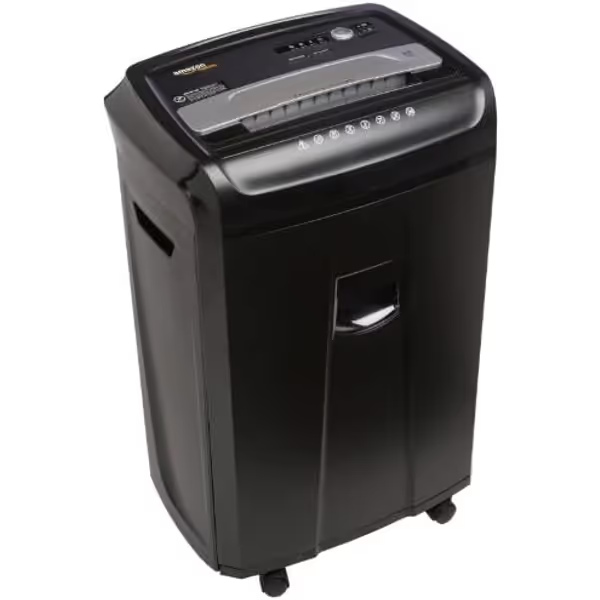
Amazon Basics 24-Sheet Cross-Cut Shredder
High-capacity cross-cut shredder for home office security and convenience.
Sheet Capacity24 Sheets
Sheet Capacity24 Sheets
Pros
Shreds paper, CDs, and credit cards effectively.
25-minute continuous run time for large tasks.
Auto-reverse clears jams, thermal protection.
Cons
60-minute cool-down time after extended use.
Larger size may not fit all compact spaces.
Customers report it shreds large volumes of paper, cards, and CDs without jamming, even with continuous use.
Customers report it shreds large volumes of paper, cards, and CDs without jamming, even with continuous use.
The practical benefit is not just its measured rate. Higher feed capacity changes behavior: instead of leaving documents in a "deal with later" pile, you can clear a batch while you are already sorting it. Its 7-gallon pullout bin also reduces how often a heavier shredding session stops for emptying.
There is, however, a hard operational boundary. Because run time and cool-down periods directly affect batch planning, review our guide to shredder duty cycles before tackling larger workloads. The listing specifies 25 minutes of continuous run time followed by a 60-minute cool-down. That is not a 60-minute run time. If your job is larger than a normal session, plan separate batches instead of treating the rated sheet capacity as permission to feed indefinitely.
The unit measures 11.9 × 16.3 × 26.2 inches, so confirm the height as well as the under-desk floor area before committing. In a tight apartment or a shared office, a capable machine that blocks a drawer or dominates a walkway is not good value.
Energy security versus energy use: what can, and cannot, be concluded
"Energy-efficient document destruction" means two different things in this comparison:
- Can the shredder still work when electricity is unavailable?
- How much electricity does the powered model consume when it does run?
The manual Nakabayashi has a firm advantage on the first question because its listing states that no power is needed to run it. That is genuine off-grid resilience. For measured comparisons of powered shredders, auto-shutoff behavior, and electricity use, see our shredder energy-efficiency comparison.
The second question has no verified answer for the electric model. There is no available wattage, standby-draw, energy-per-sheet, or active-use measurement for this specific Amazon Basics shredder. Do not let a general assumption about home shredders become a solar-sizing calculation or an energy-cost estimate. The most accurate energy draw estimate here is: not established for this model.
Likewise, a true TCO over 3 years comparison cannot be calculated from these specifications. Current purchase price, repair history, consumable needs, electricity use, warranty details beyond the retailer listing, and replacement cost notes would all matter. The Nakabayashi is listed as needing no power to run; an electric shredder may save enough staff or personal time to justify its other costs. Without the missing cost inputs, those are decision factors, not totals.
Value flags for over-spec
An electric high-capacity shredder is probably over-spec if all of these describe you:
- You shred only a handful of pages at a time.
- Your primary concern is operation during outages or away from mains power.
- You have limited room for a 26.2-inch-tall appliance.
- You are content to empty a small bin more frequently.
A manual unit is probably under-spec if any of these describe you:
- You regularly keep stacks of statements, client paperwork, or mail for one big shredding session.
- You need fast clearance so paper does not linger in an open recycling pile or desk drawer.
- Your document volume would make one-sheet feeding a recurring burden.
- You need the convenience of a 7-gallon bin and batch-oriented handling.
Pay for reliability, not for unused security theater. In this case, "security theater" can also mean buying a larger machine simply because it sounds more serious, even though your actual workload is ten pages a week.
Security level trade-offs: compare the output, not an assumed rating
Both machines are described as cross-cut shredders, but neither has a collected DIN 66399/P-level certification. That matters. It would be inaccurate to label either one P-3, P-4, P-5, or any other formal rating simply from its cross-cut label or its listed particle dimensions.
There is still a useful, bounded comparison. The Nakabayashi’s listed paper pieces are 0.12 × 0.78 inches. The Amazon Basics unit’s listed pieces are 7/32 × 1-27/32 inches. Smaller shredded particles are generally harder to reconstruct, and the Nakabayashi’s listed pieces are smaller in both dimensions. But that observation is not a certification and should not substitute for a documented requirement from your organization, client contract, or applicable policy.
For ordinary personal records, cross-cut output may be the decision point you need. For documents governed by a specific internal or contractual destruction standard, first obtain the required certified level; then shop to that requirement. Our guide to shredder security levels explains how to match P-level requirements to the sensitivity of your documents. Do not reverse-engineer compliance from an online listing.
Noise, heat, and daily livability
Quiet matters when you live with roommates, work near sleeping children, or share a small office. Yet the available evidence does not support a clean winner:
- The Nakabayashi listing says it produces "little noise."
- An independent test called the Amazon Basics model somewhat loud, though among the less offensive machines tested, with a low-pitched sound.
Those descriptions are not measured in the same way and contain no decibel values. Choose based on where you will run it, but do not treat the available evidence as a direct noise or task-duration comparison between the two machines. If noise is a deciding factor for a shared workspace, compare measured performance in our shredder decibel comparison.
Heat is more straightforward for the electric unit: its listed 25-minute operating limit and 60-minute cool-down are part of the workflow. Build that pause into a large decluttering project. With the manual unit, no published thermal interval was collected.
Which one should you buy?
Choose the Nakabayashi manual shredder if your core need is off-grid continuity, occasional single-sheet disposal, and a small footprint. It is the sensible tool when an outlet-free workflow is more valuable than rapid batch processing.
Choose the Amazon Basics 24-Sheet Cross-Cut if your core need is batch capacity and a documented measured rate. Its tested 26-sheet maximum capacity, measured 114-sheet-per-minute pace, 7-gallon bin, and 25-minute listed run period make it more suited to recurring household or small-office batches, provided you have room for it and can work around the required cool-down.
Neither is automatically "more secure" in a formal rating sense, and neither can be ranked by electricity cost from the information available. The cleanest decision is operational: buy the manual model for resilience and small volumes; buy the electric model for volume and its documented batch capacity.
FAQ
What type of shredder is best for home use?
For low-volume homes where the Nakabayashi’s no-power operation is useful, this manual cross-cut unit can be the better fit. For households that accumulate regular batches, an electric cross-cut shredder with documented capacity and a larger bin is more practical. "Best" depends on whether your constraint is power availability or the amount of paper waiting to be destroyed.
Which shredder has a 60-minute run time?
Neither model is documented here with a 60-minute continuous run time. The Amazon Basics unit is listed for 25 minutes of continuous operation and a 60-minute cool-down afterward.
What is one shredding mistake to avoid?
Do not mistake a high sheet-capacity figure for unlimited duty cycle. The Amazon Basics model handled 26 sheets in independent testing, but its listed operating schedule still calls for a cool-down after 25 minutes. Capacity and run time solve different problems.
Take the next step
Put your typical shred pile on a desk and count it. If it is a few pages and your priority is independence from the grid, choose the manual path. If it is a recurring stack, consider the electric model’s listed 24-sheet capacity, tested 26-sheet capacity, and measured 114-sheet-per-minute rate, and reserve enough space for it. That one-minute workload check will do more for your privacy routine than paying for specifications you will rarely touch.
Related Articles