Jam Proof Cross Cut Shredder Comparison for Real Workloads
By Aisha Khan • 21st Sep
Quick verdict
The Fellowes Powershred 79Ci is the balanced choice for moderate home-office batches, while the 99Ci is better for recurring small-office volume because it combines the highest tested throughput with a longer run window.
- Choose the 79Ci if: You typically shred controlled batches and want Fellowes’ conditional 100% Jam Proof system, 140 sheets-per-minute maximum tested throughput, and 20-minute run time.
- Choose the 99Ci if: You regularly process larger office workloads. It matched its 18-sheet rating in testing, reached 185 sheets per minute, and supports a 30-minute run window.
- Main trade-off: The Amazon Basics model measured the highest capacity at 26 sheets, but its 114-sheet-per-minute tested throughput and 60-minute cooldown are less suitable for sustained purges.
Important: “100% Jam Proof” is a conditional Fellowes manufacturer claim, not an independently verified guarantee. The Amazon Basics model documents overload indication and auto reverse, but no equivalent claim or deliberate-overload test is available.
A useful jam-proof cross-cut shredder comparison starts with the workload, not the largest sheet number on the box. For buyers weighing cross-cut shredder jam resistance, the meaningful differences among the Fellowes Powershred 79Ci, Fellowes Powershred 99Ci, and Amazon Basics 24-Sheet Cross-Cut are their overload behavior, tested output rate, uninterrupted run time, and cooling penalty. All three are crosscut paper shredders, but they do not handle a long purge in the same way.
The headline result: choose the Fellowes 79Ci for moderate, recurring home-office batches; step to the Fellowes 99Ci when a small office needs the fastest independently measured output and a higher daily-use recommendation; choose the Amazon Basics 24-Sheet when high single-pass capacity is the priority and a 60-minute cooldown fits your workflow. None should be selected simply because it says "jam resistant."
The comparison at a glance
| Model | Rated capacity | Independently measured capacity | Maximum tested throughput | Run time / cooldown | Jam-control approach | Relative noise score |
|---|---|---|---|---|---|---|
| Fellowes Powershred 79Ci | 16 sheets | 14 sheets | 140 sheets/minute | Up to 20 min / 30 min | Electronic thickness sensing; conditional "100% Jam Proof" claim | 7.0 |
| Fellowes Powershred 99Ci | 18 sheets | 18 sheets | 185 sheets/minute | 30 min / 40 min | Electronic thickness sensing; conditional "100% Jam Proof" claim | 9.0 |
| Amazon Basics 24-Sheet Cross-Cut | 24 sheets | 26 sheets | 114 sheets/minute | 25 min / 60 min | Overload indicator and auto reverse | 9.0 |
The measured-capacity figures and maximum sheets-per-minute results are useful comparison points, not a promise that every stack, paper weight, or environment will produce the same result. That distinction matters. The 79Ci's 16-sheet rating, for example, is specified for 20 lb paper; paper weight, humidity, and electrical conditions can reduce capacity.
Sustained throughput beats brochure bursts, every office hour, every time.
What "jam proof" means here, and what it does not
The two Fellowes models use an electronic thickness-sensing system. Their indicators show green when more sheets can be added, yellow at the stated productivity zone, and red when the stack is too thick. Fellowes calls each system "100% Jam Proof" when used in accordance with its manual. That is a conditional manufacturer claim, not proof that a shredder can never stop, reverse, or require you to remove paper.
Both manuals describe the same recovery path for a misfeed: the machine pauses for 3-6 seconds to correct automatically. If the remove-paper light remains on after reversal, you press reverse, remove the paper, reduce the stack, and feed it again. That is better described as overload prevention plus guided recovery than magic immunity.
The Amazon Basics machine takes a more conventional route: its listing specifies overload and overheat indicators plus auto reverse to clear paper jams. It should not be called 100% jam-proof; no such claim or deliberate-overload recovery test is available here.
No comparison evidence measured jam incidents per 100 sheets, recovery time after intentional overloads, or simultaneous mixed-media shredding. Those are the tests I would want before declaring any machine truly drama-free. A 20-sheet-class unit can look excellent until ten minutes into a quarterly purge, when heat, bin changes, and a single overfed packet turn peak capacity into downtime.
Fellowes Powershred 79Ci: the controlled-batch choice
The Fellowes Powershred 79Ci is rated for 16 sheets per pass, and independent testing measured 14 sheets. Its maximum measured throughput was 140 sheets per minute. That puts it behind the 99Ci on speed but ahead of the Amazon Basics model in the same comparison.
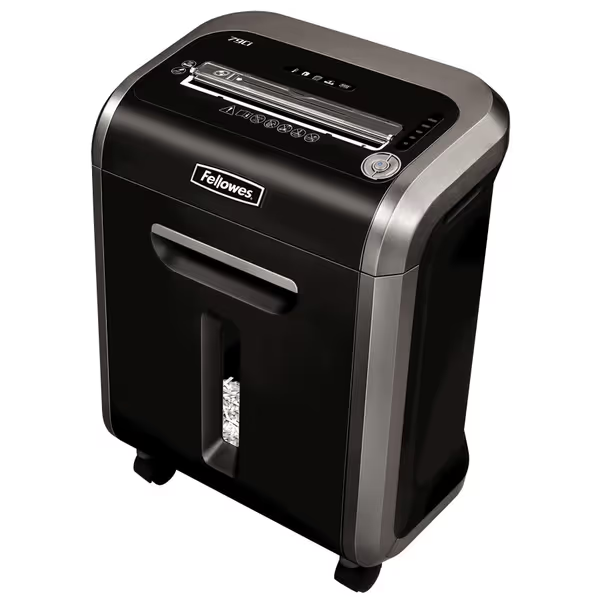
Fellowes Powershred 79Ci Crosscut Shredder
Heavy-duty, jam-proof shredder for secure, quiet, and efficient document disposal.
$278.99
Security LevelP-4 Crosscut
Security LevelP-4 Crosscut
Pros
Shreds 16 sheets + cards/CDs with ultra-quiet operation.
100% Jam-Proof system and 20-minute continuous run time.
SafeSense® technology enhances safety for hands and pets.
Cons
Mixed durability reports despite heavy-duty build.
Customers find this paper shredder to be a workhorse that shreds multiple pages with ease, including credit cards and CDs/DVDs, and appreciate its super quiet operation. The shredder features jam-proof technology that works well, and customers consider it good value for money.
Customers find this paper shredder to be a workhorse that shreds multiple pages with ease, including credit cards and CDs/DVDs, and appreciate its super quiet operation. The shredder features jam-proof technology that works well, and customers consider it good value for money.
Its workload envelope is clear: up to 20 minutes of continuous operation, followed by a 30-minute cooldown, with a recommended daily maximum of 500 sheets, 25 credit cards, and 10 CDs. For a solo accountant, consultant, or household that shreds mail, statements, and periodic client paperwork, those limits are more useful than a peak sheet count. You can complete a solid sorting session, but it is not the right fit for an all-morning archive purge.
The 79Ci produces 5/32 by 1 1/2-inch cross-cut particles. It supports paper, staples, small paper clips, credit cards, and CDs/DVDs; cards and discs are specified at one item per pass. That matters for mixed-media shredding tests: supported materials do not mean you should feed them together in one thick, unpredictable bundle.
For shared spaces, Fellowes describes its SilentShred feature as reducing noisy disruption. The independent comparison gave the 79Ci a 7.0 relative noise score, versus 9.0 for the other two. Those are rankings, not dB(A) measurements at 1 m, so they cannot tell you how loud the machine will sound beside a sleeping child or on a video call.
Fellowes Powershred 99Ci: the strongest choice for recurring office volume
If "strongest" means the combination of independent throughput, capacity, and daily workload guidance, the Fellowes Powershred 99Ci takes this three-model comparison. It matched its 18-sheet rating in independent measured capacity and led the group at 185 sheets per minute maximum throughput.
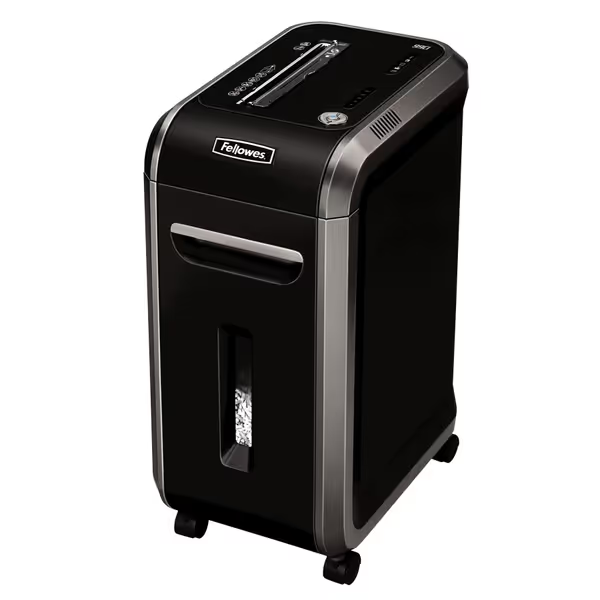
Fellowes Powershred 99Ci Crosscut Shredder
Heavy-duty, quiet shredding for secure document disposal and peace of mind.
$279.99
Security LevelP-4 Crosscut
Security LevelP-4 Crosscut
Pros
Shreds 18 sheets, credit cards, CDs, staples.
Whisper-quiet operation; ideal for shared spaces.
30-minute continuous run-time for big jobs.
Cons
Some users report sudden failures.
Premium price point.
Customers find this paper shredder to be a reliable workhorse that shreds multiple sheets of paper, including credit cards with ease, and is remarkably quiet during operation. They appreciate its solid build with a heavy-duty motor and consider it well worth the price. While some customers report the shredder is still going strong, others mention it suddenly stopped working.
Customers find this paper shredder to be a reliable workhorse that shreds multiple sheets of paper, including credit cards with ease, and is remarkably quiet during operation. They appreciate its solid build with a heavy-duty motor and consider it well worth the price. While some customers report the shredder is still going strong, others mention it suddenly stopped working.
It also has the most usable thermal profile for repeated office batches: 30 minutes of continuous operation, then a 40-minute cooldown. Fellowes recommends it for up to 1,500 sheets per day, plus 50 credit cards and 10 CDs. Those numbers do not mean it should run endlessly; they do mean it has materially more room than the 79Ci for a small team's recurring document disposal.
The 99Ci uses the same particle size as the 79Ci, 5/32 by 1 1/2 inches, and the same thickness-sensing jam-prevention logic and recovery instructions. It also supports staples, small paper clips, cards, and CDs/DVDs, with cards and discs fed individually.
The practical upgrade is not merely two more rated sheets. It is the combination of 45 more tested sheets per minute than the 79Ci and an additional 10 minutes before a thermal break. Over a real cleanout, that changes the rhythm: fewer interruptions, faster completion, and less temptation to overstuff the feed slot.
The independent relative noise score was 9.0, tied with the Amazon Basics model. Again, no collected evidence provides sound-pressure readings in dB(A), so a quiet-home-office buyer should treat this as a relative signal, not an acoustic guarantee.
Amazon Basics 24-Sheet: highest stack capacity, longest forced pause
The Amazon Basics 24-Sheet Cross-Cut is the capacity outlier. It is listed at 24 sheets per pass, while independent testing measured 26 sheets. That is the highest measured stack capacity in this group. Yet it posted the lowest maximum throughput: 114 sheets per minute.
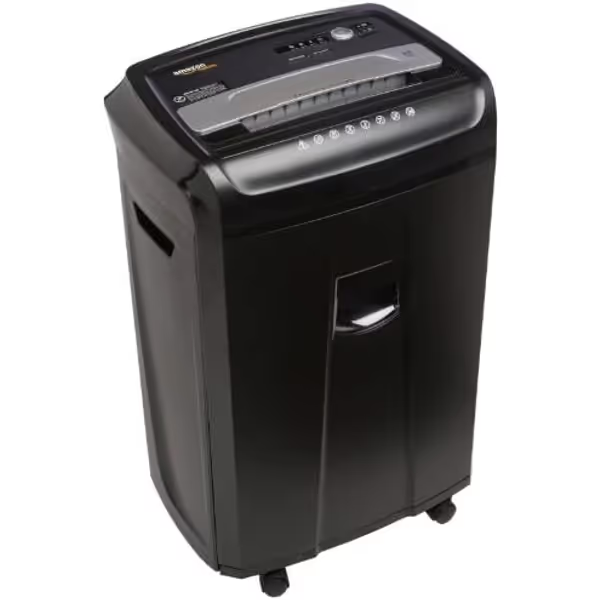
Amazon Basics 24-Sheet Cross-Cut Shredder
High-capacity cross-cut shredder for home office security and convenience.
Sheet Capacity24 Sheets
Sheet Capacity24 Sheets
Pros
Shreds paper, CDs, and credit cards effectively.
25-minute continuous run time for large tasks.
Auto-reverse clears jams, thermal protection.
Cons
60-minute cool-down time after extended use.
Larger size may not fit all compact spaces.
Customers report it shreds large volumes of paper, cards, and CDs without jamming, even with continuous use.
Customers report it shreds large volumes of paper, cards, and CDs without jamming, even with continuous use.
That combination makes sense for a particular user: someone who prefers feeding fewer, thicker stacks and can plan around longer recovery time. The stated duty cycle is 25 minutes running followed by 60 minutes cooling. A 60-minute pause is significant. If your clearing project must be completed in one uninterrupted block, it is a workflow constraint, not a minor specification.
Its listed output is 7/32 by 1 27/32 inches, larger than the two Fellowes models' stated cross-cut size. The listing supports credit cards, CDs, and DVDs, one at a time. It does not establish that you can combine media with paper in the same pass, nor does it establish a test result for staples or paper clips.
Its 9.0 relative noise score places it level with the 99Ci in the independent comparison. That does not settle the question for apartment or shared-office use: scores are not dB(A), and the available information does not include a microphone distance or acoustic test method.
Separate brochure bursts from real-work output
To choose among these machines, use four numbers in this order:
- Your normal batch length. If you shred for 10 to 15 minutes at a time, all three can fit. For longer recurring sessions, the 99Ci's 30-minute run time is the clearest match.
- Your tolerance for a thermal stop. A 30-minute cooldown on the 79Ci is easier to absorb than the Amazon Basics model's stated 60-minute cooldown. The 99Ci requires 40 minutes after its longer run window.
- Your pace, not just your stack size. The Amazon Basics model led measured sheet capacity, but the 99Ci led measured throughput by a large margin: 185 versus 114 sheets per minute. Fast feed and big feed are different benefits.
- Your likely overload behavior. The Fellowes sensing lights give you feedback before the stack goes in and provide a defined response when a misfeed occurs. The Amazon Basics model offers overload indication and auto reverse. Neither setup excuses stuffing in thick, uneven bundles.
This is also the answer to whether a more expensive shredder is "worth it." Price evidence is not part of this comparison, so I would not make a value claim. Performance-wise, the 99Ci is worth considering only if you will use its extra throughput, longer run time, and higher daily-use guidance. If your real workload is a small weekly stack, the 79Ci's lower ceiling may be the more sensible fit. If thick stacks are your bottleneck and cooldown does not matter, the Amazon Basics model has the largest measured capacity.
Maintenance and a limited jam-recovery FAQ
What should I do if a Fellowes 79Ci or 99Ci misfeeds?
Allow the machine's 3-6-second automatic correction attempt. If the remove-paper indicator remains lit after it reverses, use reverse, remove the paper, reduce the quantity, and refeed it. Do not turn an avoidable overfeed into a cutter-clearing project.
Can I use WD-40 or another petroleum-based lubricant?
For the 79Ci and 99Ci, the manuals prohibit petroleum-based and aerosol lubricants; follow this shredder maintenance guidance when selecting an approved lubricant. They specify a non-aerosol vegetable oil in a long-nozzle container. That guidance is specific to these Fellowes cross-cut models; it is not a blanket recommendation for every shredder.
Can I shred staples, clips, cards, and discs together?
No evidence here supports simultaneous mixed-material feeding. The Fellowes models support staples, small clips, cards, and CDs/DVDs, but cards and discs are one per pass. The Amazon Basics listing supports cards, CDs, and DVDs one at a time. Treat each media type as a separate pass unless the machine's own instructions explicitly say otherwise.
Final verdict
For most privacy-conscious home offices, the Fellowes Powershred 79Ci is the balanced pick: 14 sheets measured, 140 sheets per minute maximum tested output, and a 20-minute run window suit routine document disposal without buying capacity you will not use.
For a small office that repeatedly works through larger paper volumes, choose the Fellowes Powershred 99Ci. Its 18-sheet measured capacity, class-leading 185 sheets per minute maximum throughput, 30-minute run time, and 1,500-sheet daily-use recommendation give it the strongest evidence-based workload profile.
Choose the Amazon Basics 24-Sheet Cross-Cut when your priority is the largest stack capacity (26 sheets measured) and you can accept slower tested throughput and a stated 60-minute cooldown. Its auto reverse is useful, but it is not the same as the Fellowes conditional jam-prevention system.
The right shredder is the one that lets your normal stack disappear at a steady pace, without overheating, overfeeding, or making you reorganize the day around a cooling light. Separate brochure bursts from real-work output, and the decision gets much simpler.
Related Articles