Understanding Paper Fiber Chemistry for Shredding
By Linh Tran • 20th Apr
Why Paper Fiber Composition Matters to Your Shredder (And Your Peace of Mind)
Most people think of shredding as straightforward: feed paper in, get confetti out. But what's actually happening inside your machine depends entirely on the paper fiber shredding impact and the chemical composition of the paper you're processing. When I worked in a clinic, we learned this the hard way. A loud, aggressive shredder that wasn't designed for the fiber types we were processing (thick bank statements, bond envelopes, mixed media) turned what should have been quiet destruction into a disturbance that echoed through the waiting room. We swapped to a damped, slower unit suited to the materials, added an anti-vibration mat, and moved it three meters from seating. The real insight wasn't the machine. It was understanding what we were shredding and matching the tool accordingly. Place it right, and half the battle is already won. If noise is a concern, see our quiet office decibel comparison for models that stay unobtrusive in shared spaces.
This guide walks you through the fiber science behind paper and how it shapes your shredding experience, from jam prevention to noise levels to the security guarantees that actually matter.
FAQ: Paper Fiber Chemistry and Shredding
What Is Paper Actually Made Of, and Why Does It Matter for Shredding?
Paper is primarily composed of cellulose fibers derived from wood, often blended with recycled fiber, fillers, and additives.[1] This fiber matrix is what determines how your shredder will handle the material. Cellulose fibers swell in diameter by 15 to 20% as they absorb moisture, from a completely dry state to saturation.[1] This dimensional change matters because it affects how tightly the shredder blades can cut and how uniformly the fibers separate.
When you understand the fiber construction, you start to see why different papers jam differently. A sheet with tight, uniform fiber distribution (what papermakers call good formation) will feed more smoothly and cut more cleanly.[4] Papers with weak formation, loose fibers, or uneven distribution are more prone to tearing sideways rather than shredding crisply, which can stall your machine or force you to run it longer, both of which increase heat, noise, and frustration.
How Does Paper Density and Bulk Affect Shredding Performance?
Bulk is the volume per unit weight of paper, measured in cubic centimeters per gram.[2] Think of it as the inverse of density: a high-bulk paper is thicker but weighs less, because it contains more air trapped between fibers. A low-bulk paper is compact and dense.[2]
For shredding, this distinction is critical. A dense paper (low bulk) will feed more predictably and jam less often, require more cutting force, and generate less dust and waste volume in your bin. A high-bulk paper will create more volume for the same weight, feed more loosely (sometimes skewing or wrinkling in the feed path), and produce lighter, fluffier waste that may compress better in recycling bins.[2]
If your office handles a mix of paper types (from lightweight newsprint-like materials to heavyweight cardstock), a shredder with variable-speed or pressure-sensing feeding will adapt better than a fixed-speed model. The fiber density tells you which direction to adjust your feed rate or machine positioning.
What Role Does Sizing Play in How Paper Shreds?
Sizing is a chemical treatment applied to paper fibers to control how readily they absorb liquid.[5][6] A well-sized paper resists moisture uptake and holds its structural integrity; a poorly sized paper absorbs liquid in blotches, weakens, and can shed loose fibers.[5]
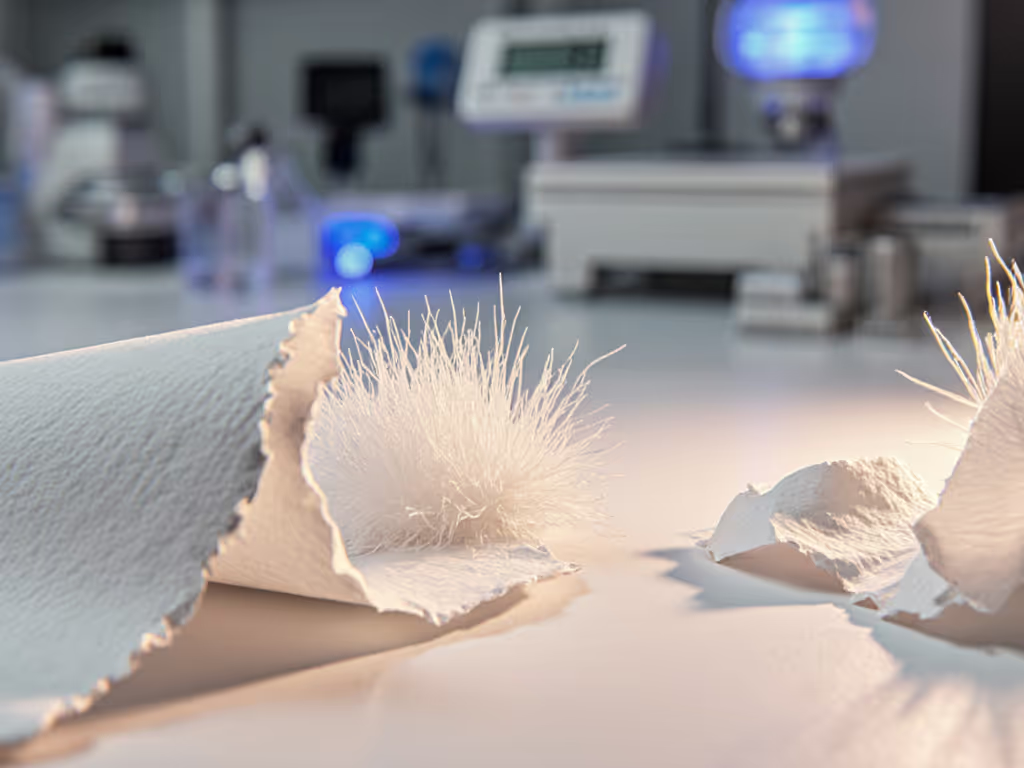
For shredding, sizing indirectly affects your experience in profound ways. Well-sized paper maintains fiber cohesion, shreds cleanly, and produces less dust and fuzz. Poorly sized paper (sometimes found in lower-quality or recycled stock) can generate fine fibers and dust that escape the collection bin and settle on surrounding surfaces.[5]
This is especially relevant in shared spaces. If you're shredding documents in an open office or near a waiting area, fiber dust from poorly sized paper becomes a cleanliness and air-quality issue. For mitigation strategies, explore our HEPA air quality solutions for shredders to reduce fine paper dust exposure. Lower-cost recycled papers sometimes have weaker sizing, which is why premium bond or security-grade papers tend to produce tidier shredding outcomes and require less cleanup afterward. Your colleagues or roommates will notice the difference.
Does Paper Opacity and Formation Impact Shredding Complexity?
Opacity measures how much light passes through paper, essentially, how well it resists showing ink from the reverse side.[4] Papers achieve high opacity by adding fillers, pigments, or coatings, or by using thicker bulk.[4]
Opacity itself doesn't directly impact mechanical shredding, but the methods used to achieve it do. Papers with heavy coatings (glossy magazines, promotional mail) can jam or clog blade surfaces more easily than uncoated bond. For material-specific techniques, see our glossy and cardstock shredding guide to avoid blade fouling. Papers with high filler content (to boost opacity without weight) can be more brittle and prone to tearing sideways in the feed. Papers with good uniform formation (even distribution of fibers and fillers) feed more smoothly and produce more uniform shredding patterns.[4]
When you're selecting a shredder for a mix of mail types (bank statements, magazines, coated postcards, textured envelopes), uniformity of feeding becomes critical. A shredder positioned with a gentle downward angle, anti-vibration damping, and feed pressure tuned to medium bulk will handle formation variability far better than a cheap, rigid unit running at fixed high speed.
How Does Moisture in Paper Affect Shredding and Noise?
Paper's mechanical properties, including stiffness and dimensional stability, are highly sensitive to humidity and moisture uptake.[8] As relative humidity increases, paper fibers absorb water, swell, and soften. This affects how the blades cut and how much vibration and noise the machine generates.
High-moisture paper (freshly printed stock or stored in a humid environment) shreds less crisply and can clog blades. Properly dried paper (stored at 40-60% relative humidity) shreds more uniformly and cleanly. For controlled tests on this effect, see our humidity vs jam performance analysis. Extremely dry paper (in heated offices or after storage) can be brittle and produce more dust.
For quiet operation, consistency is key. If your office or home fluctuates in humidity, you'll notice variation in shredding sound, speed, and jam frequency month to month. The solution isn't always a better shredder, it's understanding your document environment and, where possible, storing paper in a stable, moderate-humidity space before shredding. Store sensitive documents in a cool, dry place, and you'll spend less time clearing jams and less time hearing the machine labor.
Does Recycled vs. Virgin Fiber Affect How My Shredder Performs?
Modern papers often blend virgin fiber (new wood pulp) with recycled content.[4] If you frequently use post-consumer stock, review our recycled paper performance guide to match equipment to shorter-fiber materials. Recycled papers have fibers that have already been processed and shortened by previous shredding or pulping. This has practical implications.
Virgin fiber papers tend to have longer, stronger fibers that feed and cut more cleanly, produce larger and more uniform shred sizes, and generate less fine dust. High-recycled-content papers often have shorter, more fragmented fibers, feed less predictably (more prone to creeping or skewing), produce more fines and dust (which can escape bins and settle in shared spaces), and jam more frequently if the shredder isn't designed for weaker fiber structures.
If your organization prioritizes sustainability and uses high-recycled-content paper, choose a shredder with consistent, moderate-speed feeding and good filtration or dust containment. The trade-off between environmental responsibility and shredding performance is real, but it's solvable with the right equipment and awareness.
Practical Takeaway: Know Your Fibers, Know Your Risk
Paper fiber shredding impact isn't just about security grades or cutting levels. It's about understanding what's actually in your paper (its density, sizing, moisture, fiber type, and uniformity), so you can predict how your shredder will handle it, where it will struggle, and what environment it will create around it.
A shredder matched to your paper types will jam less often, run quieter, generate less dust, and last longer. Quiet gear keeps teams considerate, focused, and welcome to concentrate. When you understand the material, you stop chasing specs and start choosing tools that fit.
Further Exploration
The chemistry of paper runs deeper than this guide covers. If you handle specialized materials (security-grade paper, cardstock envelopes, carbon forms, or mixed media), researching shredder performance by paper type rather than just by sheet capacity will save you weeks of frustration. Look for real-world tests that measure noise in dB(A) at 1m and 3m, document jam frequency on different fiber types, and dust containment performance. Ask manufacturers directly: "How does your machine perform on 100-gsm bond versus 80-gsm recycled newsprint?" The answer often tells you more than any generic marketing claim. And remember: before you buy, hold a sample of the paper you shred most frequently and feed it into the demo unit. Feel the vibration, listen at conversational distance, and trust what your senses tell you. Confidence at purchase beats regret later.