Best Compact Paper Shredders for No-Fuss Home Privacy
By Mateo Silva • 3rd Oct
At a glance
The Amazon Basics 24-Sheet Cross-Cut model is a fit to consider for periodic household or home-office shredding—not a proven compact or quiet pick. Its listed strengths are a 24-sheet maximum, 25-minute run time, 7-gallon pullout bin, auto reverse, and thermal shut-off.
- Best overall: Choose it if you need cross-cut disposal for periodic household or home-office batches and can accommodate its listed 26.2 by 16.3 by 11.9-inch dimensions. View on Amazon
- Best for privacy-sensitive work: Cross-cut output is less secure than micro-cut output in general. No DIN/P-level rating is provided, so buyers with formal security requirements should look for a specifically stated rating.
- What decides it: The 60-minute cooldown after its listed 25-minute continuous run time matters for large purges.
Important: Noise, real-world jam resistance, durability, actual capacity, compactness, and beginner-friendliness were not independently established in the collected evidence for this exact model.
Shopping for compact paper shredders gets frustrating fast: listings emphasize sheet counts and "security," while the things that make a machine livable (space, emptying the bin, cooling breaks, and what it actually cuts) are easy to miss. For shoppers looking for the best compact home shredder picks, the sensible starting point is not the highest headline specification. It is a machine that matches the pile of documents you really generate and the privacy level you actually need.
There is an important limitation behind this guide: the available verified specifications cover one home-office model rather than a tested field of compact machines. So, rather than pretend there is a proven "best" roundup, I'll show exactly where the Amazon Basics 24-Sheet Cross-Cut Paper, CD and Credit Card Home Office Shredder with Pullout Basket fits, where it does not, and how to decide whether its trade-offs work in your home.
The real problem: privacy equipment that becomes clutter
A shredder is supposed to remove a worry. Yet many home-office buyers end up with a machine that is too small for a paperwork purge, too large for the desk nook, or more secure than the job calls for, while still leaving them with a full bin and a cool-down light halfway through the project.
The cost is not only the purchase. A poor fit creates friction:
- You postpone shredding because the bin is already full.
- You feed too much at once and lose time dealing with a jam.
- You buy a finer-cut machine when your actual need was simply dependable disposal of routine mail.
- You buy a tiny unit to save floor space, then empty it constantly.
- You discover after setup that "small" was a marketing feeling, not a measurement.
I have seen this play out in shared workspaces: premium floor units were placed in every nook, then sat half-idle while people wrestled with the one machine that received real volume. Consolidating to a few reliable units and a sensible workflow cut the waste without reducing practical privacy.
Right-size specs to actual volume.
That is especially useful for a home office privacy startup, where it is easy to buy equipment for an imagined future workload instead of the stack of statements, client notes, mailers, and expired cards in front of you.
Start with the decision framework, not the sheet count
Choose the cut type before comparing capacity
The Amazon Basics unit discussed here is listed as a cross-cut shredder. Its listed paper output measures 7/32 by 1-27/32 inches. Cross-cut is not the same thing as a verified DIN/P-level rating, and no such rating is provided for this exact model. Do not assign it a security classification from the phrase "cross-cut" or from its stated particle dimensions.
In general, smaller particles are harder to piece back together, and micro-cut shredders produce smaller, more-secure pieces than cross-cut machines. That does not automatically make micro-cut the better purchase. It makes it a different security-and-throughput trade-off.
For ordinary household disposal, make a practical inventory first:
- Routine mail and old statements: Decide whether cross-cut disposal suits your risk tolerance.
- Highly sensitive business or personal records: Consider whether your policy, client obligations, or personal comfort calls for smaller particles.
- Formal compliance needs: Do not assume a cut type alone meets a requirement. Confirm your organization’s disposal policy and documentation obligations.
This is where I will happily say it plainly: Pay for reliability, not for unused security theater. But if you handle especially sensitive records, your security threshold may be higher, and that is a legitimate reason to choose a different class of machine.
Treat the maximum sheet count as a ceiling, not a daily target
A higher sheet capacity means you can feed more paper at once. The Amazon Basics model is retailer-listed at up to 24 sheets, but the conditions behind that maximum, paper weight and test method, are not provided. The useful planning assumption is therefore conservative: separate bulky packets, avoid treating every feed as a 24-sheet challenge, and give the machine a chance to work without creating an overload.
A 24-sheet maximum can be meaningful if your normal task is periodic decluttering: several years of old mail, tax duplicates, or a batch of outdated files. It is less important if you shred only a few pages each week. In the latter case, bin design, footprint, and your tolerance for maintenance will matter more than peak capacity.
Run time tells you whether a purge will become a two-part project
Run time is the period a shredder can operate continuously before it needs to cool. This Amazon Basics model is listed for 25 minutes of continuous operation, followed by a 60-minute cool-down period.
That is a strong reason to think in batches. A 25-minute operating window may suit a scheduled declutter session, but a full hour of required cooling can interrupt an all-afternoon archive cleanout. Thermal protection with automatic shut-off is listed, which is useful protection, not a promise that the machine will feel interruption-free under every workload.
Value flag for over-spec: If you shred a few envelopes and statements weekly, paying primarily for a long run time is usually misplaced spend.
Value flag for under-spec: If several people will bring documents to one shredder or you expect frequent large batches, a machine with a short cycle will become the bottleneck, even if its sheet-count headline looks impressive.

Detailed review: Amazon Basics 24-Sheet Cross-Cut Home Office Shredder
The Amazon Basics 24-Sheet Cross-Cut Paper, CD and Credit Card Home Office Shredder with Pullout Basket is best understood as a home-office unit with a listed 24-sheet maximum, not as a verified compact or quiet pick. Its listed measurements are 26.2 by 16.3 by 11.9 inches; the listing does not identify the dimension order, and those measurements alone do not justify calling it compact. Measure your intended space before buying, including clearance needed to use the pullout bin.
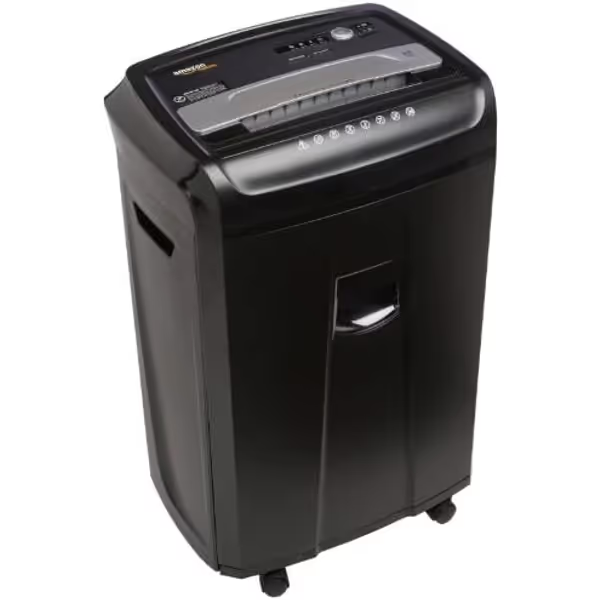
Amazon Basics 24-Sheet Cross-Cut Shredder
High-capacity cross-cut shredder for home office security and convenience.
Sheet Capacity24 Sheets
Sheet Capacity24 Sheets
Pros
Shreds paper, CDs, and credit cards effectively.
25-minute continuous run time for large tasks.
Auto-reverse clears jams, thermal protection.
Cons
60-minute cool-down time after extended use.
Larger size may not fit all compact spaces.
Customers report it shreds large volumes of paper, cards, and CDs without jamming, even with continuous use.
Customers report it shreds large volumes of paper, cards, and CDs without jamming, even with continuous use.
What it offers on paper
Its main practical specifications are straightforward:
- Cross-cut output: listed at 7/32 by 1-27/32 inches.
- Paper capacity: retailer-listed maximum of 24 sheets.
- Media support: credit cards, CDs, and DVDs, fed one at a time.
- Operating cycle: 25 minutes continuous run time, then 60 minutes cooling.
- Waste handling: a 7-gallon pullout bin.
- Jam-response features: auto start and auto reverse; the listing says auto reverse is intended to clear jams.
- Status lights: standby, overheat, overload, and door-open LED indicators.
- Protection: thermal protection with automatic shut-off.
- Listed warranty: an Amazon Basics 1-year limited warranty; check the current terms before purchase.
The pullout bin's real performance impact deserves more attention than it gets in most shopping lists. For small, inexpensive shredders, pullout waste bins are generally easier, cleaner, and safer to empty than pull-off tops. For anyone who dislikes paper confetti or wants a lower-mess routine, that design choice has more day-to-day value than an extra marketing label.
Where this model makes sense
This is a plausible fit if you want one centrally located machine for a household or light home office that does periodic shredding. The combination of a 7-gallon pullout bin, a listed 24-sheet maximum, and a 25-minute run time suggests a design aimed at more than occasional single-page disposal.
It also has useful feedback signals. The named LED indicators can tell you when the unit is on standby, overheated, overloaded, or has an open door. Still, the retailer listing does not assess how visible, clear, or convenient they are in real use. Treat them as a helpful listed feature, not a usability guarantee.
The ability to destroy a card, CD, or DVD one at a time can also reduce the temptation to keep old media in a drawer indefinitely. Follow the listing’s one-at-a-time limitation rather than combining media with a paper batch.
Where it is a mismatch
Do not buy this model because the title of an article promised a small, quiet appliance. Neither point is established by the available evidence:
- The collected sources provide no noise rating or independent quiet-operation test for this model. If noise is a deciding factor, compare measured results in our shredder decibel comparison rather than relying on a product title or subjective claim. It may not be appropriate for a shared bedroom, late-night apartment use, or a call-heavy workspace if silence is non-negotiable.
- It is not verified as compact. The dimensions are available; your furniture plan has to make the call.
- The collected sources do not independently test real-world jam resistance, capacity, durability, or ease for beginners. Auto reverse is a recovery feature, not proof that jams will not happen.
- No DIN/P-level rating is provided for this exact unit. Buyers who require a stated rating should choose accordingly rather than infer one.
There is also no collected energy-draw or standby-power figure. That means a defensible TCO over 3 years calculation is not possible from the available information. You would need the current purchase price, your electricity rate, how often the machine runs, consumable costs, and the warranty terms. Any precise "cost per year" claim without those inputs is just spreadsheet decoration.
Replacement-cost notes
The listed 1-year limited warranty is a useful baseline, but the complete terms and current availability of service or parts are not established here. If this will be your only document-disposal machine, plan for continuity: keep a secure temporary folder for documents during a repair or replacement gap rather than letting sensitive paper accumulate beside the bin.
Build a no-fuss workflow around the machine
Even a well-matched shredder becomes annoying when every document is handled as a separate decision. The practical fix is a short, repeatable first-week shredding routine.
A simple first-week shredding routine
- Choose one holding spot. Use a covered tray or folder for documents awaiting disposal. The point is to keep them out of the recycling pile without feeding the shredder every day.
- Separate materials before you start. Make a paper stack and a separate pile for cards, CDs, or DVDs. The listed media capability is one item at a time.
- Run manageable feeds. Do not begin by testing the listed maximum with thick mixed stacks. Work in smaller portions, especially with folded mailers or packets.
- Watch the indicators. An overload or overheat signal is a cue to stop, not a challenge to keep forcing paper through.
- Empty before the bin becomes a problem. Pullout bins make this less awkward than lifting off a cutting head, but emptying still works best before contents are packed tight.
- Use the required maintenance method. One independent category recommendation is to run a shredder oil sheet every time the bin is emptied. Because no official manual for this exact model was collected, confirm the compatible lubricant and maintenance instructions from the current product documentation before doing so.
This approach matters more than turning shredding into a dramatic quarterly project. A machine used calmly and within its cycle limits is more likely to stay useful.
What a good home shredder looks like in plain language
A good-quality home shredder is not defined by its brand name or a single massive specification. It is the one that gets used consistently because it fits your space, accepts your realistic batch size, gives you enough security for the documents involved, and does not make bin emptying or cooling pauses a constant nuisance.
For a small-space buyer, evaluate these in order:
- Measured fit: Compare the published dimensions with the intended location and access for opening the bin.
- Privacy requirement: Select cut type based on the sensitivity of what you dispose of; seek a specific stated rating if your policy requires one.
- Weekly volume: Match the bin and run time to the pile you actually generate, not an occasional marathon cleanout.
- Interruption tolerance: If you need to shred continuously for longer sessions, a 60-minute cool-down after a listed 25-minute run time is material.
- Emptying and upkeep: A pullout bin and a simple maintenance habit can save more aggravation than cosmetic features.
- Noise and power data: If quiet operation or energy use is decisive, require published measurements or credible testing before you buy. They are not available in the collected evidence for this model.
FAQ
How do I maintain a home shredder?
Keep maintenance uncomplicated and follow the shredder maintenance guidance and current instructions for your exact model. As general category guidance, running a shredder oil sheet each time you empty the bin can help maintain cutting performance. Confirm the lubricant type and interval in the product documentation before applying that advice to this unit.
Is a more expensive shredder worth it?
Only when the added capability solves a recurring problem. More capacity and longer run time can be worth paying for when several users create regular batches. They are poor value when you shred only a handful of pages at a time. Price alone cannot show value; the avoided hassle over three years is the better measure.
What is the smallest size a shredder can make?
This guide cannot establish the smallest shred size available across the market. It can say that smaller particles generally correspond to higher security, and that micro-cut models make smaller, more-secure bits than cross-cut models. The Amazon Basics model reviewed here is listed at 7/32 by 1-27/32 inches.
Summary and final verdict
The Amazon Basics 24-Sheet Cross-Cut model is not a substantiated "best compact shredder" pick, because its dimensions do not prove compactness, and the collected evidence includes no verified noise measurement or independent performance test for this exact unit. What it does offer on its listing is a meaningful set of home-office specifications: 24-sheet maximum capacity, a 25-minute run time, a 7-gallon pullout bin, auto reverse, thermal shut-off, and one-at-a-time destruction for cards, CDs, and DVDs.
Final verdict: Consider it when you need a cross-cut home-office shredder with a pullout bin and can accommodate its listed 26.2 by 16.3 by 11.9 inch dimensions. Pass if you need a stated DIN/P-level or want documentation beyond the retailer listing to confirm quiet operation, compactness, and reliability. The right purchase is the one that makes secure disposal routine, not the one with the most ambitious headline.
Related Articles