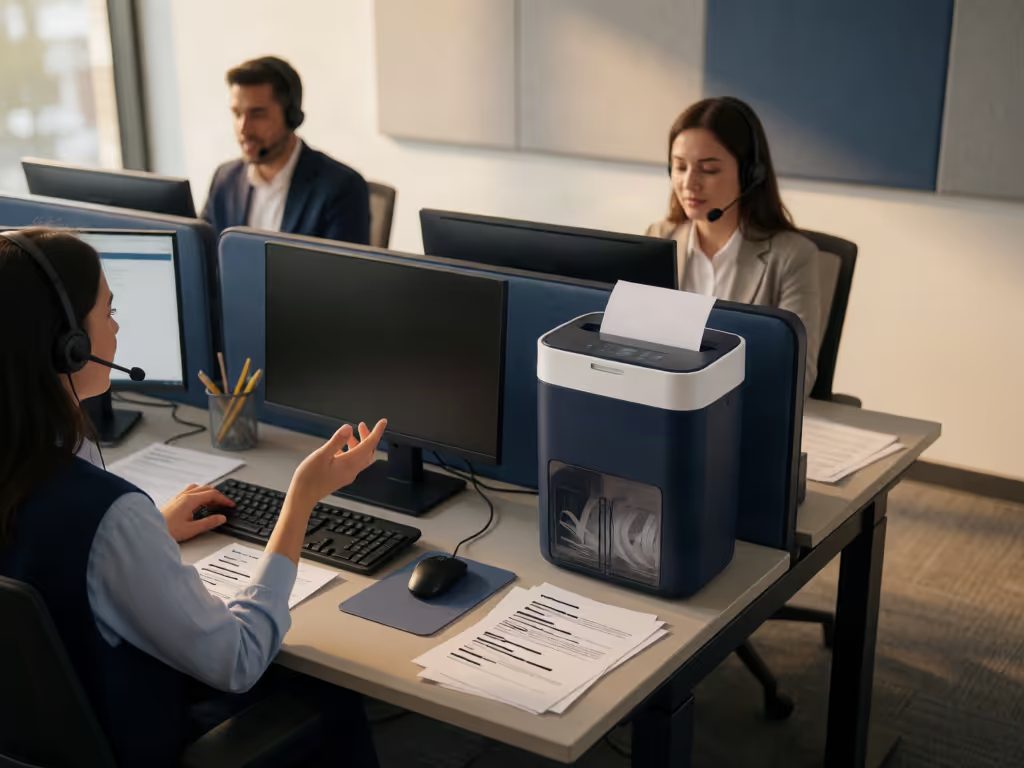
Best Quiet Call Center Shredders for Voice-Friendly Security
By Priya Nair • 15th Aug
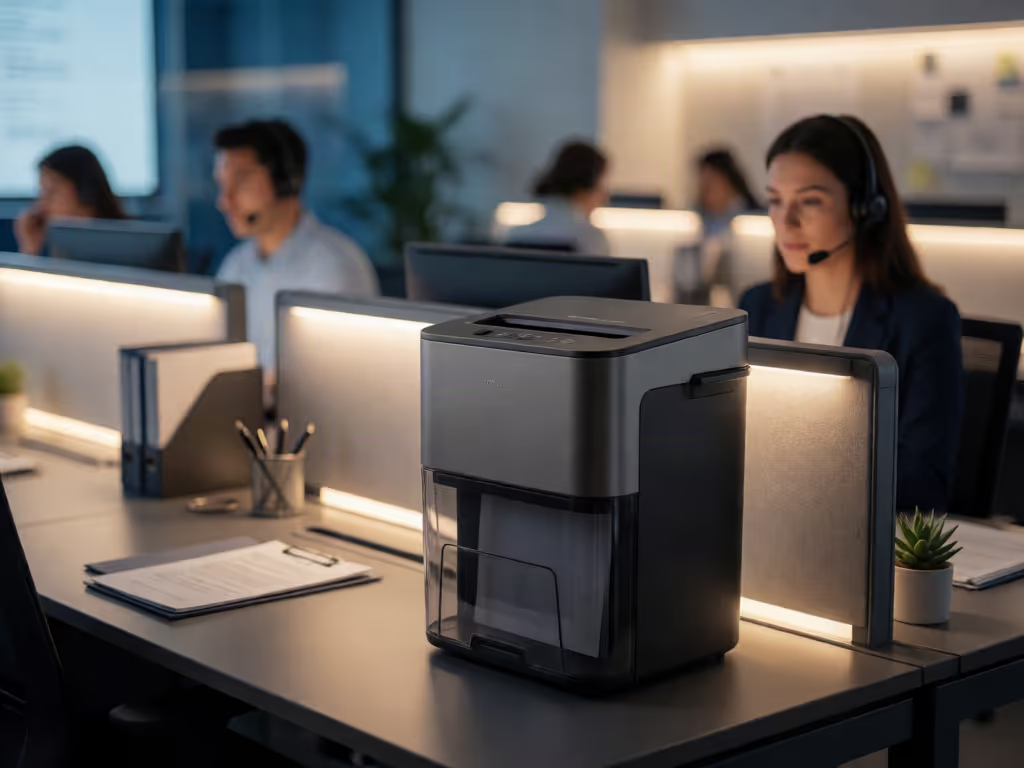
At a glance
The WOLVERINE SD9113 is the strongest overall choice when a published noise figure and routine manual feeding matter. Choose the Aurora AU200MA instead for larger batches, 200-sheet auto-feed, and manufacturer-documented P-5 security.
- Best overall: The SD9113 lists 58 dB, 18-sheet feeding, 60-minute runtime, and a 6-gallon bin. View on Amazon
- Best for batch workflows: The AU200MA offers 200-sheet auto-feed, 10-sheet manual feed, 60-minute runtime, P-5 micro-cut output, and an 8.51-gallon bin. Aurora calls it ultra-quiet but provides no numerical dB measurement.
- What decides it: Match the choice to your document-risk policy and paper flow: SD9113 for smaller manual batches and documented noise information; AU200MA for larger stacks and P-5 requirements. Evidence does not support a definitive overall ranking.
Important: The BONSEN S3105 lacks reliable accessible specifications and cannot be responsibly compared. No equal-condition testing establishes actual call-center voice clarity, throughput, or durability.
A call center shredder has two jobs that often pull in different directions: it must dispose of sensitive paper reliably while keeping a customer-service workspace calm enough for calls. The best quiet call center shredders are not automatically the smallest, the highest security, or the most aggressively marketed. They are the units whose documented noise, run time, feed method, and DIN level match the paper workflow you actually have.
For this comparison, the usable evidence supports two different buying paths: the WOLVERINE SD9113 for buyers who want a published noise figure and a straightforward manual-feed workflow, and the Aurora AU200MA for teams with recurring batches that benefit from automatic feeding and P-5 micro-cut output. A third model sometimes raised in this category, the BONSEN S3105, does not have enough reliable product documentation available to assess its noise, capacity, runtime, or security level responsibly.
Match the document risk to the shred, not the hype.
This is general buying and operational guidance, not legal advice or a promise of compliance; see our guide to document destruction compliance requirements for the legal context behind retention and disposal policies. Your organization’s retention, privacy, and destruction rules should decide what paper is eligible for routine shredding and what DIN level is required.
The problem: a shredder can interrupt the work it is meant to protect
In a customer-service environment, paper disposal is rarely dramatic. It is usually a steady trickle of printed customer information, notes, misprints, and completed paperwork. The problem arrives when that ordinary task becomes disruptive: a loud motor during active calls, a machine that stops halfway through a batch, or a security level chosen with no risk category mapping behind it.
Noise claims deserve particular care, so review our shredder decibel comparison to understand how quiet-office measurements should be interpreted. A decibel number can be useful, but only when you know how it was measured. For the WOLVERINE SD9113, the available 58 dB figure is a retailer-stated specification; the measurement distance, weighting, operating load, and test method were not provided. That makes it a comparison point, not a guarantee of how the unit will sound in your own room.
The Aurora AU200MA is described by its manufacturer as having "ultra-quiet operation," but no numerical dB result is published in the available manufacturer specifications. Treat that as a manufacturer characterization rather than proof that it is quieter than a 58 dB-rated alternative.
A useful distinction: independent testing of a different Aurora model, the AU120MA, recorded 58 to 62 dB while shredding. That is evidence that noise can be measured with a decibel meter; it is not evidence of the AU200MA's sound level.
Why "quiet" alone is not a buying specification
A quiet purchase can still be the wrong purchase if it creates a backlog. For call-center and small-office buyers, compare four things together:
- Published operating noise - Prefer a numerical figure, while recognizing that the test conditions matter.
- Run time - This is the amount of continuous shredding a machine can do before it needs to rest and cool down.
- Feed workflow - Manual-feed capacity helps with small, immediate batches; auto-feed capacity changes the workflow for larger stacks.
- DIN level spelled out in your policy - "High security" is not a risk category mapping. Write down the DIN level required for each document category and purchase to that requirement.
That last point, explained further in our guide to shredder security levels, prevents both familiar mistakes. Underbuying leaves your policy and your machine out of step. Overbuying can turn basic office disposal into an unnecessarily slow, expensive ritual. I err toward higher cut levels only when the risk truly warrants it.
A plain-language audit note can be as simple as: "Customer documents awaiting destruction: designated secure bin; required DIN level: [your policy level]; pickup or emptying logged." That is more useful than a vague statement that the office uses a "secure shredder."
Review 1: WOLVERINE SD9113: the documented-noise choice for routine manual feeding
The WOLVERINE SD9113 is the clearer option when a published noise claim is central to your decision. The retailer listing identifies it as a P-4 cross-cut shredder with an 18-sheet capacity, 60-minute continuous runtime, 6-gallon pull-out bin, 4 × 35 mm listed particle size, and automatic jam-reverse functionality. It also states 58 dB operation.
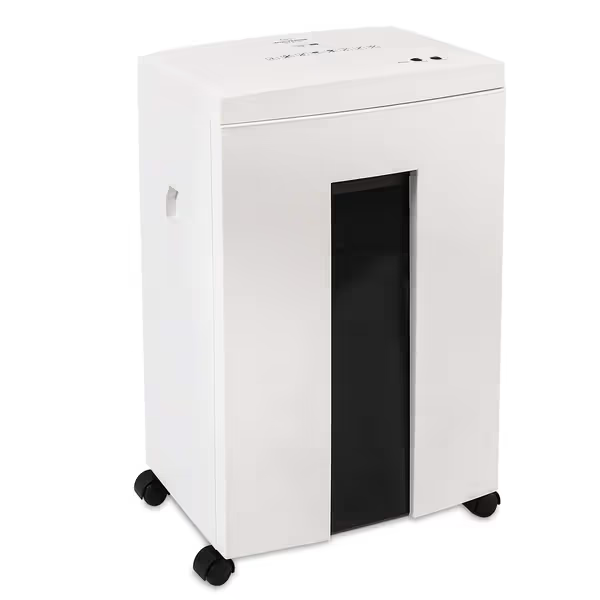
WOLVERINE SD9113 P4 Cross Cut Shredder
Quiet, continuous P4 shredding for sensitive documents and busy offices.
$237.97
Security LevelP-4 Cross-Cut (4x35mm)
Security LevelP-4 Cross-Cut (4x35mm)
Pros
High P-4 security for confidential data (18 sheets).
60-minute continuous run-time with cooling system.
Quiet 58dB operation & automatic jam reverse.
Cons
Large 6-gallon bin may require frequent emptying.
Shreds CDs into 3 fragments, not micro-cut.
What stands out
The SD9113’s value is not that 58 dB proves it will disappear into a live calling environment (it does not). Its value is that you have a specific number to evaluate, rather than only a broad "quiet" label. For a buyer comparing documented claims, that is meaningful.
The listed 60-minute continuous runtime also makes the SD9113 more credible for regular cleanup periods than a short-duty personal unit, although our guide to shredder duty cycles explains why stated runtimes still require careful interpretation. A 6-gallon bin is a defined capacity to plan around, and the automatic jam-reverse feature is intended to address jams without making the operator manually fight every stalled feed.
Best fit
Choose the WOLVERINE when your disposal pattern is frequent, smaller manual-feed batches and you want a P-4 cross-cut model with a stated 58 dB figure. It is also the more transparent of these two products on noise, within the limits of a retailer claim that lacks a disclosed testing protocol.
What to keep in mind
The available specifications are retailer-stated rather than independently tested. That means the 18-sheet capacity, 60-minute runtime, 6-gallon bin, and 58 dB figure should be treated as listed specifications, not real-world guarantees under every paper type or load.
For customer-service workspace security, also avoid treating the P-4 label as a universal answer. Confirm that P-4 is the DIN level your internal policy assigns to the document category in question. If your written risk category mapping calls for P-5, this is not the match simply because its capacity is higher.
Review 2: Aurora AU200MA: the auto-feed choice for larger paper batches
Aurora identifies the AU200MA as a commercial-grade, 200-sheet auto-feed, high-security P-5 micro-cut paper shredder. Its manufacturer documentation specifies a maximum 200-sheet automatic-feed capacity, a separate 10-sheet manual-feed capacity, a 60-minute continuous runtime, 5/64 by 15/32 inch (2 by 12 mm) particle size, an 8.51-gallon pull-out bin, and caster wheels.
What stands out
The AU200MA changes the workload question. The 200-sheet maximum auto-feed specification speaks to a team that accumulates stacks and wants the machine to process them without manually inserting every small batch. Its 10-sheet manual-feed capacity gives it a second use case for individual documents that need immediate disposal.
The AU200MA is also explicitly designated P-5 by its manufacturer. For organizations whose risk category mapping specifies that DIN level for a particular stream of paper records, this is the relevant differentiator, not the word "commercial" alone.
The 8.51-gallon bin is larger than the WOLVERINE’s listed 6-gallon bin, which may matter when the office has regular batch disposal. The caster wheels are a documented mobility feature, though they do not by themselves tell you whether the unit will fit your particular workstation footprint.
Best fit
Choose the AU200MA when your process is batch-oriented and your policy requires P-5 for the records you are destroying. Its documented 200-sheet auto-feed capacity, 60-minute runtime, and larger bin create a strong on-paper fit for that workflow.
What to keep in mind
Aurora calls the AU200MA "ultra-quiet," but the manufacturer information available does not provide a dB figure. Do not assume it is quieter than the SD9113, and do not transfer noise measurements from Aurora's distinct AU120MA model.
That limitation matters for voice-friendly document destruction. If sound is the deciding criterion, the AU200MA gives you an undefined quietness claim rather than a measured or published decibel specification.
Side-by-side: which specification solves your actual bottleneck?
| Decision point | WOLVERINE SD9113 | Aurora AU200MA |
|---|---|---|
| Documented security designation | P-4 cross-cut, retailer stated | P-5 micro-cut, manufacturer stated |
| Feed approach | 18-sheet capacity, retailer stated | 200-sheet maximum auto-feed; 10-sheet manual feed, manufacturer stated |
| Continuous runtime | 60 minutes, retailer stated | 60 minutes, manufacturer stated |
| Noise information | 58 dB, retailer stated; method not disclosed | "Ultra-quiet" manufacturer characterization; no dB figure collected |
| Bin | 6 gallons, retailer stated | 8.51 gallons, manufacturer stated |
| Jam handling / mobility | Automatic jam reverse, retailer stated | Caster wheels, manufacturer stated |
| Most logical buying case | Smaller, regular manual batches where a published noise figure matters | Larger accumulated batches where P-5 and auto-feed matter |
This is not a defensible overall "best" ranking. There is no equal-condition independent comparison of these models for sound, jams, durability, or throughput. The practical conclusion is narrower: select the SD9113 for the more specific published sound claim; select the AU200MA for the documented auto-feed and P-5 workflow.
Solve the process, not just the purchase
A good office shredder should become routine equipment rather than an event. Start with a short internal decision sheet before buying.
1. Make a simple DIN level and document-risk map
List the paper categories your team generates, then assign the DIN level already required by your policy to each one. Keep it operational:
- Document category: customer-facing printouts, administrative drafts, or other defined stream
- Required DIN level: write the exact level, such as P-4 or P-5, from your policy
- Disposal route: secure bin, immediate shredding, or another approved route
- Owner: person or role responsible for the step
- Proof: pickup, emptying, or destruction log as appropriate to the process
Do not use a shredder purchase to invent a compliance standard. The cut level follows the risk decision; it does not replace it.
2. Match feeding style to paper accumulation
If documents arrive continuously in small handfuls, the SD9113’s listed 18-sheet manual capacity may be the simpler fit. If a manager collects scheduled stacks for disposal, the AU200MA’s 200-sheet auto-feed specification is the more relevant number.
A 60-minute run time appears on both product specifications, but the source strength differs: Aurora states it on the manufacturer page, while the SD9113 figure comes from a retailer listing. In either case, run time should be assessed as a workflow figure, not just a number to admire on a product page.
3. Keep chain of custody visible and boring
The shredder is only one part of customer-service workspace security. The paper needs a clear path from desk to destruction. Label the collection point, define who can empty it, and record the handoff or emptying step that your process requires.
During one records audit, the disposal policy was the easiest part to review because document categories were mapped to DIN levels, bins were labeled, and pickups were logged. No flourish, no scramble, just ordinary evidence that the process had been followed.
That is the goal: Right cut, right place, every time.
4. Separate home and office decisions
Home shredders and office shredders can share the same basic logic, but do not assume the volume is the same. A remote worker may value a stated noise figure and manual-feed convenience. A small office may prioritize auto-feed, bin volume, and a higher policy-mandated DIN level. Write a home vs. office policy pointer that tells people which disposal route applies in each setting, especially when customer paper moves between them.
Final verdict: buy for the known constraint
For a buyer specifically shopping quiet call center shredders, the WOLVERINE SD9113 is the more direct choice when you need a published noise specification: the retailer lists 58 dB, along with P-4 cross-cut, 18-sheet capacity, 60-minute runtime, a 6-gallon bin, and automatic jam reverse. The qualification is important: those are retailer-stated claims without a disclosed measurement method or independent comparison.
The Aurora AU200MA is the better-defined option for a higher-volume batch workflow: Aurora documents 200-sheet auto-feed, 10-sheet manual feed, P-5 micro-cut, 60-minute runtime, and an 8.51-gallon bin. Its weak point for a voice-first purchase is simple: "ultra-quiet" is not a decibel measurement.
If your priority is known noise information and everyday manual disposal, choose the SD9113. If your priority is P-5, larger batches, and auto-feed, choose the AU200MA, after accepting that its sound level is not numerically documented here. In either case, make the shredder the last step of a repeatable chain of custody, not the whole privacy plan.
Related Articles