
Document Hoarding Psychology: Build a Shredding Habit
By Linh Tran • 10th May

Introduction
Document hoarding psychology isn't a disorder; it's a rational response to uncertainty. You keep financial statements because "they might matter." You hold onto old mail because shredding feels like a chore. And that stack of expired insurance documents? They're physically safe, so why bother?
But shredding habit formation doesn't happen by accident. It emerges when you understand why you hold documents (anxiety, lack of system, unclear security needs) and when you remove the friction that stops you from acting. Noisy machines, cramped spaces, and confusing specifications all conspire to keep documents in drawers.
This article examines the psychology behind document accumulation, the barriers to building a disposal routine, and how the right setup (quiet, compact, and honest about your actual needs) can transform document management from a source of stress into a calm, regular practice.
FAQ: Understanding Document Hoarding Psychology
Q: Why do people hold onto documents even when they no longer need them?
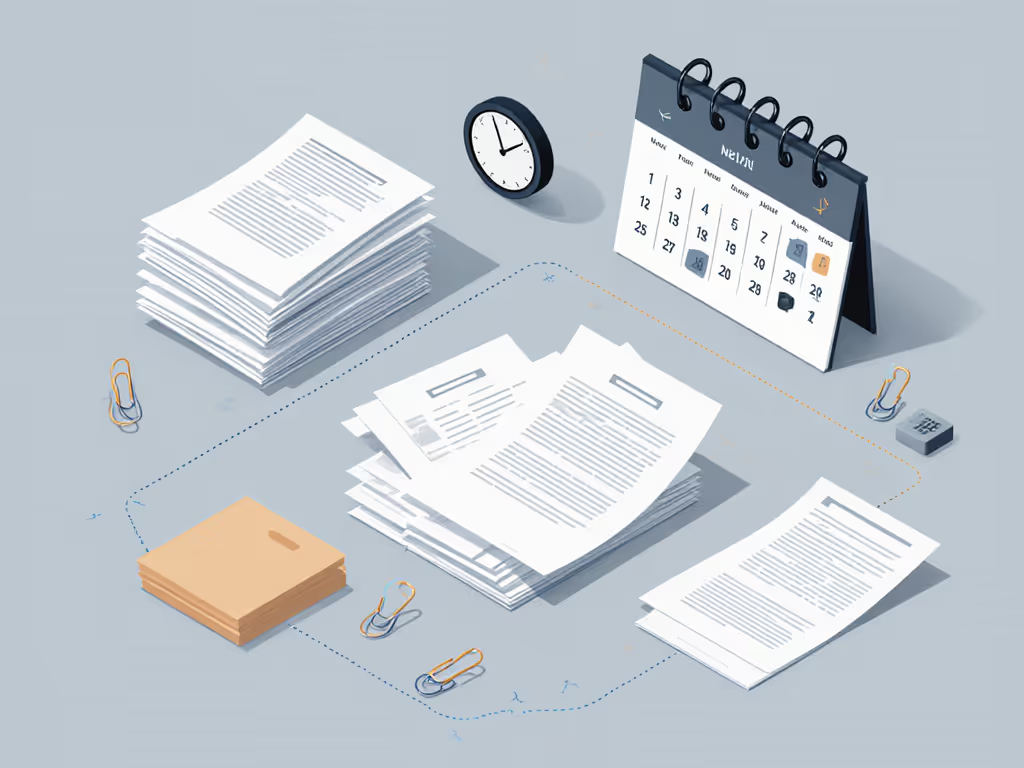
Document hoarding is rooted in information anxiety reduction and loss-aversion bias. Humans tend to overestimate the future utility of information; we keep documents "just in case" because the abstract cost of needing it later outweighs the concrete cost of storing it now. A tax return from eight years ago feels like insurance against an IRS audit, even though your accountant says you're safe after three years.
Behavioral security compliance also plays a role. Some people keep documents out of a vague sense that "legal documents should be kept," without clarity on what actually needs retention. This creates a buffer zone: keep everything a little longer, and compliance anxiety disappears (temporarily). The result is a filing cabinet, a desk drawer, and a cardboard box of "important stuff" that occupies mental and physical space.
Additionally, document retention can signal control. In a world of increasing identity theft and data breaches, holding your own documents feels safer than trusting disposal. This protective impulse is rational, but without a clear destruction protocol, it becomes hoarding.
Q: What blocks people from building a regular shredding habit?
Three friction points emerge repeatedly:
-
Decision Fatigue: Which documents stay? Which go? Without clear retention guidelines, every item triggers a judgment call. Over time, this mental load makes the whole task feel overwhelming, so it's postponed.
-
Equipment Discomfort: Shredders are loud, hot, and bulky. If your machine runs at 75-80 dB(A) at 1m, it's louder than a busy office or television. To choose a calmer machine, see our quiet office models tested. If it overheats after 20 minutes, you can't finish a batch in one session. If it dominates your desk, it's a visual reminder of an unfinished task.
-
Ambiguous Security Needs: Should you buy a DIN P-4 cross-cut shredder or a DIN P-2 strip-cut? Without guidance on what "sensitive enough" actually means for your life, you either underbuy (and worry you're exposed) or overspend on overkill specs.
Together, these barriers turn shredding into a procrastinated chore rather than a routine.
Q: How does quiet equipment relate to habit formation?
Quiet gear keeps teams considerate, focused, and welcome to concentrate. This goes beyond etiquette; it changes behavior. A shredder running at 55-65 dB(A) at 1m feels like ambient office noise (acceptable during business hours, viable during evening or early-morning batches). One running at 75+ dB(A) is intrusive; you'll hesitate to use it, and you'll resent neighbors or coworkers who are present. For engineering fixes that cut noise at the source, compare noise reduction technologies.
In a clinic waiting room I managed, a loud shredder turned whispers into winces. We swapped to a damped, slower unit, added an anti-vibration mat, and moved it three meters from seating. The dB(A) at 3m dropped dramatically, complaints disappeared, and staff could run after-hours without side-eye. Quiet tools changed the room's mood, and the staff's behavior changed with it.
Respect the room; respect the boundaries. When your shredder is quiet and compact, it stops announcing its presence and becomes forgettable (in the best way). This invisibility is what allows habit formation. You don't avoid using it because it's socially painful or takes up all your cognitive space.
Q: What role does "documentation psychology" play in sustaining the habit?
Documentation psychology refers to how clearly labeled systems influence behavior. A shredder with a visible, marked bin and clear fill indicator (say, a transparent or color-coded chamber) makes you see progress. See our bin capacity performance test to time empties before jams. A retention chart taped to your desk or filed nearby answers the "how long do I keep this?" question instantly, without mental effort.
Clear specifications also matter. When a product lists noise at 1m and 3m in dB(A) (for example, 60 dB at 1m and 52 dB at 3m), you can map real placement: "If I put it in the corner, three meters from the desk, it'll blend in." This transforms abstract specs into tangible placement diagrams in words, which builds confidence.
Security mindset training accelerates when you see your actions working. Habits stick when friction is low and feedback is visible. Transparent bins, honest noise ratings, footprint-to-room mapping: these aren't nice-to-haves; they're habit enablers.
Building a Shredding Habit: A Framework
Step 1: Define Your Document Sensitivity
Information anxiety reduction starts with clarity. If you're unsure which cut to trust, start with our security levels guide. Ask yourself:
- Personal financial docs (bank statements, tax records) → DIN P-4 cross-cut is typically sufficient.
- Regulated client data (healthcare, finance, legal) → DIN P-5 or P-6 may be warranted; check compliance guidelines (HIPAA, GLBA).
- Identity-linked materials (credit cards, passports, Social Security documents) → P-5 is prudent; shred any item that could enable fraud.
This clarity kills decision fatigue at the moment of shredding. You no longer ask, "Is this worth keeping?" You proceed with confidence.
Step 2: Right-Size Your Equipment
Overspend on quiet and compact; underspend on unnecessary tonnage. A behavioral security compliance mindset means buying enough to feel secure without feeding the anxiety monster with overkill specs.
- Footprint-to-room mapping: Measure your desk or storage nook. Ideal is 12-15 inches wide and under 24 inches tall for a desktop unit. This fits under most desks or in a narrow closet niche.
- Noise at 1m and 3m: Aim for <=65 dB(A) at 1m for daytime use, <=60 dB(A) if using after-hours or in shared spaces. At 3m (a typical office distance), this drops 6-9 dB, making it much less intrusive.
- After-hours suitability: Will you shred at 7 p.m. when a partner is on a call, or kids are sleeping upstairs? Choose models rated for low vibration and damped operation. Vibration/desk transfer notes matter; an anti-vibration mat (a few millimeters of neoprene under the feet) cuts audible hum further.
- Continuous duty: Verify run-time before cool-down. A 15-minute continuous rating at 20 sheets per minute gives you 300 sheets per session (enough for a typical batch without interruption). For deeper selection tips, read our duty cycle guide.
Step 3: Establish a Trigger
Habits form when a cue is consistent. Set a trigger: "Every Friday at 4 p.m., I shred this week's junk mail and old receipts." Or: "When my bin reaches the fill line, I finish that batch, then empty and resume." Pairing shredding with an existing routine anchors it.
Step 4: Monitor Compliance and Anxiety
After a month of regular shredding, note what you feel:
- Less mental clutter from a shrinking document pile?
- No longer second-guessing what to keep?
- Comfortable that sensitive docs won't linger?
These signals mean the habit is forming. Security mindset training is self-reinforcing: as you destroy documents on schedule, the fear of data leakage drops, and the habit feels easier.
The Quiet Gear Advantage
Quiet shredders aren't a luxury; they're a prerequisite for habit sustainability in shared or noise-sensitive environments. Equipment rated 55-65 dB(A) at 1m, paired with placement three meters away and an anti-vibration mat, is virtually unnoticed. Low vibration also protects desk surfaces and prolongs motor life.
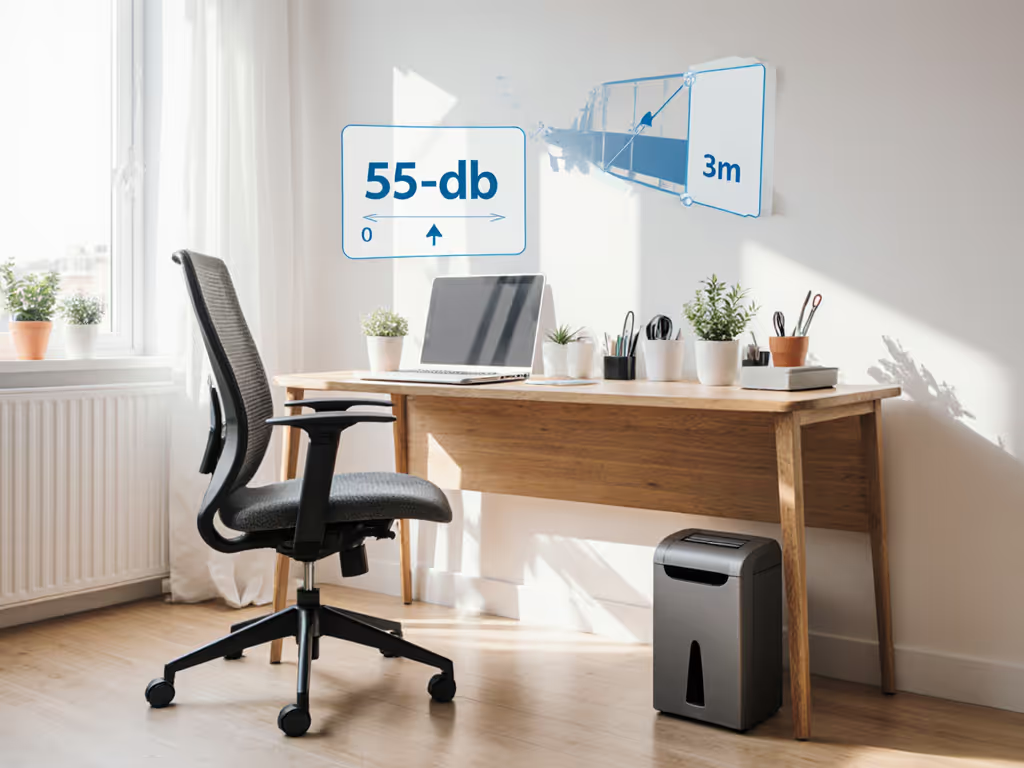
When your setup is respectful of the room, you use it without guilt. Guilt is a habit-killer.
Conclusion: Further Exploration
Document hoarding psychology and shredding habit formation are mirrors of each other. One reflects anxiety and avoidance; the other reflects clarity and ease. The pivot happens when you understand your security needs, remove physical and acoustic friction, and build a simple, visible routine.
As you think about your own document strategy, consider these questions:
- What documents are genuinely keeping you up at night?
- Where would a quiet, compact shredder actually fit in your space?
- What time of day could you commit to a 15-minute weekly batch?
- How would it feel to know that sensitive documents were destroyed on schedule, not stored indefinitely?
There's no one-size-fits-all answer. But there is a right-sized answer for your life, one that quiets both the machine and the anxiety. Explore your retention needs, measure your space, and test your assumptions. The habit you build will be unique to you, but the principle is universal: a calm, considerate tool becomes a calm, considerate habit.
Related Articles