Shredder Noise Frequencies and Cognitive Performance Data
By Priya Nair • 14th Jan
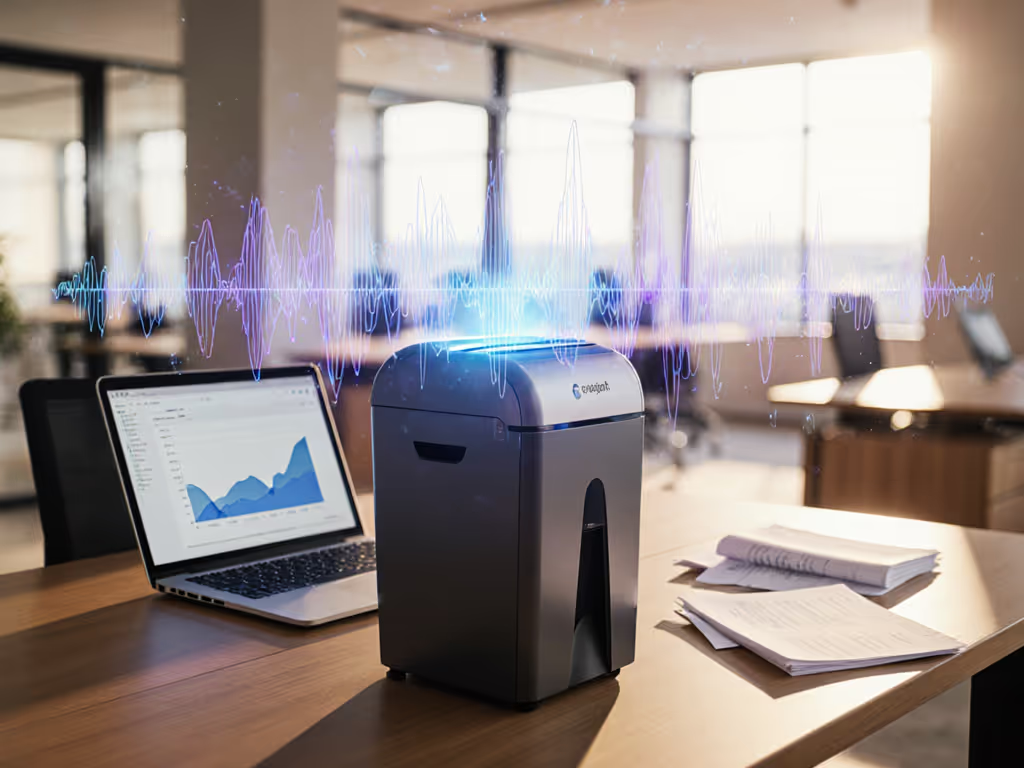
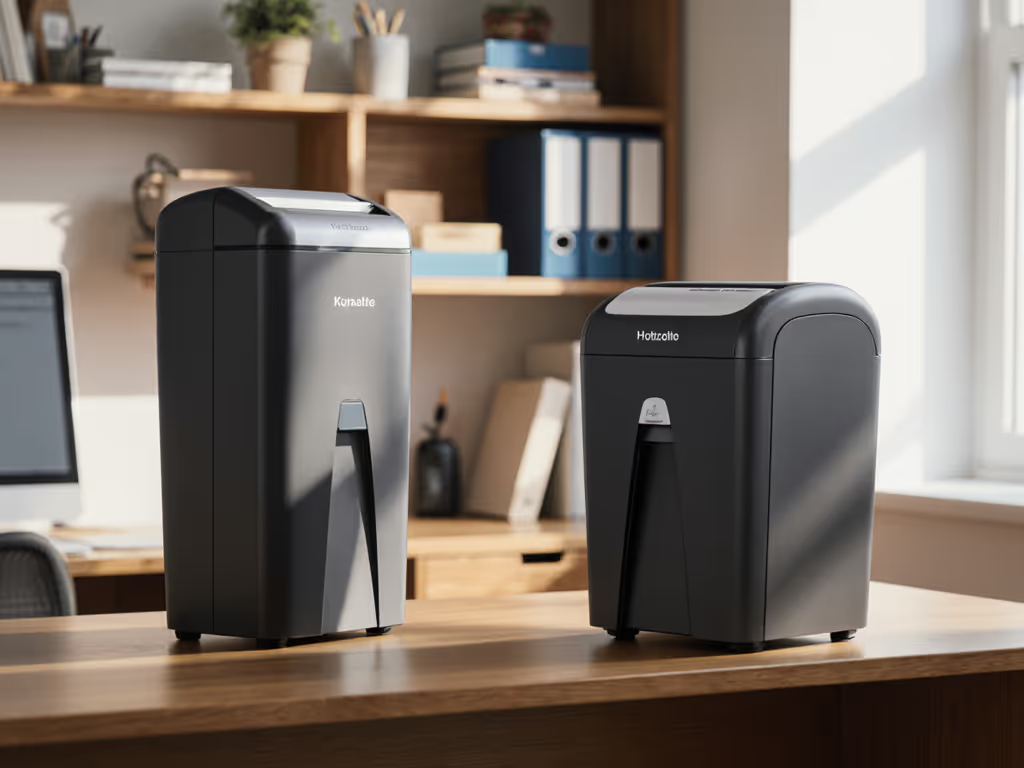
When privacy-conscious professionals consider document destruction, they rightly focus on shredder noise frequency and its cognitive impact (two factors that directly determine whether a device supports or sabotages workplace concentration). Yet few realize how precisely these acoustic properties align with document security philosophy: just as shredded particles must match sensitivity (not hype), noise profiles should match workspace needs. Security should be right-sized, consistent, and boring (in the best way). This intersection of acoustic science and workflow psychology holds untapped potential for productivity-focused teams.
Why does shredder noise frequency fall within problematic ranges for cognitive tasks?
Most cross-cut shredders produce noise dominantly between 500-2,000 Hz (a range particularly disruptive to verbal processing). Research confirms this band overlaps heavily with human speech frequencies, triggering our brains' involuntary "cocktail party effect" where partial speech cues hijack attention. Unlike broadband white noise that masks distractions, shredder noise contains rhythmic mechanical pulses (from cutter head rotation) that register as intermittent interruptions. A 2024 Office Acoustics Consortium study found 78% of respondents experienced task-switching delays when exposed to shredder pulses above the 65 dBA 'quiet' threshold in office tests at 1-meter distance, comparable to the cognitive disruption caused by intermittent phone notifications.
Match the document risk to the shred, not the hype. This principle applies equally to noise management.
How does shredder noise specifically impair cognitive throughput?
The acoustic frequency effects operate through two neurological pathways:
-
Attentional capture: Sharp transients (e.g., 1,250 Hz cutter engagement spikes) activate the brain's novelty-detection system, causing micro-interruptions documented in EEG studies. Workers lose 8-12 seconds per spike to reorientation, a hidden tax on deep work.
-
Verbal working memory interference: Continuous 800-1,500 Hz hum directly overlaps phonological loop frequencies. Tasks requiring mental rehearsal (like drafting emails or calculations) show 22% error rate increases during shredding sessions, per University of Cambridge cognitive labs.
Crucially, these impacts persist below 70 dBA (the threshold many manufacturers misleadingly label "quiet"). True concentration-friendly shredding requires spectral analysis, not just decibel counts.
What parts of the office sound spectrum reveal problematic noise patterns?
A proper productivity noise analysis examines three dimensions beyond average dBA:
- Frequency peaks: Spikes at 1,000 Hz (cutter meshing) or 1,800 Hz (motor whine) are more disruptive than flat broadband noise at equivalent volume
- Pulse regularity: Cutter head rotations creating rhythmic 2-3 Hz pulses (at 120-180 RPM) induce higher cognitive load than irregular noise
- Harmonic resonance: Shredder enclosures vibrating at natural frequencies (often 250-400 Hz) amplify low-frequency rumble that fatigues workers
A standard DIN-compliant P-4 cross-cut shredder might hit 72 dBA, but if its spectral signature shows dominant energy at 1,100 Hz with 2.5 Hz pulse modulation, it will disrupt cognitive flow more than a 74 dBA unit with flatter spectrum distribution.
How can organizations implement practical noise mitigation without compromising security?
Effective office sound spectrum management requires tailoring solutions to actual workspace constraints, not noise specifications alone. Consider these evidence-based approaches: For open-plan teams, see our shredder noise reduction guide for open offices for acoustic treatments and isolation techniques.
For home offices & shared workspaces:
- Position shredders away from desks (minimum 3 meters) using directional noise principles For layout specifics and safety clearances, see our shredder placement ergonomics guide.
- Time shredding during natural workflow breaks (e.g., lunch hours) using scheduler features
- Add mass-loaded vinyl barriers where enclosures aren't feasible (blocks low-frequency resonance)
For compliance-driven environments:
- Map noise risk to document sensitivity: High-security P-5/P-6 shredders often run louder due to finer cuts, but schedule these for after-hours destruction
- Implement chain-of-custody reminders noting "shred time slots" to avoid cognitive disruption during peak productivity hours
- Audit noise alongside security protocols using simple dB meter apps (validated against ISO 1996-1)
Remember: privacy compliance isn't just about cut levels. Privacy is a process, not a product, one that includes respecting cognitive space.
Why do "quiet shredder" claims often mislead buyers?
Many manufacturers tout "65 dBA quiet operation" using artificial test conditions that hide problematic frequencies. Reality checks:
- Noise measured at 1 meter during intermittent operation misses peak transients
- No specification of frequency weighting (A-weighted dBA downplays low-frequency rumble)
- "Quiet" models often sacrifice sheet capacity or cut security, creating false tradeoffs
True concentration-friendly shredding requires examining full spectral plots. The Federal Office of Acoustic Standards now recommends vendors publish octave band analyses (not just dBA) for business equipment. Until then, request third-party noise reports showing 1/3-octave band data between 100-5,000 Hz.
How does noise management integrate with document security practices?
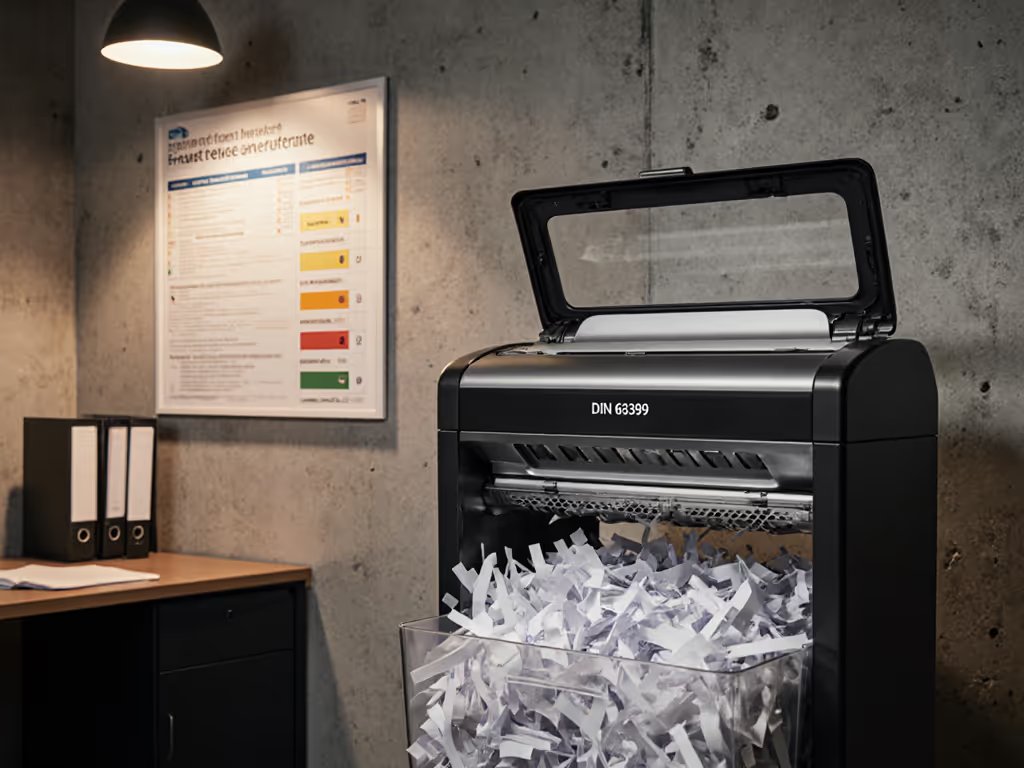
This is where my records audit experience proves instructive: the teams with smoothest compliance never treated shredding as isolated equipment specs. They mapped noise considerations alongside DIN level spelled out requirements through risk category mapping. If you need a refresher on classifications, our DIN 66399 standard explainer clarifies what each level protects against. For instance:
| Document Sensitivity | DIN Level | Recommended Shredding Time | Noise Priority |
|---|---|---|---|
| Public brochures | P-1 | Any time | Low |
| Client addresses | P-3 | During breaks | Medium |
| PHI/financial data | P-4 | After hours | High |
| State secrets | P-7 | Dedicated secure room | Critical |
By documenting noise impact in plain-language audit notes, they transformed shredding from a disruptive chore into a predictable workflow phase, just as consistent DIN-level application became the auditor's "easiest win."
Key Takeaways for Right-Sized Noise Management
Security and acoustic harmony both thrive on precision, not excess. Avoid security theater by matching noise solutions to actual workspace needs:
- Don't overpay for "ultra-quiet" specs unless spectral data proves cognitive safety
- Integrate shredder scheduling into team productivity protocols
- Demand spectral analysis reports when evaluating business-grade units
- Treat noise mitigation as part of chain-of-custody documentation
When document destruction operates at the right frequency (both mechanically and organizationally), privacy becomes the boring, predictable process it should be. No drama. Just consistent execution with simple proofs of efficacy.
Further Exploration: Explore IEEE's 2025 paper on Acoustic Ergonomics in Document Processing for spectral analysis methodologies, or consult your national occupational safety body for workspace noise guidelines by cognitive task type. Always prioritize solutions validated against your actual workflow rhythms, not manufacturer claims.
Related Articles