Portable Shredder Battery Life Compared: Real Travel Power Tests
By Mateo Silva • 29th May
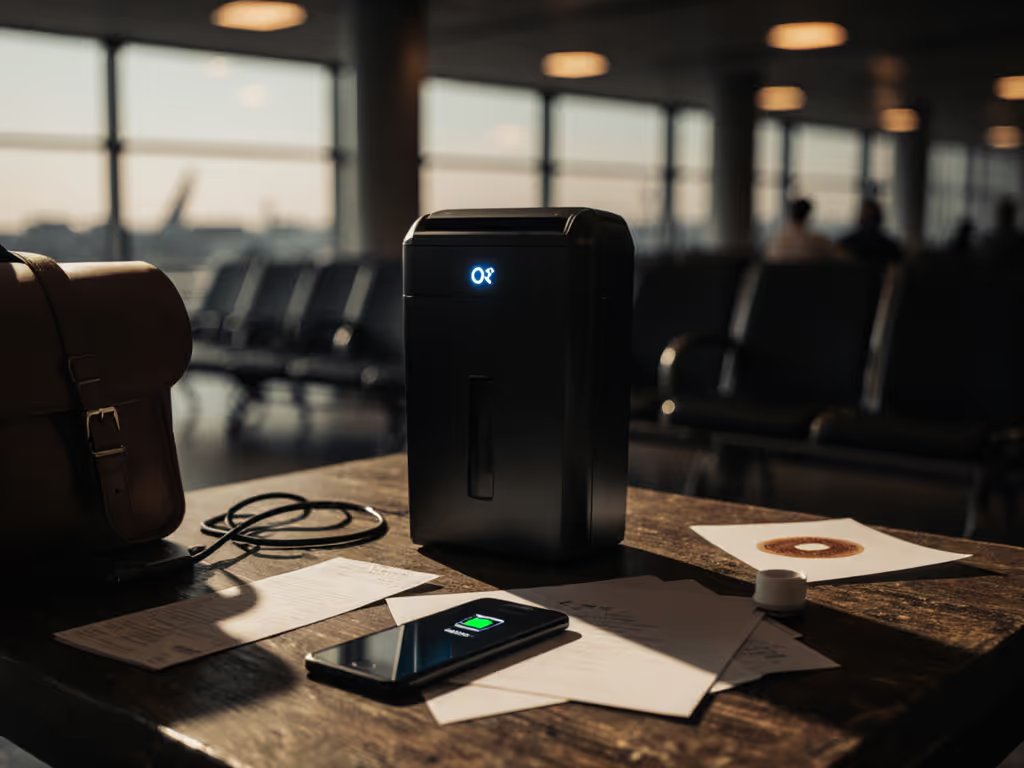
When you live on the road between home office, clients, and coworking spaces, portable shredder battery life becomes the difference between quiet compliance and an anxious pile of "to shred later" documents. If you care about travel shredder power performance, you need more than vague "up to 20 minutes" claims and glossy product photos.
I'm going to walk you through how to size, test, and sanity-check battery-powered travel shredders so they don't fail you at the worst possible time, on the road, far from an outlet, with sensitive papers in your bag.
Buy once, buy right, skip the fluff.
Problem: Why travel shredder power is so confusing
The marketing doesn't match your real life
Most people shopping for a cordless shredder see:
- "Up to X minutes continuous run-time"
- "Shreds Y sheets per pass"
- "Compact, portable, ideal for travel"
None of that tells you the real question: how many pages can I shred before the battery dies in my actual workflow?
Independent testing of home and office shredders shows that real run-time and throughput often fall short of optimistic box claims, especially when you feed full sheet capacity or thicker paper.[10] For a deeper look at how run time and thermal limits affect real performance, see our shredder duty cycle guide. Cordless models are even more sensitive, because their motors must live within the limits of a small battery pack.
So you end up guessing, hoping that a little cordless unit can handle:
- Receipts and boarding passes on a business trip
- Client records in a hotel room (HIPAA/GLBA-style sensitivity)
- Rental applications or financial paperwork in a short-term stay
If that guess is wrong, you get a dead shredder, a full folder, and a creeping "I'll deal with this later" pile.
Privacy risk doesn't wait for wall power
If you're privacy-first, the idea of:
- Tossing unshredded boarding passes in hotel trash
- Traveling with intact bank statements or client lists
- Waiting weeks until you're back near your main shredder
...is a non-starter.
For regulated fields (healthcare, finance, legal, real estate), compliance anxiety doesn't turn off just because you're on the road. If you're unsure which rules apply, our document destruction compliance guide explains the essentials. You still need a disposal method that feels defensible, especially when documents cross borders or stay in shared accommodations.
Tiny footprints, big compromises
The smallest cordless shredders are built to fit in drawers and duffel bags. That usually means:
- Smaller motors
- Smaller batteries
- Lower sheet capacity
- Shorter safe run-times
Editors who test shredders for home and small office use routinely find that compact units trade away run-time and power for size and quiet operation.[10] The same trade-off is even sharper in battery-powered travel units.
But product pages rarely say:
- How many total pages per charge you can expect
- How much performance drops near low battery
- Whether it can run reliably from a power bank
Instead, you get ambiguous phrases like "high efficiency" and "ideal for home and travel," which don't tell you whether it can clear a day's worth of client files.

Solve: A clear framework for real travel power tests
You don't need lab equipment to make good decisions. You need a simple, honest way to translate your real workflow into battery and power requirements, then verify them.
Step 1: Define your real shredding profile
Before you even look at models, write down three numbers:
- Pages per day on the road
- Conservative: 10-20 pages (receipts, a few statements)
- Moderate: 30-60 pages (consulting/finance/real estate)
- Heavy: 80-150+ pages (legal/healthcare, document-heavy audits)
- Days between guaranteed wall power
- Hotel every night: 1 day
- Multi-day travel with unreliable power: 2-3 days
- Maximum time you're willing to spend shredding per day
- Most people tolerate 5-10 minutes; beyond that, it feels like work.
Multiply: pages per day × days between charges.
That's your required pages-per-charge. Not run-time minutes: actual pages.
Step 2: Understand cordless shredder testing metrics
For cordless shredder testing, the only metrics that matter in practice are:
- Pages per full charge at your typical sheet thickness
- Continuous run-time before thermal or voltage cutoff
- Recharge time back to full
- Power input type (wall adapter, USB-C, barrel plug)
Because manufacturers rarely publish pages-per-charge, you need to translate what they do publish. To calibrate your expectations, see our real-world travel battery test results comparing actual runtime and pages-per-charge across portable models.
Common claims and how to read them:
-
"X minutes continuous run-time"
-
Assume real usable run-time under realistic load is 60-70% of that.
-
"Y sheets per pass"
-
For battery planning, assume you'll feed half to two-thirds of rated capacity to keep motor draw moderate and reduce jams.
-
"High efficiency motor" / "mobile shredder energy efficiency"
-
Marketing language. What you care about is total pages per charge and whether it bogs down near the end of the battery.
A simple rule of thumb:
Whatever performance is claimed, mentally subtract 30-40% when planning for travel.
Step 3: Battery tiers for portable shredder battery life
Now map your profile to battery tiers in terms of pages per charge you should expect.
Tier 1: Light travel (receipts + a few statements)
- Profile: 10-20 pages/day, hotel power nightly
- Target: 40-60 pages per charge
- What this looks like:
- Very compact units
- 2-4 sheets per pass
- Short run-time, but perfectly adequate if you shred daily, not in huge batches
This is enough for personal identity protection on the road, but marginal for regulated client work.
Tier 2: Moderate travel (typical small-office work)
- Profile: 30-60 pages/day, 1-2 days between reliable charging
- Target: 100-150 pages per charge
- What this looks like:
- Mid-size cordless units
- 4-6 sheets per pass (you'll realistically run 3-4)
- Usable continuous run-time around 10 minutes under real load
This tier suits most consultants, financial professionals, and small legal/real estate practices on the road, where P-4 cross-cut security is usually appropriate.
Tier 3: Heavy travel (document-heavy, high-sensitivity)
- Profile: 80-150+ pages/day, 2-3 days off-grid
- Target: 250-400 pages per charge (or regular access to both wall power and a robust power bank)
- What this looks like:
- Larger, often heavier cordless units or hybrid corded/battery designs
- True 6-10 sheets per pass
- More noticeable noise and heat
At this point, consider whether carrying a compact corded P-4 shredder plus a reliable power source at your destination might be more practical than pushing cordless gear beyond its design envelope. Larger corded models generally provide more sustained power and throughput than the smallest portable units.[10]
Step 4: Power bank compatibility and real travel shredder power performance
If you want battery-powered travel shredding backed by a power bank, you need to check:
- Input type
- USB-powered mini shredders can often run from a USB-C PD power bank.
- Larger cordless units may only charge via their own AC adapter, which then requires an AC outlet or an inverter-style power bank.
- Power draw vs. power bank rating
- Many small electronics draw 10-30 W; compact shredders tend to sit at the higher end of that or above, especially under load.
- Check that your power bank can comfortably supply the continuous wattage (not just peak).
- Watt-hours (Wh) vs pages
- Power banks are usually rated in Wh.
- Shredder manufacturers rarely expose their battery Wh directly, but you can infer from behavior: if a full internal charge handles ~100 pages, and your power bank has 2-3x that energy, you can expect 2-3 "refills," minus conversion losses.
- Conversion losses
- Using an AC inverter from a power bank typically wastes 10-20% of energy as heat.
- USB-C direct power is generally more efficient.
In practice, treat a decent-sized power bank as a safety net, not your primary battery. Your portable shredder should still be able to complete a normal day's workflow on its internal battery alone.
Step 5: Do your own 20-minute cordless shredder testing
Nothing beats a simple, controlled home test before trusting a device on the road.
Here's a quick real travel power test you can run the week your shredder arrives:
- Charge fully
- Leave it on charge until any indicator confirms 100%.
- Prepare a realistic stack
- Use your actual paper: mixed receipts, statements, printed emails, maybe a few staples.
- Aim for 150-200% of what you expect to produce on a single travel day.
- Time continuous shredding
- Feed at half claimed sheet capacity (if it says 6 sheets, feed 3).
- Time how long it runs before:
- Slowing noticeably
- Hitting thermal or battery cutoff
- Count (or estimate) how many pages you got through.
- Simulate travel use
- Let it cool and recharge.
- The next day, do two shorter 5-minute sessions instead of one long one.
- Note if performance drops when the battery is partially depleted.
- Test power bank backup (if relevant)
- Run a session powered from your power bank.
- Confirm it doesn't trip overload protection.
If the shredder can't clear your realistic test stack with 20-30% buffer left in the battery, it's under-spec for your travel profile. Exchange or return it while you still can.
Step 6: TCO over 3 years: don't chase specs you won't use
When you compare models, look at Total Cost of Ownership (TCO) over 3 years rather than just price. Our cost-per-sheet analysis shows how small reliability differences add up over time.
Consider:
- Purchase price vs. real usable performance
- Expected lifespan under your load (light/medium/heavy use)
- Battery degradation - many packs lose noticeable capacity after 2-3 years
- Replacement cost if the battery is non-user-replaceable
- Energy draw if you're often using wall power or a power bank
A rough breakdown:
-
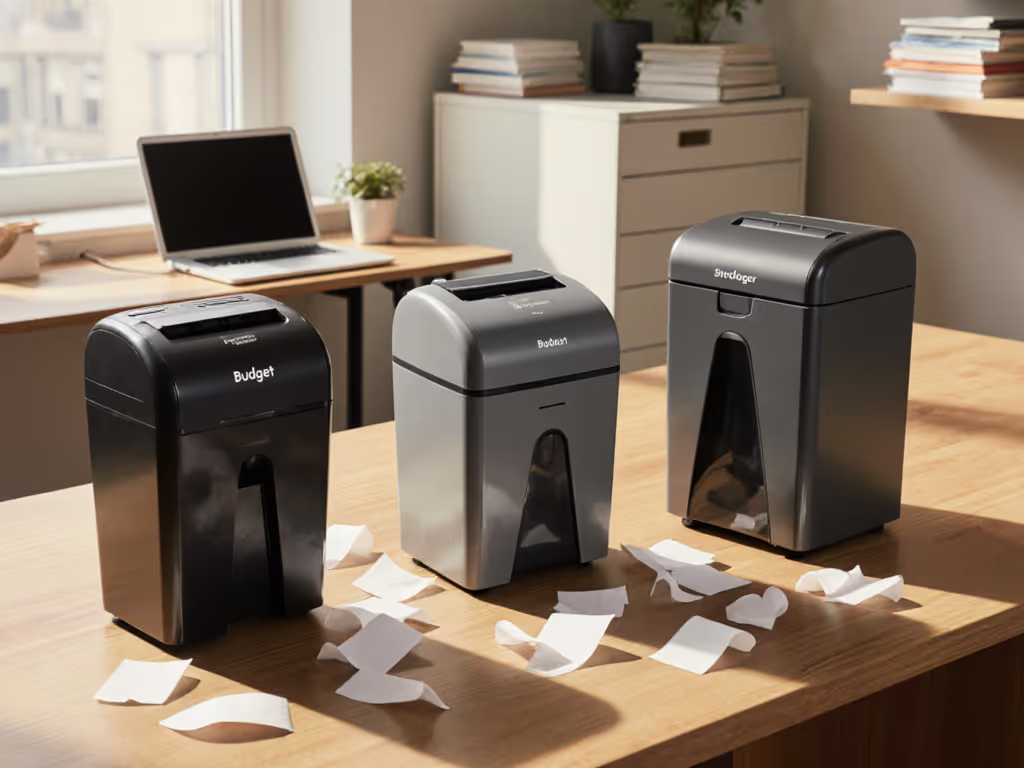
Budget minis (<$60)
-
Great for light travel profiles
-
May struggle with heavier paper or frequent use
-
Often disposable when the battery degrades
-
Mid-range cordless ($60-$150)
-
Best value for moderate, regular travel use
-
Typically better motors and more consistent run-time
-
Good compromise between mobile shredder energy efficiency and throughput
-
Premium or hybrid solutions ($150+)
-
Worth it only if you truly have heavy, high-sensitivity workloads on the road
-
Otherwise, you risk paying for security and capacity you rarely use
In my experience, pay for reliability, not for unused security theater. A stable, mid-tier P-4 cross-cut cordless unit that quietly handles your real travel profile is better value than a temperamental, overpowered micro-cut that lives mostly in a drawer.
Actionable next steps: Your personal travel shredder checklist
To make this concrete, here's a simple path you can follow this week.
1. Quantify your travel shredding
Write down:
- Pages per typical travel day
- Days between reliable access to wall power
- Whether you need client-grade disposal (regulated data) or mainly personal privacy
This defines your Tier 1 / 2 / 3 profile.
2. Set a minimum pages-per-charge target
Based on your profile:
- Light: 40-60 pages per charge
- Moderate: 100-150 pages per charge
- Heavy: 250-400 pages per charge (or clear plan to use wall power/cord plus power bank)
Keep this number visible when comparing models.
3. Shortlist only models that match your real constraints
Filter by:
- Cut type: P-4 cross-cut for most; higher only if clearly required
- Noise: look for user feedback mentioning quiet operation
- Size/weight: acceptable for your bag or rolling case
- Charging: USB-C or straightforward wall power; avoid weird proprietary chargers if you travel internationally
Remember: cordless shredder testing has shown that compactness always costs power. For models that balance size with real travel security, start with our compact travel shredder picks. Don't pick ultra-tiny unless your page volume truly fits Tier 1.
4. Run the 20-minute home test
Once you buy:
- Fully charge
- Shred a realistic test stack
- Time run-time and pages per charge
- Test from your power bank if that's part of your plan
If results fall short, don't rationalize. Return it and try a better-matched tier.
5. Reassess after 12 months
Set a reminder one year out to:
- Repeat a shorter version of the test
- Note any decline in run-time or pages per charge
- Decide whether it still meets your travel profile
If your volume has grown or the battery has sagged significantly, it may be cheaper over the next 3 years to upgrade than to fight a dying pack.
If you map your actual travel workload to pages per charge, test your gear honestly, and ignore flashy but irrelevant specs, you'll end up with something that quietly does its job trip after trip. Portable shredder battery life stops being a gamble, and becomes one more piece of your privacy workflow you can stop worrying about.
Related Articles