
Shred Security Longevity: The Degradation Timeline
By Priya Nair • 15th Dec

When you drop sensitive documents into a shredder, you're not just creating confetti, you're setting a clock on information vulnerability. Understanding shred particle degradation and the document reconstruction timeline is essential for anyone who handles personal or business records. Too many organizations operate with a false sense of security, believing that "shredded is shredded" without considering how long it actually takes for those scraps to become truly unrecoverable. As someone who's translated compliance standards into practical workflows for clinics and small firms, I've learned that proper document security requires more than just pushing paper through blades (it demands understanding the science behind when information becomes irretrievable).
How Long Until Shredded Documents Are Truly Safe?
The Critical First 72 Hours
Contrary to popular belief, shredded paper remains reconstructable far longer than most people realize. During the first 72 hours after shredding, even cross-cut particles (DIN 66399 P-4) can be painstakingly reassembled with modern tools. This window represents your highest time-based security risk, the period when identity thieves could potentially harvest enough strips to reconstruct sensitive information. If you're unsure how cut type changes reconstructability, see our micro-cut vs cross-cut security guide.
The real security milestone comes when paper oxidation science takes over. As cellulose fibers begin breaking down through exposure to oxygen, moisture, and light, the ability to reconstruct information diminishes rapidly. Standard office paper starts this process within 5 to 7 days, with particles becoming increasingly brittle and fragile.
Match the document risk to the shred, not the hype.
By day 14, most shredded paper experiences significant micro-tearing along the cut edges, a natural byproduct of document decomposition that further fragments the particles. This is why basic strip-cut (DIN P-1) documents shouldn't be stored for more than two weeks before disposal, while micro-cut (DIN P-7) particles provide security for months or even years before reconstruction becomes theoretically possible.
How Environmental Factors Impact Security Longevity
Storage Conditions Matter More Than You Think
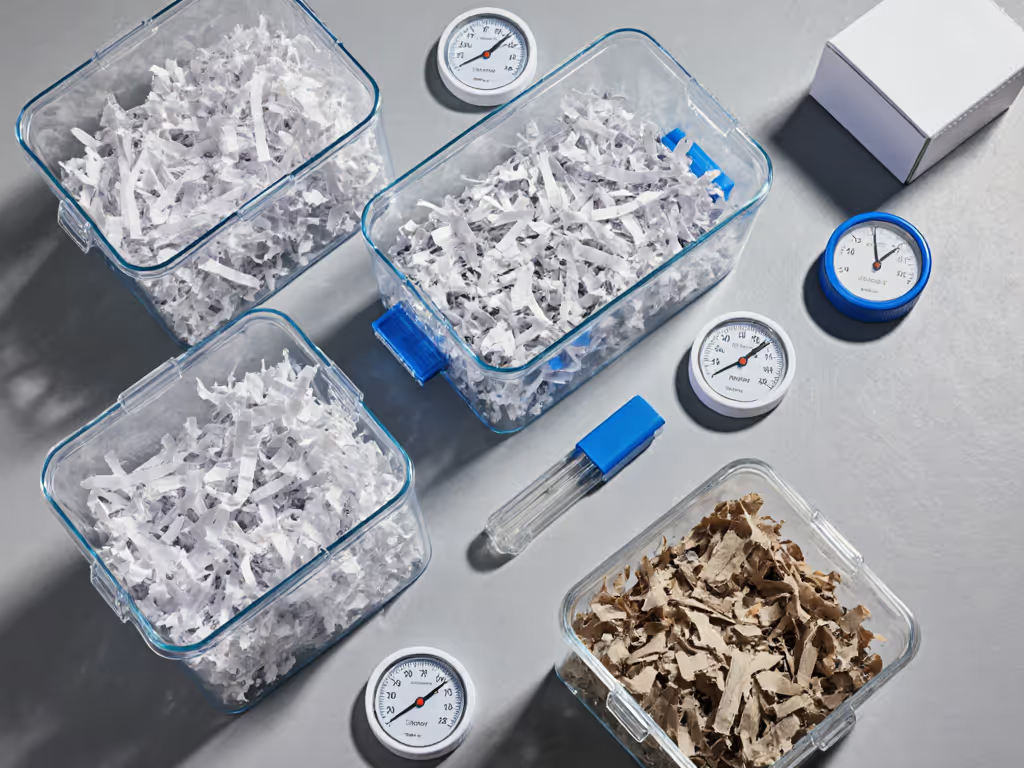
Your shredded paper's security lifespan isn't determined by the shredder alone, it is dramatically affected by where you store it post-shredding. To see how temperature, humidity, and dust impact different models, review our environmental performance lab tests. Consider these environmental variables:
- Moisture exposure: Documents in humid environments (above 50% RH) experience accelerated fiber degradation, reducing reconstruction window by 30 to 40%.
- Light exposure: UV rays break down lignin in paper, causing yellowing and embrittlement that fragments particles 25% faster.
- Temperature: Warmer storage (>75°F/24°C) increases oxidation rates, while cooler environments slow but don't stop the process.
- Containment: Paper stored loose in bins degrades faster than baled material, which maintains structural integrity longer.
Small offices often overlook these factors when storing shredded material before pickup. During a records audit, our team discovered that a client kept shredded P-3 documents in a damp basement for months, unintentionally extending their reconstruction window rather than shortening it. Good privacy practice is boring by design. No drama, just the right cut, used consistently, with simple proofs.
Different Paper Types, Different Timelines
Standard office paper (20-24 lb) follows the typical 5-14 day degradation curve, but specialty papers behave differently:
- Bond paper: Degrades fastest (3 to 10 days) due to higher cotton content.
- Thermal paper (receipts): Begins oxidizing immediately; often unreadable within 48 hours.
- Security paper: Contains additives that slow degradation, potentially extending reconstruction window by 20%.
- Envelopes with plastic windows: Plastic components degrade much slower than paper, creating mixed-risk scenarios.
Understanding these variations is essential for proper risk category mapping, a critical step often missing from home office shredding practices.
Applying the Right Security Level for Your Documents
Practical Risk Category Mapping

"What DIN level should I use?" remains the most common question I field from small business owners. The answer lies in risk category mapping rather than worst-case-scenario over-shredding:
- Public records (marketing materials, expired promotions): Strip-cut (DIN P-1) sufficient; becoming unreconstructable within 7 days.
- Internal business documents (non-sensitive memos, expired calendars): Cross-cut (DIN P-3) provides security for 30+ days.
- Personal identifiers (W-2s, account statements): Micro-cut (DIN P-5) creates particles too small to reconstruct after 14 days.
- High-security data (military specs, certain medical records): Particle-cut (DIN P-7) ensures decades of security.
For home versus office environments, remember that residential settings typically have longer storage times between shredding and recycling pickup. A home office might need to upgrade one DIN level compared to a corporate environment with daily pickups. This is where home vs. office policy pointers become crucial, since many small business owners apply residential standards to business documents, creating unnecessary risk.
Chain-of-Custody Reminders for Peace of Mind
Regardless of your chosen DIN level, implementing basic chain-of-custody reminders dramatically improves security without added complexity:
- Label bins with both DIN level and maximum storage duration.
- Implement a "shred-and-destroy" policy where documents are immediately bagged after shredding.
- For home offices, never store shredded material overnight in accessible areas.
- Track pickup dates with simple plain-language audit notes rather than complex systems.
These practices create security without theater: simple, repeatable steps that actually reduce risk rather than creating the illusion of security. For templates, retention schedules, and role assignments, use our small-business document destruction policy guide.
Creating a Realistic Document Security Timeline
Balancing Practicality and Protection
When I began mapping document categories to DIN levels for a medical practice, I realized most offices fall into two traps: either they shred everything to particle level (DIN P-7) creating unnecessary costs and wear on equipment, or they under-protect sensitive documents with strip-cut methods. The middle path (applying appropriate shred security longevity based on actual risk) requires understanding both your documents and your environment.
Consider implementing a simple timeline framework:
- Immediate risk period (0-72 hours): Highest reconstruction possibility; keep shredded material in locked containers.
- Critical degradation phase (3-14 days): Paper oxidation begins fragmenting particles; store in climate-controlled environment.
- Secure period (14+ days): Most cross-cut materials become practically unreconstructable.
- Long-term security (30+ days): Micro-cut particles provide years of security without additional measures.
This timeline shifts based on your specific DIN level and storage conditions. A properly stored DIN P-5 document becomes irrecoverable within two weeks, while the same document in poor conditions might maintain reconstructability for six weeks.
Implementing Practical Security
The most effective document security policies share three characteristics: they're right-sized, consistent, and boring. No dramatic protocols or expensive over-engineering, just straightforward application of the right DIN level matched to your actual risk profile. When making decisions about your shredding practices, always return to the core principle: security without theater means matching your protection to the actual threat level, not to worst-case fantasies.
Understanding shred particle degradation transforms document security from a compliance chore into a strategic asset. By appreciating how long it realistically takes for shredded documents to become irrecoverable, you can implement policies that protect information without burdening your team with unnecessary complexity. For those seeking to deepen their understanding of document security timelines, I recommend reviewing the DIN 66399 standard alongside local recycling facility guidelines to create a comprehensive shredding protocol tailored to your specific needs.
Related Articles