
Pharma Shredders: GxP Compliance Essentials
By David Okoro • 23rd Feb
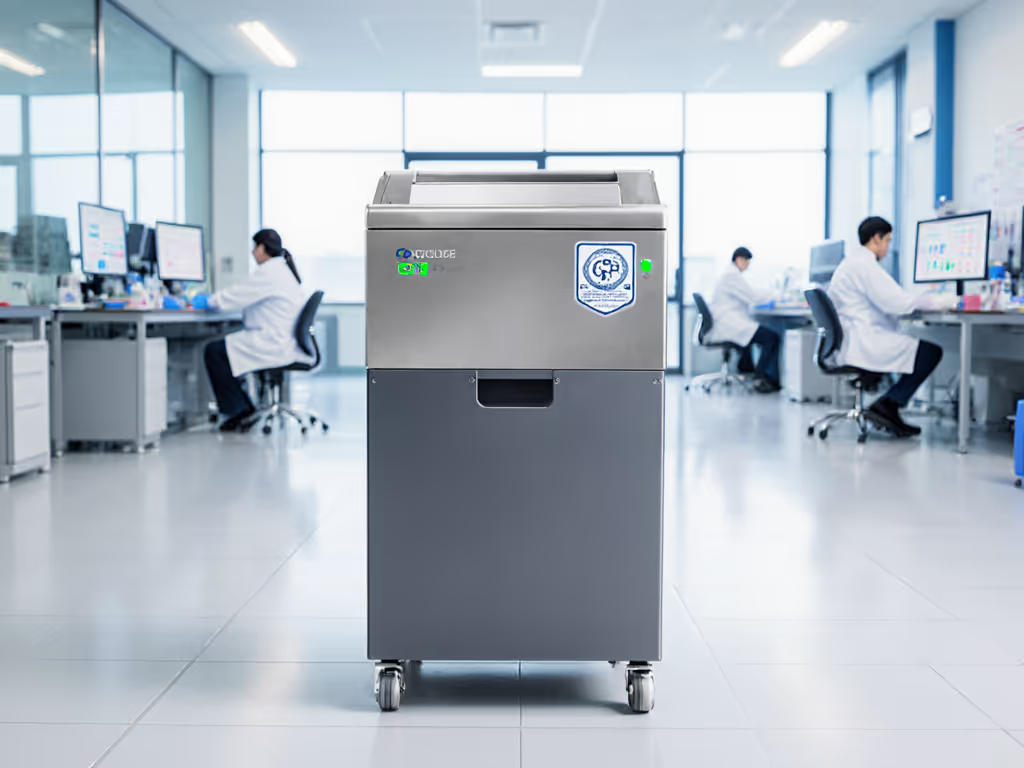
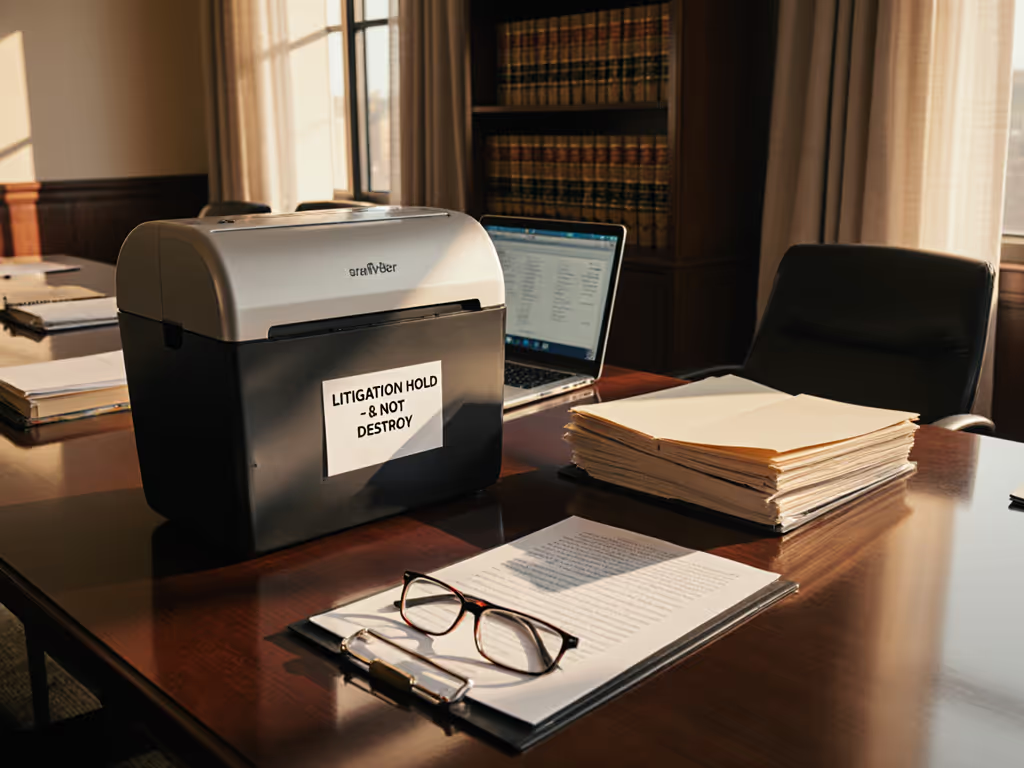
When regulated document destruction matters, it's not just about speed, it's about proving you did it right. Pharmaceutical research shredders and GxP compliance shredding aren't luxury upgrades; they're infrastructure that protects both data integrity and your organization's regulatory standing. The difference between casual office shredding and GxP-aligned destruction can mean the gap between a clean audit and a warning letter.
Understanding what makes a shredder suitable for regulated environments (and how to sustain that reliability) turns a routine task into a compliance safeguard. This guide walks you through the essentials, so you can move from confusion to confidence.
Why GxP Compliance Starts with Document Destruction
GxP is a collection of quality regulations and guidelines: Good Manufacturing Practice (GMP), Good Laboratory Practice (GLP), Good Clinical Practice (GCP), and Good Documentation Practice (GDP), designed to ensure that pharmaceutical, medical device, and clinical trial products are safe and maintain data integrity[2][3]. Secure clinical trial document security and proper FDA-regulated shredding are not add-ons; they're embedded requirements[1].
In regulated research, every document that touches product development, manufacturing, or distribution carries compliance weight. Batch manufacturing records, laboratory notebooks, and clinical trial case report forms all fall under GxP oversight[3]. When those documents reach end-of-life, their disposal must be auditable, traceable, and verifiable, just like their creation was. For a broader overview of industry regulations, see our document destruction compliance guide.
Failure to adhere to proper destruction practices exposes your organization to data breaches, compliance findings, and reputational loss[1]. More concretely, inadequate documentation (including proof of secure destruction) is among the top reasons for FDA Form 483 observations and failed inspections[7].
The GxP Shredding Mandate: What Regulators Expect
Regulatory bodies worldwide, including the FDA, EMA (European Medicines Agency), WHO, and MHRA (UK), set specific expectations for pharma lab destruction requirements[1]. The framework that governs this is rooted in ALCOA++ principles: Attributable, Legible, Contemporaneous, Original, Accurate, Traceable, Complete, Consistent, Enduring, and Available[1].
Applied to document shredding, ALCOA++ means:
- Attributable: You can identify who authorized the destruction, when, and why.
- Legible: Destruction logs are clear and unambiguous.
- Contemporaneous: Destruction happens on schedule, not retroactively.
- Original: Records of destruction are primary evidence, not copies.
- Accurate: The shredding method and security level match the document sensitivity.
- Traceable: You can reconstruct the chain of custody from document creation through destruction.
- Complete, Consistent, Enduring, and Available: Destruction records are comprehensive, uniform across batches, retained per regulation, and accessible for audit.
This is why casual office shredders don't suffice. A GxP compliance shredding program demands a shredder that supports traceability (reliable cut levels, verifiable run logs, and predictable performance) paired with documented destruction procedures[3][5].
The Security Level Question: Cut Classification and Your Document Risk
One of the most common sources of confusion is matching pharmaceutical research shredders to the right security level. Shredders are classified by DIN 66399 or NIST standards into categories (P-1 through P-7, or NSA equivalent), each reflecting strip width, cross-cut dimensions, and particle size[1].
For most pharmaceutical research and clinical trial settings:
- P-4 (or equivalent) covers personal identifiers, financial data, and non-clinical lab notes. This is the minimum for clinical trial document security in environments handling participant data or internal business records.
- P-5 is appropriate for confidential research drafts, batch records not yet finalized, and sensitive supplier agreements.
- P-6 to P-7 enters high-security territory, reserved for completed clinical trial master files, regulatory submissions, or materials with national security implications.
The trap is over-specifying. Buying a P-7 shredder when P-4 suffices wastes money, adds unnecessary noise and maintenance overhead, and creates jam-risk grading that penalizes your team. Conversely, under-specifying risks audit findings. The right approach: map your document sensitivity to regulation and internal policy, then choose a shredder that meets that level reliably.
The Auto-Feed Reliability Imperative
Jams kill workflow and breed shortcuts. I've seen shared equipment on busy floors jam three times before lunch, until we color-taped the feed guides, taught people to feed steadily instead of stuffing, and set a clear oiling schedule. Jams dropped by 80%, cleanup was faster, and nobody dreaded bin day. Reliability comes from good design plus habits people will actually do.
For pharma lab destruction requirements, an auto-feed mechanism (or at minimum, a forgiving manual feed) is non-negotiable. For recommended models, see our hands-free auto-feed shredders tested for bulk document security. Key traits to verify:
- Auto-reverse on jam detection: The shredder senses blockage and reverses to clear paper without user intervention.
- Adaptive feed rate: Sensor-driven systems that slow or pause when the cutting chamber is full, preventing overload and jam cycles.
- Thermal protection with grace: After 20-30 minutes of continuous run, the motor enters cool-down. But the best units offer 10-15 minute cool-down windows, not forced hour-long breaks.
- Maintenance intervals in minutes: Oil the cutting head every 100 sheets or monthly, whichever comes first. Clear guidance prevents edge-case jams from dry blades.
These aren't luxury specs. They're the difference between a tool that enables compliance and one that becomes a bottleneck.
Bin Hygiene and Dust Control in Regulated Spaces
Research data protection encompasses more than what gets shredded; it includes how shredded material is stored and disposed. Dust and confetti spillage creates mess, contaminates lab surfaces, and signals poor process control to auditors.
Essential bin-change ergonomics:
- Transparent or semi-transparent bins: You see fill level at a glance. Full bins get changed before overflow; no spillage during removal.
- Integrated pull-handle or tab: Bins slip out smoothly without tilting or tipping debris.
- Base alignment and catch tray: Prevents confetti escape during bin extraction.
- Dust catch filter or vented design: Cross-cut shredders generate more fine particles than strip-cut. A small HEPA or mesh filter in the bin mount catches dust that might otherwise waft into the room.
For regulated labs, even small mess callouts during internal audits can signal "controls not followed." A shredder paired with a tidy bin system and a simple bin-change checklist (date, time, operator initials) turns a potential finding into proof of discipline.
Maintenance Routines That Prevent Reliability Collapse
Oiling and alignment routines are unglamorous, but they separate shredders that run for years from ones that fail within months. Prevent the jam you never have to by adopting a maintenance schedule your team will actually follow. Use our usage-based maintenance schedules to set practical oiling and cleaning intervals.
Minimal sustainable routine:
- Weekly (if high-use): Visual inspection of feed opening and bin for paper fragments caught in hinges.
- Monthly: Oil cutting blades per manual, typically 3-5 drops of the recommended oil applied to the blade guard area. Run 5-10 sheets of oiling paper to distribute.
- Quarterly: Check bin seal and motor housing for dust accumulation. Brush gently with a soft brush.
- Annually: Replace the dust catch filter if equipped; inspect power cord for damage.
Documentation is critical. A simple maintenance log (date, task, initials) creates the audit trail that regulators expect. It proves that the shredder's reliability was not assumed, but actively managed.
Navigating FDA-Regulated Shredding in Multi-User Environments
Clinical research sites, quality control labs, and regulatory affairs teams often operate shared shredders in multi-user spaces. FDA-regulated shredding in these settings requires procedural clarity to prevent jams, cross-contamination of document batches, and incomplete destruction records.
Best practices:
- Dedicate the shredder: Don't mix research documents with routine office mail in the same bin on the same day. Separate batches by sensitivity and complete one before starting another.
- Use batch tags: Attach a small label to the bin indicating what's being shredded (e.g., "GCP Trial 2026-01 Participant IDs"). Log the date, operator, and bin-full time. This creates a clear destruction record.
- Stagger, don't stack: Feed documents consistently, not in bursts. Burst feeding causes thermal spikes, early cool-down, and frustration.
- Clear access: Keep the shredder area free of clutter. A busy desk or crowded corner increases the risk of someone bypassing the shredder and leaving sensitive documents in recycling.
- Training turnover: When new staff arrive, show them the shredder, the maintenance log, and the bin batch tags. A 5-minute orientation prevents months of drift.
Selecting the Right Shredder: Capacity, Noise, and Footprint Trade-Offs
When evaluating pharmaceutical research shredders for your lab or office, three practical constraints matter most: how much, how loud, and where.
Capacity and throughput:
Estimate your monthly document volume. 50 pages per day in a solo practice suggests a compact shredder with a 10-15 sheet capacity and a 2-3 gallon bin. A team of five generating 200-300 pages daily needs a 20-30 sheet capacity and 4-5 gallon bin. A clinical trial site with regulatory submissions might need 40+ sheet capacity or continuous-duty equipment.
Noise profiles:
Ultra-quiet shredders (below 65 dB) work in open offices and quiet labs. Most consumer and office-grade shredders run 70-75 dB, acceptable during normal business hours but noisy during nights or shared spaces. Continuous-duty industrial units can exceed 80 dB and require dedicated enclosures.
Footprint and placement:
Under-desk shredders are under 12 inches wide and 12 inches deep, but often sacrifice capacity and auto-feed sophistication. Desktop units (14-18 inches wide) offer better balance. Freestanding units (18-24 inches) maximize capacity but require dedicated floor space.
Reliability comes from good design plus habits people will actually do. Choose a shredder that fits your space and use pattern, not an imagined ideal. A smaller, reliable auto-feed shredder used consistently outperforms an overpowered unit gathering dust because it's too loud or unwieldy.
Compliance Documentation and Audit Readiness
A shredder alone doesn't guarantee GxP compliance shredding. The documentation ecosystem does. Auditors don't check the shredder; they check the log[3]. For automated audit trails and reporting, integrate your shredder with a DMS using our DMS integration guide.
Essential compliance artifacts:
- Destruction procedure: A written policy specifying which document types are shredded, at what security level, by whom, and when.
- Shredder validation record: Confirmation that the shredder meets the specified security standard (P-4, P-5, etc.), ideally from the manufacturer or a third-party test.
- Maintenance log: Monthly entries showing oiling, inspection, and any repairs, proof that the shredder was kept in a controlled state.
- Destruction batch records: Logs linking each batch of documents destroyed to a date, operator, security level, and bin number. If documents were cross-cut to P-4, the log says so.
- Retention policy: How long batch records are kept (typically 3-10 years, depending on the document type and regulation).
These don't need to be elaborate. A spreadsheet or simple logbook suffices, as long as entries are contemporaneous, legible, and complete. Regulators value discipline, not theater.
Actionable Next Steps: From Selection to Sustained Compliance
Moving from confusion to action:
1. Audit your current state. Gather your team and map document sensitivity: what's personal health information (PHI)? What's confidential clinical data? What's routine business mail? This clarifies your security-level requirement.
2. Define your procedure. Write a one-page destruction SOP. Include the security level, frequency, roles, maintenance schedule, and where records are logged. Circulate it; get buy-in.
3. Select a shredder that matches your volume estimate, noise tolerance, and space. Prioritize auto-feed, thermal protection, and manufacturer support over maximum sheet capacity or novelty features.
4. Create and commit to a maintenance calendar. Monthly oiling, quarterly filter checks. One person owns it; it takes 10 minutes. A lapsed maintenance schedule is a compliance liability.
5. Start a destruction log. Date, operator, document type (or batch label), security level, bin number. Print it or keep it in a shared spreadsheet. Consistency is key.
6. Train anyone with access. A brief orientation, what goes in, how to feed, when to call for help, prevents workarounds and jams.
7. Retain records per your document retention policy. If clinical documents are retained for 7 years, so are their destruction logs.
GxP compliance shredding is not a one-time purchase. It's a system: the right equipment, clear procedures, consistent maintenance, and meticulous records. When that system works, it recedes into the background, documents flow to the shredder, bins get swapped smoothly, and logs remain clean. That calm, routine reliability is exactly what regulators want to see. Choose a pharmaceutical research shredder that supports your habits, not one that demands heroics. Then document the discipline, and you'll move from anxiety to confidence.
Start today: List your three most sensitive document types, check your current shredder against your need, and schedule a maintenance conversation with your team. A documented destruction routine is better than the fanciest equipment running unseen.
Related Articles