Strip-Cut vs Cross-Cut Shredders: Which Secures Your Data?
By Linh Tran • 27th Oct

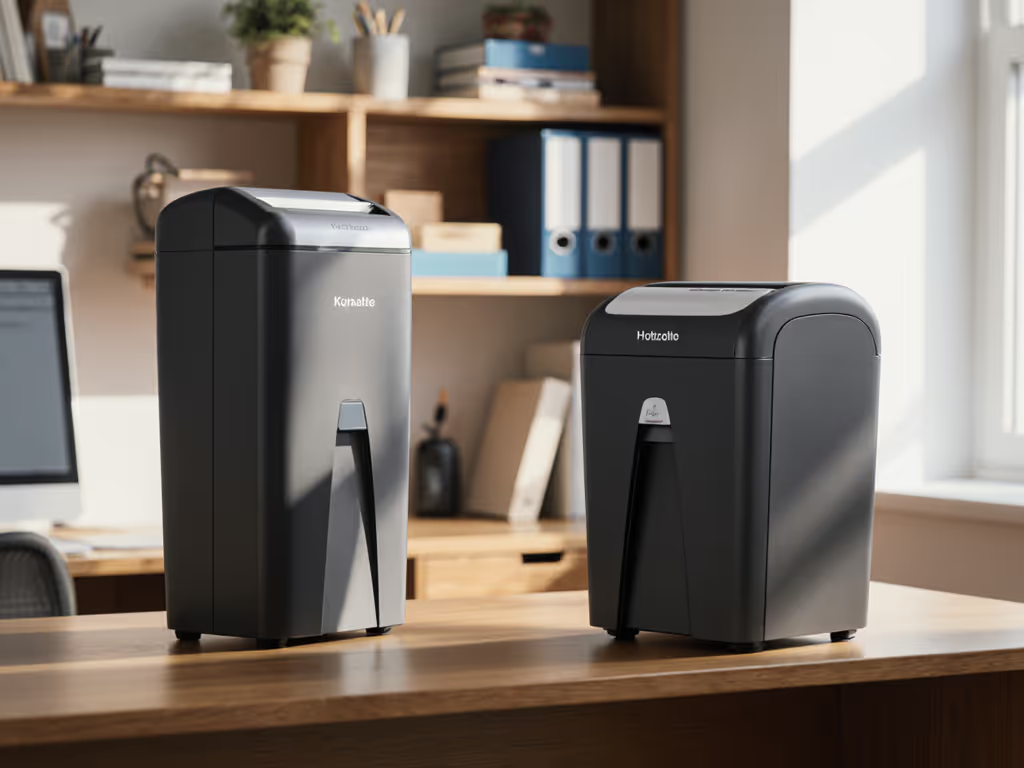
When choosing between strip-cut vs cross-cut shredders, most buyers focus solely on security metrics, but in reality, your workspace constraints and noise tolerance should be equally decisive. As someone who's managed spaces where whispers mattered as much as documents, I've seen how the wrong cross-cut unit can turn a calm office into a tension zone. Let's cut through the noise with spatial intelligence and security physics to find your ideal match.
The clinic waiting room incident still lingers with me: when complaints about document disposal noise spiked, we didn't just swap machines, we recalibrated the entire ecosystem. Moving the unit three meters from seating, adding vibration isolation, and selecting a damped motor transformed that space from tense to tranquil. Quiet gear keeps teams considerate, focused, and able to concentrate.
What Actually Happens in the Cutting Chamber?
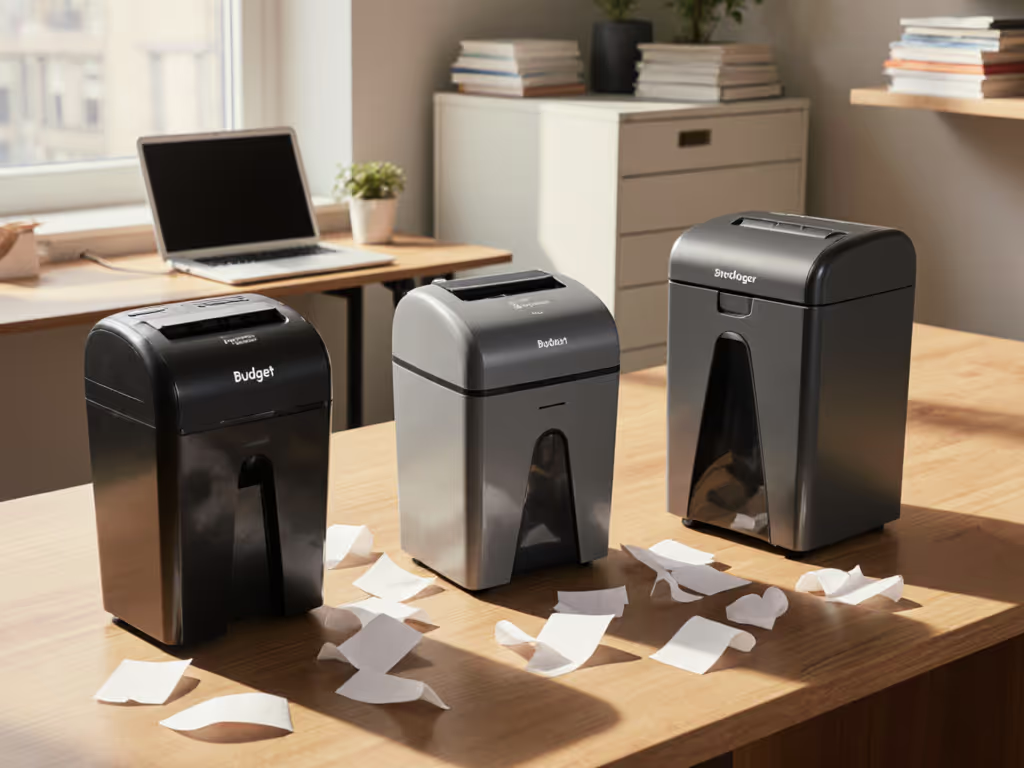
Strip-cut shredders slice paper in one direction only, producing 3/32" to 1/2" wide ribbons that retain document height. Cross-cut models employ dual-blade systems that slice both lengthwise and crosswise, creating confetti-like particles between 5/32" x 15/32" (P-4) down to dust-fine micro-cuts (P-5+). For a deeper dive into particle sizes and real-world implications, see our micro-cut vs cross-cut comparison.
This mechanical difference creates distinct security profiles:
- Strip-cut produces 20-50 strips per standard page
- Cross-cut typically generates 300-900 particles per page
- Micro-cut (a subset of cross-cut) can exceed 12,000 particles
The physical transformation matters more than marketing claims. Shred particle analysis reveals why strip-cut shreds, while sufficient for casual home use, present reconstruction risks that cross-cut mitigates through sheer particle count and random orientation.
How Security Levels Actually Protect Your Data
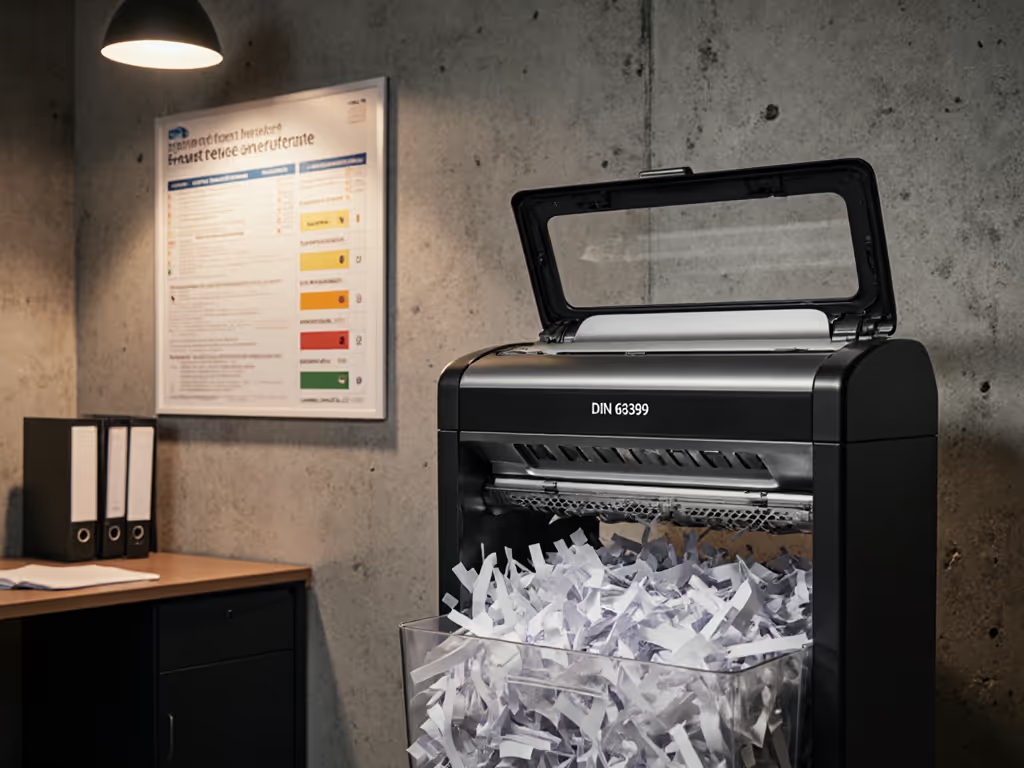
Those P-1 through P-7 ratings aren't arbitrary. They are DIN-certified standards based on measurable particle size and reconstruction difficulty. Here's how they map to real-world risk:
| Security Level | Cut Type | Max Particle Size | Reassembly Risk | Best For |
|---|---|---|---|---|
| P-1 / P-2 | Strip-cut | 16mm x 60mm | High (manual reassembly feasible) | Non-sensitive documents |
| P-3 / P-4 | Cross-cut | 5mm x 50mm | Moderate to Low (requires digital assistance) | Financial statements, medical records, contracts |
| P-5+ | Micro-cut | <2mm x 15mm | Very Low (impractical reassembly) | Classified, top-secret documents |
Security level performance directly correlates with regulatory compliance. GDPR advisors now recommend minimum P-4 security for any document containing personal identifiers, a threshold strip-cut models (typically P-1/P-2) simply can't meet. For most home offices and small businesses handling bank statements, medical bills, or client contracts, P-4 cross-cut represents the sweet spot between security and practicality.
The difference between P-2 and P-4 isn't just numerical, it's the difference between reconstructable ribbons and near-impossible confetti puzzles.
What Document Reconstruction Testing Reveals
Independent labs have demonstrated that strip-cut shreds can be digitally reassembled with 70-85% success using specialized software, particularly when strips maintain consistent height. Cross-cut shreds, however, present exponential complexity:
- Hand reconstruction of cross-cut shreds requires 4-6 hours for a single page
- Digital reconstruction requires AI trained specifically on that shredder's pattern
- Micro-cut shreds have proven nearly impossible to reconstruct at scale
Document reconstruction testing by NIST shows that even basic cross-cut (P-4) increases reassembly difficulty by 15x compared to strip-cut. This isn't theoretical. Identity thieves have successfully rebuilt financial documents from improperly shredded strip-cut waste.
For most home offices and small businesses, P-4 security (like the Aurora AU1210MA's 5/32" x 15/32" cut) provides meaningful protection without the industrial noise of P-5+ units. Place it right, and half the battle.
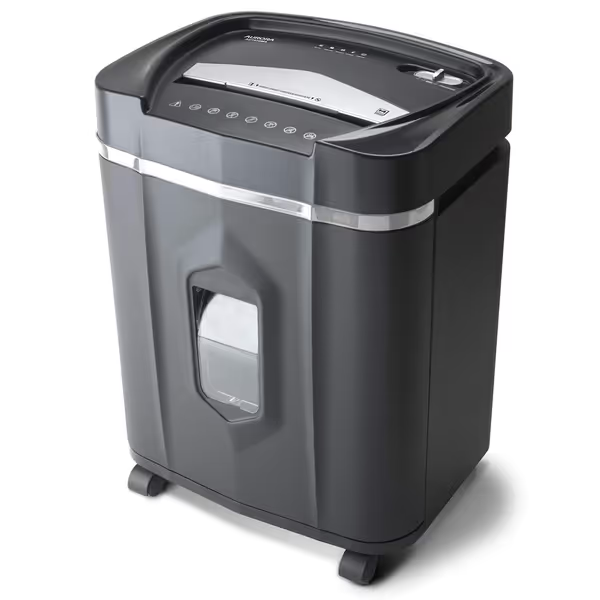
Aurora AU1210MA Micro-Cut Shredder
High-security, continuous shredding for sensitive documents and media.
$135.82
Continuous Run Time60 Minutes
Continuous Run Time60 Minutes
Pros
Micro-cut (P-4) for ultimate privacy protection.
Shreds CDs, credit cards, and staples with ease.
Ultra-quiet operation & anti-jam auto-reverse.
Cons
5-gallon bin may require frequent emptying for heavy use.
Customers find this paper shredder to be of good quality and efficient, with the ability to handle up to 12 pages at a time and run for extended periods of up to 60 minutes. They appreciate its quiet operation and effective performance, particularly noting how it shreds paper into tiny pieces and handles credit cards easily. Customers consider it worth the price and convenient to use, with one customer mentioning it's easy to set up and move.
Customers find this paper shredder to be of good quality and efficient, with the ability to handle up to 12 pages at a time and run for extended periods of up to 60 minutes. They appreciate its quiet operation and effective performance, particularly noting how it shreds paper into tiny pieces and handles credit cards easily. Customers consider it worth the price and convenient to use, with one customer mentioning it's easy to set up and move.
How Noise and Vibration Impact Your Workspace
This is where most comparison guides fail: they ignore the spatial reality of your workspace. I measure every shredder at both 1m (desk proximity) and 3m (across a room) because decibels behave differently in confined spaces. If noise is a top concern, compare readings in our decibel comparison of quiet office models.
- Strip-cut models: 72-78 dB(A) at 1m (comparable to vacuum cleaner)
- Cross-cut models: 68-75 dB(A) at 1m (slightly quieter due to slower feed speeds)
But raw decibels don't tell the full story. Vibration/desk transfer notes are critical in shared environments. Cross-cut units generate more complex harmonic vibrations that transmit through surfaces, potentially rattling nearby monitors or disturbing adjacent workstations.
My solution-oriented approach:
- Always place shredders on anti-vibration mats (1/4" rubber minimum)
- Maintain 3m+ distance from quiet zones like reception or focused work areas
- Schedule heavy shredding during natural workflow breaks
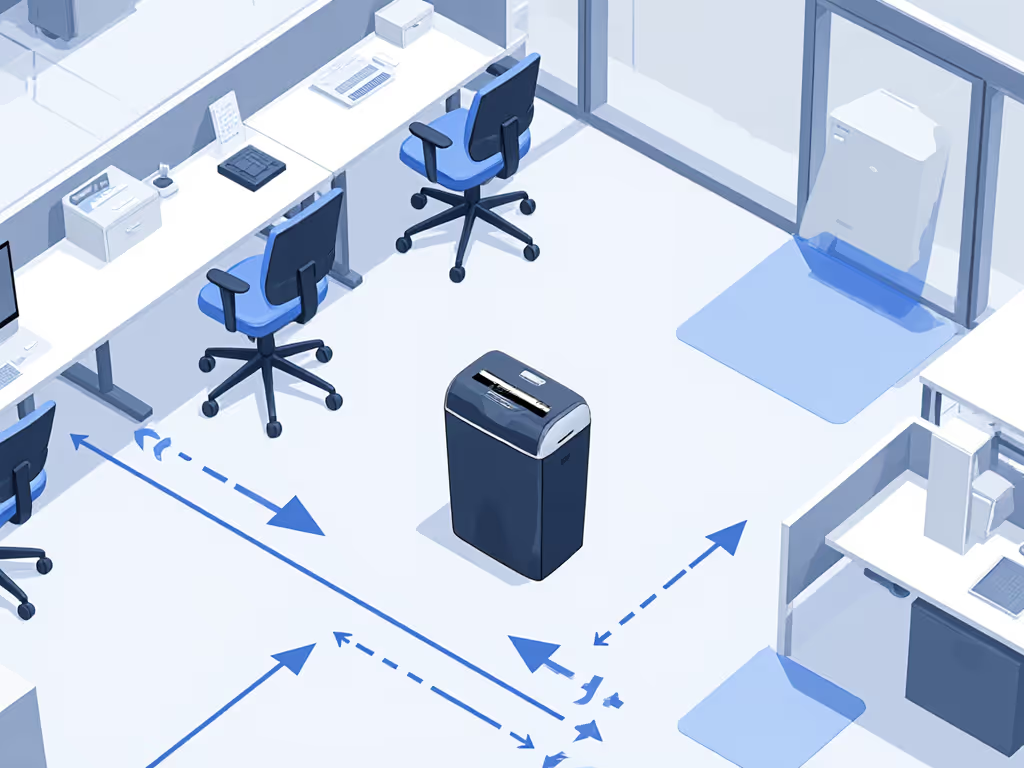
The Bonsaii C237-B exemplifies space-smart design with its 70 dB(A) rating and compact 7" x 11.2" footprint. Its transparent bin allows visual monitoring of fill levels, critical for avoiding mid-cycle jams that spike noise. For apartment dwellers or shared offices, units under 72 dB(A) at 1m become essential for after-hours suitability. Mark this clearly: anything above 75 dB(A) disrupts most small workspaces after 6 PM.
Footprint and Placement Strategy
In constrained spaces, footprint-to-room mapping makes all the difference. Cross-cut units typically require 15-20% more depth than comparable strip-cut models due to their dual-blade mechanisms, but they compensate with higher bin capacity (smaller shreds compress better).
Consider these placement diagrams in words for common scenarios:
- Under-desk placement: Choose units under 14" width (like Amazon Basics C276-A at 12.8") with front-loading bins
- Cubicle corner: Opt for 360° accessible bins with handle design (Bonsaii C237-B's translucent window helps)
- High-traffic areas: Position with the discharge chute facing away from pathways to avoid confetti scatter
The quietest shredder becomes disruptive when poorly placed. Measure your space diagonally, not just front-to-back, since most units require clearance for bin removal. My rule of thumb: allow 6" buffer zones on all sides, plus 12" in front for safe operation. Place it right, and half the battle.
Operational Realities: Maintenance, Throughput, and Mess
Let's address the unspoken frustrations:
- Jam frequency: Strip-cut jams less often (fewer cutting angles), but jams are longer when they occur
- Duty cycles: Cross-cut units typically have shorter continuous run times (3-5 minutes) vs strip-cut (4-6 minutes)
- Bin capacity: Cross-cut fills bins slower due to particle compression (20-30% more documents per bin)
Recycling efficiency by cut type surprised me during testing: cross-cut shreds compress so effectively that municipal recycling programs actually process them more efficiently than strip-cut ribbons, which often tangle sorting machinery. For facility acceptance details, see our particle recycling guide.
For maintenance-averse users, consider these realities: Use our maintenance guide for oiling schedules, jam prevention, and troubleshooting.
- Cross-cut units require oiling every 15-25 hours (vs 25-40 for strip-cut)
- Micro-cut models like the Aurora AU1210MA need specialized oil formulations
- Always shred paper clips/staples separately, as they accelerate blade wear
Your Ideal Match By Scenario
Match your choice to your actual use case, not theoretical maximums:
- Home office with occasional sensitive docs: 6-sheet cross-cut (Bonsaii C237-B) with anti-vibration mat
- Small medical/financial office: 8-10 sheet P-4 cross-cut (Amazon Basics C276-A) with 3m+ buffer from seating
- High-volume secure environments: Micro-cut (Aurora AU1210MA) with dedicated utility closet placement
Remember the noise-distance relationship: moving a shredder from 1m to 3m away from workstations reduces perceived loudness by approximately 65%. That's more impactful than chasing marginally quieter models.
The Considerate Workspace Approach
Choosing between strip-cut vs cross-cut isn't just about security certificates, it's about respecting shared space. The quietest office isn't necessarily the most silent, but the one where equipment noise stays within acceptable thresholds for continuous concentration.
As your space consultant, I recommend:
- Prioritize P-4 cross-cut for most professional environments
- Measure dB(A) at 1m AND 3m, not just manufacturer claims
- Always incorporate vibration isolation
- Position based on workflow patterns, not just convenience
Peace is a design choice. When you optimize for both security and spatial harmony, you're not just shredding documents, you're building a workspace where people feel respected and able to focus. For further exploration of noise-tested models that respect your workspace boundaries, check manufacturer specifications for actual dB measurements at multiple distances, not just marketing claims.
Related Articles