Shredder Security Verification: Audit Trail Comparison
By Aisha Khan • 24th Apr
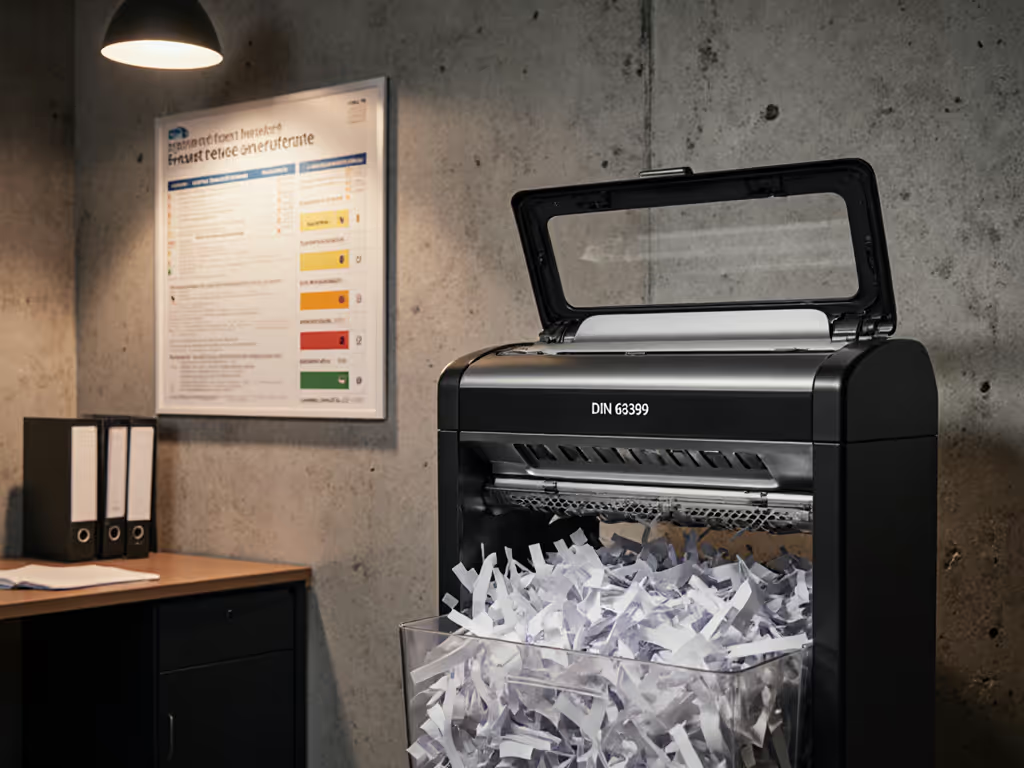
When you buy a shredder, you're buying a promise: that your documents will be destroyed beyond reconstruction. But which promise (and for which documents)? This article cuts through the marketing noise to compare what different security levels actually deliver, helping you verify that you're choosing the right protection without overspending or underbuying.
Understanding the DIN 66399 Standard
The shredder security verification framework you need to understand is the DIN 66399 standard, created by the German Institute for Standardization in 2012. It defines seven security levels (P-1 through P-7), each tied to particle size, reconstruction difficulty, and appropriate document types.
This isn't marketing speak. It's a measurable scale. Higher security levels mean smaller particles, lower reconstruction probability, and stricter compliance fit. Understanding this framework is how you verify that a shredder matches your actual needs.
The Seven Levels at a Glance
P-1 and P-2: Strip Cut (Basic Protection)
P-1 uses strip-cut shredding and is the lowest security tier. Documents are cut into strips approximately 1/4 inch wide. P-2 is similar, with slightly narrower strips. These are suited for non-sensitive junk mail, packaging, and general office waste. They're quick and inexpensive, but they should never touch personal information. Reconstruction is straightforward: a determined person with patience can tape pieces back together.
Strip cutters prioritize speed over security. Don't use them for anything containing identifying data.
P-3: The Awkward Middle
P-3 uses cross-cut shredding (cutting paper both horizontally and vertically) to create pieces approximately 5/32 x 1-1/16 inches. It sits between strip cut and micro cut, offering moderate security for sensitive business documents and financial data. However, shredder manufacturers and security experts often recommend skipping P-3 and moving directly to P-4 if you need confidentiality. P-3 carries the jam and maintenance headache of cross-cut machines without full security assurance. If you're deciding between cut mechanisms, our micro-cut vs cross-cut guide shows the real security and capacity trade-offs with particle photos.
P-4: The Industry Workhorse
P-4 uses cross-cut shredding with even smaller particles (approximately 5/32 x 9/16 inches), producing at least 1000 particles per A4 sheet. This is the level that satisfies HIPAA and FACTA compliance minimums. Reconstruction is extremely difficult. For most small offices, law firms, healthcare practices, and finance professionals handling client or patient data, P-4 is the right landing spot. It balances security, throughput, and practical workflow. Most businesses choose P-4, and there's good reason: it's where security stops being theoretical and starts being real.
P-5 and P-6: Micro Cut (Superior Security)
P-5 particles measure roughly 2x15mm at maximum, producing at least 2000 particles per A4 sheet. It's ideal for highly confidential data: balance sheets, strategic documents, patents. P-6 particles are even smaller, producing at least 6000 particles per sheet. Both levels trade some throughput speed for particle size; most small offices don't need them unless they're handling trade secrets or sensitive research. If you're debating P-5 versus P-4, start by asking whether your documents truly require "fundamental importance" confidentiality or if P-4's reconstruction barrier suffices.
P-7: High Security (Military/Classified)
P-7 particles are tiny (1x5mm maximum) and satisfy NSA requirements for top-secret information. It is essentially impossible to reconstruct data shredded to the P-7 level. Unless you're a government contractor or defense firm, you will never need P-7. Most private sector operations consider it overkill.
The Comparison: Security Versus Real-World Trade-Offs
Here's where skepticism matters. Higher security levels mean better reconstruction prevention, but they also introduce trade-offs that marketing materials gloss over.
Throughput and Speed
Smaller particles require blade systems designed to handle finer tolerances and make more cuts per sheet. A P-1 strip-cut machine handles fewer blade interactions per page, allowing faster feed rates. A P-4 cross-cut makes hundreds of cuts across and down each sheet. A P-5 or P-6 micro-cut multiplies that work further. The practical effect: security level correlates with mechanical work per page, which affects sustained throughput. The spec sheet won't volunteer this reality; you have to ask.
Thermal Load and Recovery Time
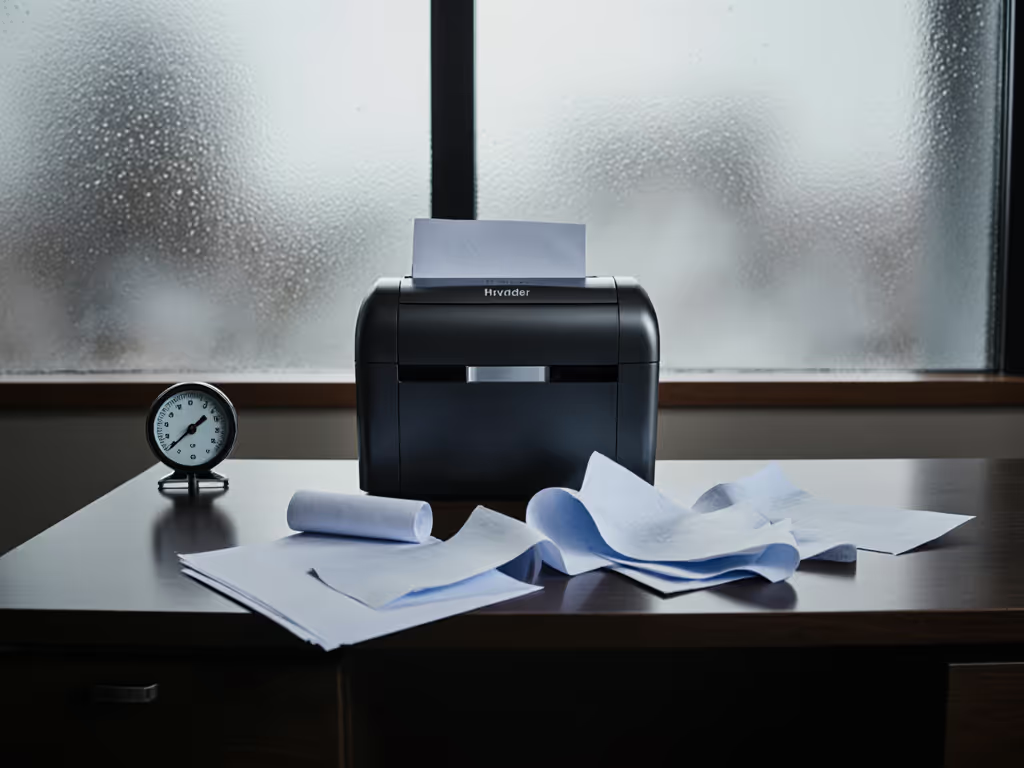
Finer cutting generates more friction and heat. During a quarterly purge (or any sustained batch), smaller-cut machines reach thermal limits faster. I've timed it: a 20-sheet capacity unit with micro-cut shredding can overheat and trigger a 10-to-15-minute cool-down after just five or six minutes of continuous feeding. Strip-cut machines rarely have this problem because the blades handle less work. If your workflow involves back-to-back batches or high-volume days, thermal recovery time becomes a hidden operational cost. For deeper guidance on run time, cool-downs, and thermal design, see shredder duty cycle explained.
Sustained throughput beats brochure bursts, every office hour, every time.
Jam Rates
Cross-cut and micro-cut machines have tighter blade tolerances and more complex feed paths. Staples, paper clips, and thick cardboard stock increase jam probability compared to strip-cut machines. P-1 machines almost never jam; P-4 machines jam occasionally; P-5/P-6 machines jam more frequently under real office mail (mixed grades, staples, windows, thick stock). If low frustration and uninterrupted workflow matter to you, security level affects reliability more than marketing will admit.
Footprint
Micro-cut machines are often larger to accommodate finer cutting heads and waste bins, since smaller particles compress less efficiently. If you're fitting a shredder under a small desk or in a corner office, the footprint constraint may rule out P-5 or P-6, even if security level alone would be appropriate.
Noise
Noise is a spec, not a vibe. Cross-cut and micro-cut machines generate more noise because finer cutting requires blade systems that work harder per sheet. A typical P-4 cross-cut runs at 72 to 78 dB(A) at 1 meter. A typical P-5 micro-cut runs at 78 to 84 dB(A). In a quiet office, shared workspace, or home environment, that 6 to 10 dB difference is perceptible and annoying. Decibels are logarithmic; a 10 dB increase is roughly double the perceived loudness. For model-by-model measurements, see our quiet office shredder decibel comparison. If you're working from home or in a shared space, higher security levels exact a noise penalty.
Comparing Compliance Fit Across Document Types
Here's the practical comparison framework that helps you verify you're choosing the right level:
| Document Type | Sensitivity | Recommended Level | Why |
|---|---|---|---|
| Junk mail, packaging, outdated flyers | Low | P-1 or P-2 | No personal data; speed and cost matter most |
| General office printouts, internal memos | Low to Moderate | P-2 or P-3 | Low reconstruction risk; privacy not sensitive |
| Bank statements, utility bills, tax forms | Moderate | P-4 | Satisfies consumer privacy norms; meets HIPAA-adjacent protection standards |
| Client/patient data, contracts, medical reports | High | P-4 or P-5 | Regulatory minimum (HIPAA, FACTA); reconstruction must be extremely difficult |
| Financial statements, trade secrets, legal strategy | Very High | P-5 or P-6 | Requires near-impossible reconstruction; competitive/legal exposure is severe |
| Government classified or military data | Extreme | P-7 | NSA-required standard |
The right security level matches your document sensitivity and compliance obligation, not the marketing budget of the shredder brand.
The Verification Question: Am I Overspending?
Most small offices and home users hover between P-3 and P-5 on the feature checklist, then panic and buy P-6 or P-7 "to be safe." This is overspending driven by anxiety, not risk.
If you are:
- A solo entrepreneur or consultant handling your own documents and a few client files: P-4 is almost certainly sufficient.
- A healthcare practice, law firm, or financial office handling regulated client data: P-4 is the regulatory minimum; P-5 adds assurance but check your state or client contracts first.
- A business with trade secrets or R&D documents: P-5 is justified; P-6 is precaution.
- A household managing personal finances: P-4 is overkill. P-3 or even P-2 covers identity theft risk. But if you want peace of mind and don't mind a slower machine, P-4 is reasonable.
The verification process is: (1) list what documents you shred, (2) identify the most sensitive category, (3) match it to the comparison table above, (4) choose that level, not the one above it, not two above it. Overspending signals anxiety masquerading as diligence.
Measuring Real Security: Beyond the Standard
The DIN 66399 standard tells you what security level a machine is certified for, but not how well a particular manufacturer's machine executes it. Two P-4 cross-cut machines from different brands don't guarantee equal reconstruction difficulty if one has looser blade tolerances, inconsistent feed paths, or bypass gaps.
Here's what to verify beyond the label:
- Cutting consistency: Do all shred pieces meet the size specification, or do some slip through undersized?
- No bypass: Can a sheet slip past the cutting head due to feed path design flaws?
- Blade sharpness over time: Does the machine maintain particle size after 1000 sheets, or do dull blades create larger, more reconstructable pieces?
- Thermal stability: Does the machine maintain consistent throughput during a 30-minute continuous session, or does thermal throttling slow output halfway through?
Manufacturers don't publish these metrics. You verify them by reading user reports, asking for a hands-on demo, or (in your own office) timing and measuring performance on your actual document mix for a few weeks. Real verification beats brochures. To automate proof of destruction, follow our DMS integration guide for audit trails.
Choosing the Right Level: An Actionable Framework
- Audit your document types: For two weeks, collect the documents you shred. Categorize each pile by sensitivity (low, moderate, high).
- Identify the ceiling: The most sensitive document type dictates the minimum security level you need.
- Cross-reference compliance: If you handle regulated data (healthcare, finance, legal), verify your state or client contract specifies a security level. If it does, match it. If not, use the comparison table above.
- Quantify throughput needs: How many sheets per month? If under 500, speed matters less. If over 2000, thermal recovery and jam rates become operational constraints.
- Assess your environment: Is noise a concern? Is footprint tight? Do you have a cool-down schedule tolerance? These constraints may push you down one level despite security logic.
- Test if possible: Before committing, request a hands-on demo or trial. Run your actual documents through the machine for 10 minutes. Does it jam? Does it heat? Does the noise surprise you?
- Buy once, right: Upgrading later is expensive and wasteful. Choose conservatively but not fearfully.
Conclusion: Sustained Security Beats Marketing Claims
Shredder security verification isn't about buying the highest number on the label. It's about matching the security level to your actual risk, understanding the real-world trade-offs (speed, noise, thermal load, jam rates), and auditing manufacturer execution against the standard.
Most users overshoot toward higher security levels out of anxiety, then suffer with slower machines, thermal frustration, and higher costs. Most undershoot toward lower levels to save money, then worry about data breaches.
The right shredder is the one that sustains your real workload without drama, and delivers the security assurance your documents actually need. Sustained throughput beats brochure bursts, every office hour, every time. Start by auditing what you shred. Match it to the standard. Test before you buy. Verify the machine holds its spec under continuous use. Then trust your choice and move on. Document destruction should be routine, not a source of regret.
Related Articles