Real Estate Closing Shredders: Quiet Speed, Right-Sized Security
By Mateo Silva • 15th Mar
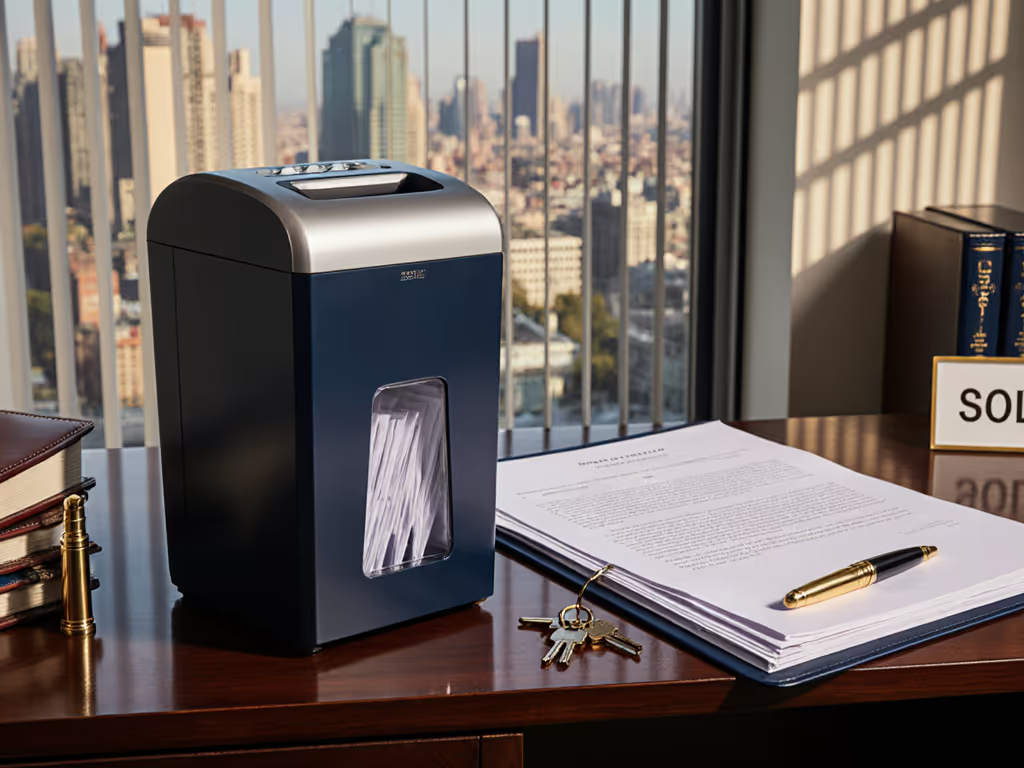
When transaction documents land on your closing specialist's desk, you're holding proof of sale, financial statements, tax records, client identification, loan data, and titles (some of the most sensitive collateral in any business). A real estate closing shredder must balance three things most offices pretend aren't in tension: security deep enough to protect client trust, quiet enough that it doesn't shatter the hush of a closing room or shared space, and sized right so you're not bankrolling features you'll never trigger.
The stakes are real. Mishandle document disposal in real estate, and you face FACTA fines, client liability, reputational wreckage, and the quiet erosion of trust. For a sector-specific breakdown, see our real estate office shredder guide. Overbuy a shredder (a hulking beast with cross-continental security specs and industrial noise levels), and you've leased 3 years of resentment and wasted floor space. I've watched closing firms burn through budget on micro-cut monsters when an honest cross-cut would have solved the problem cleanly and left everyone calmer. The math on that mistake stings.
Let's map what you actually need.
Understanding Security Levels: The Real Estate Reality
Shredder security in the U.S. is defined by DIN 66399 standards, which range from P-1 (lowest) to P-7 (NSA-grade destruction)[1][3]. For deeper technical context, see our DIN 66399 explainer. For most professionals confused by this taxonomy, here's what matters:
Strip-cut shredders (P-1 to P-2) reduce documents to thin ribbons. These are cheap and loud, and reconstruction is theoretically possible[1]. Avoid them for anything client-facing.
Cross-cut shredders (P-3 to P-4) slice paper both horizontally and vertically, producing confetti-like fragments[1][4]. A P-4 shredder creates particles ≤160 mm² with width ≤6mm, small enough that reconstructing a document is impractical[1]. This is the tier industry guidance consistently recommends for confidential business and legal work[5]. For most real estate closings, this is your floor.
Micro-cut shredders (P-5 to P-7) push into smaller territories. P-5 produces particles ≤30 mm² (width ≤2mm)[1], offering measurably higher security but at the cost of slower feed rates and higher energy draw[1]. P-7, the apex, meets NSA requirements for classified material and is overkill for real estate[1].
Here's the honest assessment: If you're a solo closer, a small firm, or a branch office handling standard transaction documents, P-4 is where your money stops making sense. If you're managing competitive market research, legal strategy files, or some broker's client acquisition playbook, P-5 earns its keep. If you're destroying classified government contracts, P-7 is mandated[1]. If you won't use it, don't fund it.
The Real Estate Closing Shredder Problem: Beyond Security Specs
Security level is one variable. But three other forces collide in closing rooms and small offices:
Noise and Disturbance
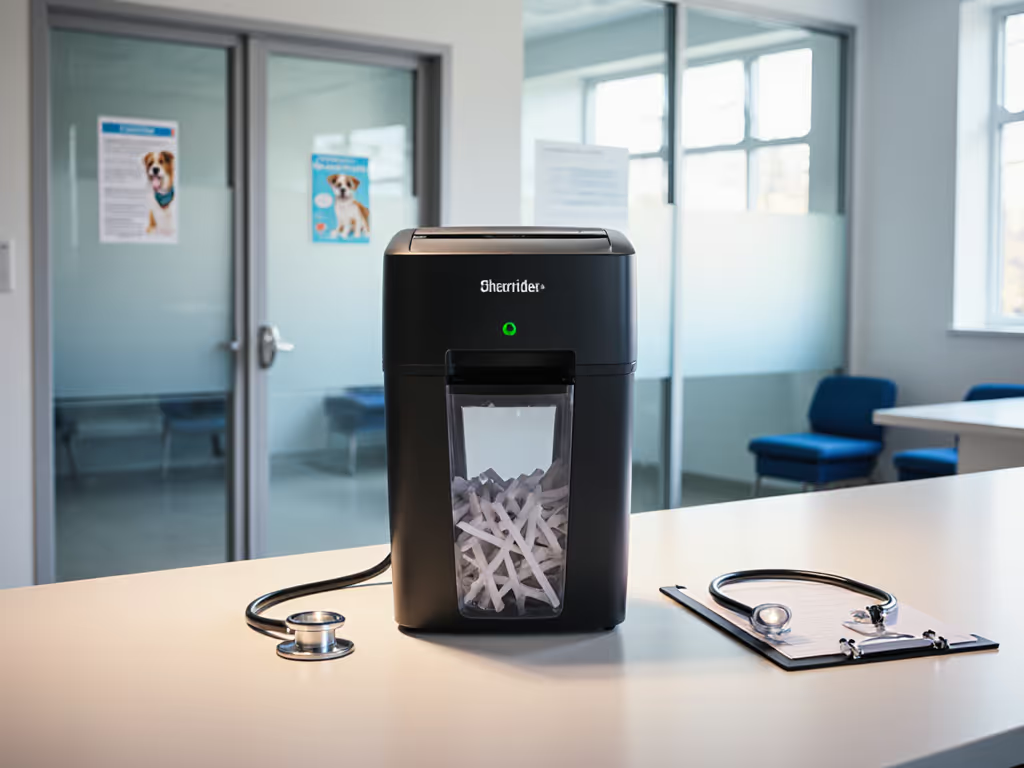
A closing happens in real time with clients present. A roaring shredder in the corner isn't just annoying, it signals disorder. Strip-cut and low-end cross-cut models often operate at 70-80 dB, comparable to a blender or vacuum[10]. Check our decibel comparison for quiet office models and measured noise ranges. Quieter cross-cut and micro-cut units stay closer to 65-72 dB. That gap is material. Your ideal unit sits at the lower range, running calm enough that background conversation remains possible.
Compact Footprint and Heat Management
Most closing firms aren't sprawling. You need a unit that fits under or beside a desk, doesn't demand a dedicated circuit, and doesn't force a 30-minute cool-down between document batches. Overheating is a signature problem with undersized, duty-cycle-mismatched shredders. Use our duty cycle guide to match run-time and thermal recovery to your actual workload. If you're feeding 500 sheets daily and your unit is rated for 100-sheet bursts, you'll hit thermal shutdown. Then you wait. Then clients wait. Then your practice's tempo suffers.
Capacity vs. Sheet Volume
Closing documents include thick envelopes, stapled packets, and mixed media. Your shredder must reliably handle 10-20 sheets per pass without jamming, with a bin that doesn't overflow after a single batch[7]. A too-small capacity tank becomes a frequent frustration and a hidden labor cost.
Agitation: The Cost of the Wrong Choice
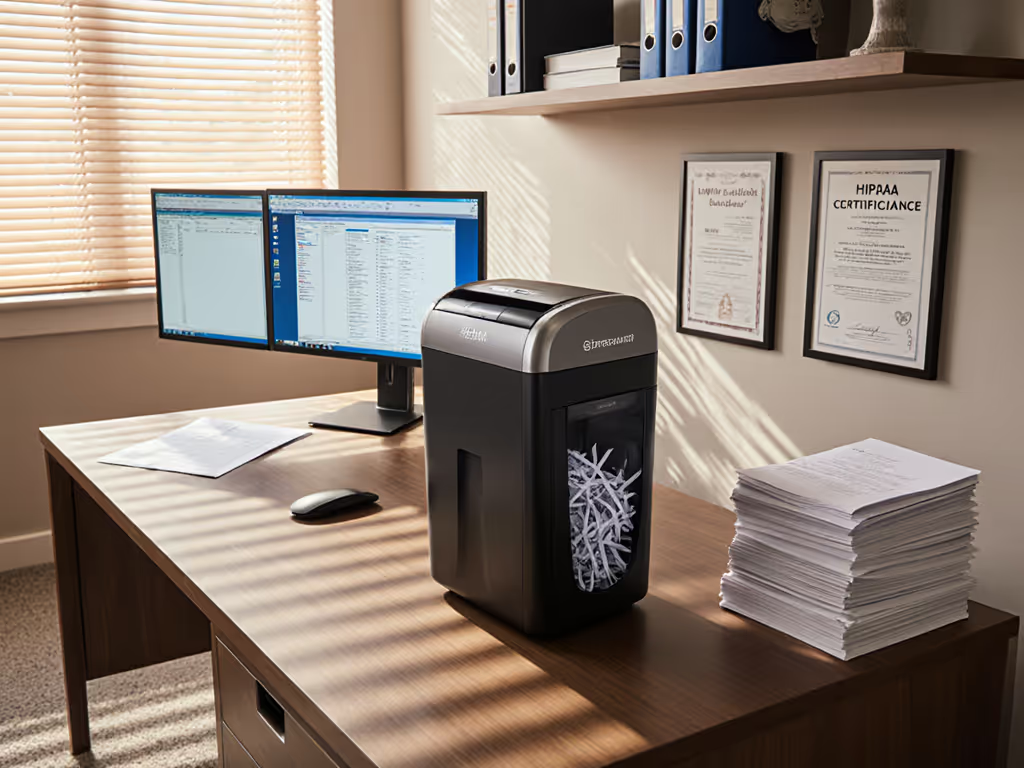
Underbuy security, and you're exposed. Miss a compliance detail, and the fine isn't speculative, financial institutions under FACTA rules face civil penalties, and HIPAA-adjacent data handlers risk liability[2]. A breach via improperly shredded documents is preventable, which makes it worse in hindsight.
Overbuy specs you won't touch, and you're paying for insurance against hypotheticals. I recall a co-working space that outfitted every nook with micro-cut machines. Gorgeous, overpriced units. Six months in, leadership mapped actual shred volume: it was one-tenth the design load. Half the machines sat idle. We consolidated to two reliable cross-cuts, locked them down, and cut spend by thousands without losing a single security layer. Nobody noticed the difference, except finance.
Misalign noise or duty cycle to your environment, and you create friction with staff, clients, or neighbors. That friction compounds: people avoid the shredder, documents pile up, and you're scrambling to outsource destruction or breach your own retention schedule.
Solution: Matching Shredder Specs to Real Estate Workflows
Step 1: Classify Your Document Sensitivity
Not all closing documents carry equal risk[6]. Title documents, financial statements, and client identification require P-4 minimum[2]. General correspondence or market research might merit P-3 in a pinch, but don't assume. Regulatory compliance in real estate hinges on FACTA, GLBA (financial privacy), and sometimes state-specific real estate practice laws. If you're uncertain, P-4 is the safe baseline and the one most guidance recommends[5].
Step 2: Estimate Actual Monthly Volume and Batch Size
Count the days you shred in a month. Count the average sheets per session. Does your firm process 500 closing packages annually (roughly 40 per month) with 20-30 pages each, or 10 per month? That volume dictates whether you need a compact personal-office unit (50-80 sheet capacity) or a small workgroup machine (100-150 sheets). Oversizing doubles your footprint and noise; undersizing guarantees jams and cool-downs.
Step 3: Prioritize Noise and Run-Time Over Micro-Specs
In a client-facing environment, noise matters more than going from P-4 to P-5. A 72 dB cross-cut (P-4) that runs for 20 minutes without thermal shutdown is vastly more useful than a 78 dB micro-cut that overheats after 10 minutes. Real-world data: cross-cut shredders in the P-4 range typically deliver 10-15 minute continuous run-times before requiring a 5-10 minute cool-down. Verify this spec before purchase.
Step 4: Calculate Total Cost of Ownership Over 3 Years
Shredder TCO includes the unit purchase, replacement parts (often belts or drive shafts), bags or disposal costs, maintenance oiling, and utility draw. A P-4 cross-cut typically costs $200-$400 for a mid-range unit. P-5 micro-cuts run $300-$600. Energy draw for a cross-cut is roughly 250-400W; micro-cuts often exceed 400W[10]. Over 36 months of twice-weekly use, the difference in power cost is modest (~$20-$40 annually) but the maintenance and replacement-part cost can swing the verdict. Cross-cuts have fewer moving parts and fewer jam incidents, reducing your support burden. If you're comparing a $300 P-4 unit with a 3-year warranty against a $500 P-5 unit, and your actual volume doesn't justify the higher security, the math leans P-4.
Step 5: Validate Practical Durability and Support
Brands with strong service networks and transparent warranty terms (not fine-print gotchas) absorb uncertainty. Compare real terms in our warranty coverage review. Look for units with auto-reverse technology to clear minor jams without disassembly, thermal-overload sensors, and documented field-replacement rates for consumable parts like belts. A shredder that fails after 18 months costs you far more than the purchase price in downtime and replacement[7].
What the Real Estate Market Needs: A Clear Profile
Your transaction document destruction workflow has three distinct moments:
-
Closing day preparation: You're organizing title documents, financial statements, and client identification. Ideally, sensitive originals go into a locked bin; duplicates are shredded same-day to minimize exposure. This means your shredder must be instantly available, reliable, and quiet enough that a closing room stays professional.
-
Post-closing archive purge: 30 days post-closing, retention schedules demand disposal of work copies, notes, and temporary files. This is your highest-volume moment and the point most offices falter, it is boring work deferred until a weekend or evening when bulk-fed to an overheating machine. A unit that runs cool and steady for 30 minutes is worth its weight.
-
Ongoing FACTA/GLBA hygiene: Monthly disposal of bank statements, promotional credit offers, and other PII-laden mail. This keeps your office clutter-free and your compliance posture clean. A quiet, always-on-hand shredder eliminates the friction that causes document piles.
Client-facing shredder quietness isn't cosmetic; it is operational. A P-4 cross-cut in the 70 dB range achieves this; a P-3 strip-cut at 75+ dB undercuts it.
Practical Decision Tree for Real Estate Teams
Answering these questions in order narrows your choice:
- Are you handling FACTA-regulated financial data regularly? → Yes = P-4 minimum. No = P-3 may suffice, but P-4 is safer.
- Do you store originals or just copies? → Originals = aim for P-5 if budget allows; copies = P-4 is standard.
- Monthly volume (approx. pages per shred session)? → Under 500 sheets/month = compact personal unit. 500-2000 = mid-range workgroup. Over 2000 = consider outsourcing or a commercial tier.
- Noise tolerance? → Shared office or near clients = prioritize units ≤72 dB. Solo/isolated space = 75 dB acceptable.
- Cool-down friction acceptable? → If you can pause and wait, a compact unit with shorter run-times works. If you need continuous throughput, buy the larger run-time spec.
- Maintenance bandwidth? → No = select brands with sealed-blade designs and auto-reverse. Yes = cross-cuts are lower-maintenance than micro-cuts.
The Verdict: Right-Sized Security Beats Specification Theater
Real estate closing shredders serve a specific, manageable purpose. Your goal is to secure client trust and meet compliance while keeping your operation calm and efficient. P-4 cross-cut shredders accomplish this for most teams at a rational cost point. They're faster than P-5 micro-cuts, cheaper than P-7 government-grade units, and deliver security that no reasonable closing specialist will reconstruct past. They run quieter than strip-cut alternatives and handle real-world batches (envelopes, staples, thick statements) without jamming.
The most common mistake isn't underspending; it's buying P-5 or P-7 specs because the marketer's language sounds official. Pay for reliability, not for unused security theater. If your firm closes 50 transactions per year and archives carefully, a single mid-range P-4 cross-cut (placed in your office, with a 3-year warranty and proven support) will likely outlast your need for it and cost roughly $30-$50 annually to operate when you factor electricity and supplies. That's not an expense; it's your insurance policy, and it's cheap.
Start with these specs: P-4 cross-cut, 72 dB or quieter, 10-15 minute continuous run-time, 80-100 sheet capacity, auto-reverse, thermal overload protection, and a documented brand reputation in your region. Compare three finalist models on warranty terms, parts availability, and actual user reviews from similar offices (not generic reviews). Verify the noise spec is field-measured, not marketing-smoothed. Then buy once and move on. Your closing room will stay professional, your compliance posture will stay solid, and your budget will thank you for not chasing specs you'll never use.
Related Articles