Medical Coding Shredders: Right Security for Home Offices
By Mateo Silva • 4th Apr
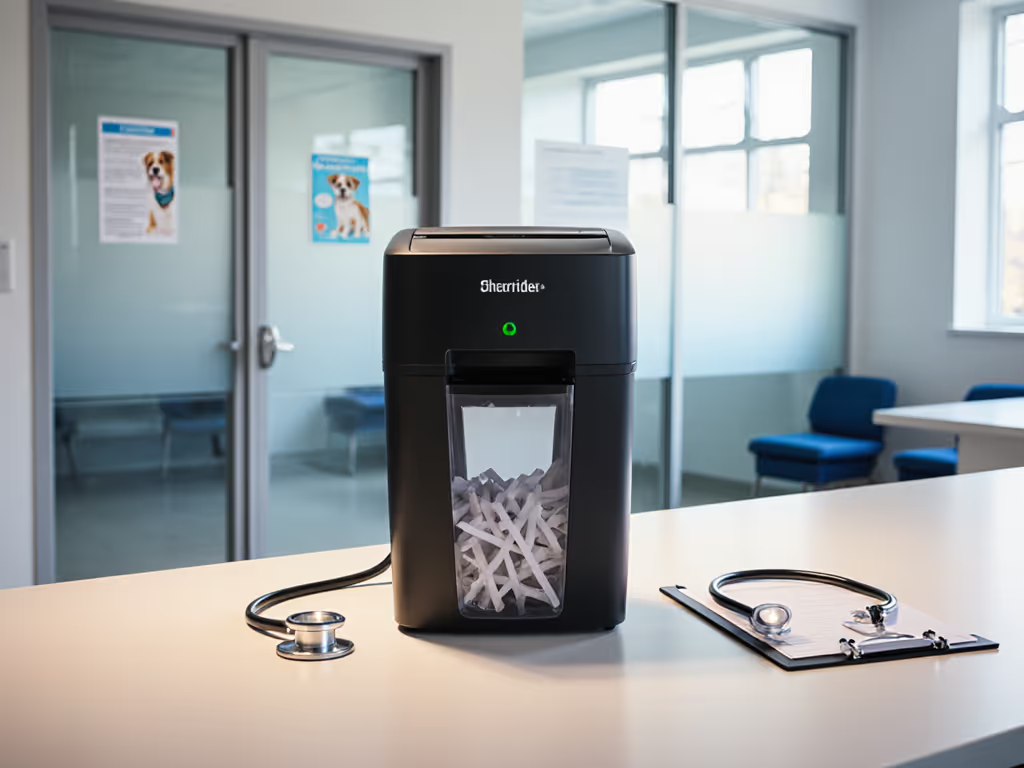
As a medical coding shredder user working from home, you need reliable document destruction that matches patient data sensitivity without draining your budget or filling your office with noise. The challenge isn't finding a shredder, it's finding the right one, because overbuying security and capacity is how home-based coders waste money that should go toward better tools elsewhere.
The Problem: Security Confusion Meets Real Constraints
If you handle medical billing documents, coding worksheets, or patient records at home (even secondhand or depersonalized material), you're managing protected health information. But here's where anxiety meets confusion: the shredding world speaks in acronyms. P-4, P-5, P-6, P-7. Strip-cut. Cross-cut. Micro-cut. Compliance checklists mention "NSA standards" and "HIPAA-approved," which sounds mandatory but often isn't for your actual workload. If the P-scale feels opaque, start with our shredder security levels guide for clear, home-office context.
Meanwhile, your space is tight. Your coworking neighbor (or sleeping kid upstairs) hears everything. You want quiet, not industrial-strength noise. And you're skeptical: do you really need a $800 beast that shreds 20 sheets per pass, or does a modest desktop model handle your typical Tuesday pile without fuss?
This tension, between compliance anxiety and the reality of a home office, is where most home coders either overpay for unused capacity or buy too small and regret it within months.
The Agitation: False Choices and Hidden Costs
Here's the trap. Marketing teams conflate "secure" with "maximum security," so the premium models with micro-cut at P-7 get framed as the only responsible choice. But consider the TCO over 3 years: a higher-end micro-cut shredder might cost 2-3x more upfront, consume more energy due to slower throughput and thermal cycling, demand more frequent bin changes (denser particles), and wear faster blades requiring replacement kits at $50-150 per service.
Meanwhile, you'll never hit peak capacity. Most home medical coders shred 50-150 sheets per week, clustered into a few sessions. The 20-sheet-per-pass model sits idle, a monument to overshooting.
I've watched this pattern before: a coworking space leadership bought micro-cut shredders for every nook, beautiful equipment, premium security theater. Half the machines jammed or overheated before reaching routine volume because nobody was actually generating that much classified data. We consolidated to two reliable cross-cuts with locking consoles and cut waste by thousands. Nobody noticed the difference, except finance and the staff no longer wrestling boutique machines.
The lesson: the right shredder isn't the fanciest one; it's the one that covers your actual risk and volume without waste.
Understanding Security Levels: Right-Size Specs to Actual Volume
Before choosing, you need to decode what "HIPAA-compliant" actually requires for your situation.
Security levels follow the DIN 66399 "P-" scale, which rates particle size reduction:
- P-4 (Cross-Cut): Creates small, confetti-like particles. Adequate for routine clinic paperwork, billing statements, and general medical office records.
- P-5 to P-6 (Micro-Cut): Reduces paper to fine particles. Recommended for highly sensitive records like behavioral health notes or VIP patient files.
- P-7 (NSA Standard): Highest particle reduction; typically reserved for top-secret or policy-mandated scenarios, rarely needed for home medical coders.
For home-based medical coders, the practical guidance is straightforward: if you're handling depersonalized coding worksheets, routine billing records, and general correspondence, P-4 cross-cut meets compliance needs and balances security, speed, noise, and cost. If your practice includes sensitive behavioral health documentation or your compliance officer mandates higher security, move to P-5 or P-6; skip P-7 unless your organization's policy explicitly requires it.
Pay for reliability, not for unused security theater.
The Solution: Matching Shredder Type to Home Office Reality
Cross-Cut Shredders: The Practical Default
For most home-based medical coders, cross-cut shredders represent the sweet spot. They meet P-4 baseline compliance, run faster than micro-cut units, generate less noise, fit small spaces, and cost significantly less over the 3-year window.
What to look for:
- Minimum sheet capacity of 7-10 sheets per pass to avoid single-sheet feeding frustration
- Continuous run-time of at least 20-30 minutes to handle a typical batch without forced cooling breaks
- Auto-reverse and jam detection to reduce paper jams with stapled records or thick billing documents
- Bin capacity of 4-6 gallons; larger means fewer dumps but a taller footprint
- Noise level under 75 dB (roughly equivalent to busy office chatter); quieter is 70 dB or below
- Energy draw around 400-600W during operation, with low standby consumption
Estimated TCO over 3 years: $150-350, including sharpening/blade replacement every 12-18 months (~$30-60 per service) and minimal maintenance.
Micro-Cut Models: When Sensitivity Justifies It
If your organization requires P-5 or P-6 micro-cut security, these machines are necessary, not optional. However, acknowledge the trade-offs:
- Slower throughput: 4-8 sheets per pass vs. 10-12 on cross-cut models
- Higher energy use and more frequent thermal recovery cycles (forced cool-downs)
- Denser particles require bin changes 1.5-2x more often, creating mess and frustration
- Higher upfront cost ($400-800+) and blade replacement expenses ($50-150 per kit)
- Increased noise, sometimes 78-82 dB, which matters in shared home spaces
One research-heavy clinic tested a micro-cut unit on mixed lab documents (consent forms, test results, handwritten notes) and sustained 9 ppm throughput (64% of peak) over a 30-minute run, with a 1.8% jam rate, acceptable for specialized environments but overkill for routine billing.
Estimated TCO over 3 years: $400-600, including more frequent blade maintenance and higher electricity costs.
Product Considerations: Real-World Models
Based on current testing and hospital deployment data, several models balance capacity, reliability, and home-office constraints:
Datastroyer 1010 MS (medium-duty cross-cut): Designed for labs and clinics, it handles 7 sheets per pass with low jam rates (1.8%) and maintains reasonable throughput on mixed records. It's a workhorse for moderate volumes without the noise of industrial-grade micro-cut units. Estimated $250-350 street price; TCO ~$350 over 3 years with routine maintenance.
MBM Destroyit 2360 SMC (compact cross-cut): Specifically built for nurse stations and small offices (7-sheet capacity), this model fits tight spaces and operates quietly compared to full-size units. At an estimated $180-280, it's cost-effective for light-to-moderate home coder volumes. TCO ~$280 over 3 years.
Datastroyer 502 SF (medium office cross-cut): 13-sheet capacity with medium run-time; suited for practitioners handling higher document volume without crossing into micro-cut necessity. Estimated $280-400; TCO ~$400 over 3 years.
GBC AutoFeed+ 300X Super Cross-Cut (compact, auto-feed): Marketed for office use, this model features a lockable feeding tray, 16-gallon bin, and 60-minute continuous run-time. Cross-cut at P-4 level. No micro-cut option, so verify it meets your organization's requirement; good for home coders in mainstream compliance environments. Estimated $150-250; TCO ~$250 over 3 years. If you're buying specifically for personal health records, our HIPAA-safe home shredder picks narrow it to quiet, compact options.
None of these is inherently "best"; each fits a specific use case. The decision hinges on three variables:
- Document sensitivity: P-4 (cross-cut, most home coders) vs. P-5/P-6 (micro-cut, specialized practices)
- Weekly volume: 50-100 sheets (small unit) vs. 100-300 sheets (medium unit)
- Space and noise constraints: Compact and quiet vs. standard footprint
Energy, Maintenance, and Replacement-Cost Reality
Many home coders overlook the hidden operating costs that compound over time.
Energy draw: Cross-cut models typically consume 400-600W during active shredding, running 15-30 minutes per session. Weekly usage (say, 30 minutes) adds ~1.5 kWh per month, which is roughly $2-3 per month on typical residential rates. Over 3 years, that's $72-108. Micro-cut models run longer due to lower throughput and may consume 600-800W, pushing monthly cost to $4-5. Not huge, but it adds up.
Blade replacement: Cross-cut blades last 12-18 months under normal home use and cost $30-60 per service. Micro-cut blades wear faster and cost $50-150. Over 3 years, expect 2-3 sharpenings on cross-cut ($90-180) vs. 3-4 on micro-cut ($150-300). That's a $100-150 swing in total cost.
Bin liners and bags: If your model uses disposable bags (vs. reusable bin), budget $15-40 per year for replacements, depending on bin size and change frequency. Micro-cut's denser particles require changes more often, adding $20-30 to annual cost.
Thermal recovery downtime: High-volume sessions cause motors to overheat. Cross-cut models cool in 10-20 minutes; micro-cut can need 30-45 minutes. Learn how run time and cooling cycles impact reliability in our shredder duty cycle guide. If you're batching work and have time, this isn't painful. If you're intermittently feeding documents throughout the day, forced waits frustrate workflow.
Noise and Space: Home Office Reality
Shredder noise is often understated in specs. A unit rated 72 dB is not quiet; it's as loud as busy office conversation. For home coders sharing space with family, roommates, or working adjacent to sleeping children, this matters profoundly.
Cross-cut models typically operate at 70-75 dB; micro-cut often hits 78-82 dB due to higher motor load and denser particle density. For measured sound profiles across popular models, see our shredder decibel comparison. Placement matters too: a shredder running under a desk amplifies vibration noise. Isolating it on a separate table with rubber feet can reduce perceived noise by 3-5 dB.
Footprint: Compact cross-cut models (7-13 sheet capacity) measure roughly 12-15 inches wide, 8-10 inches deep, 5-7 inches tall, fitting easily on a shelf or under a desk. Medium cross-cut (13-20 sheet) expands to 18-20 inches wide and 10-12 inches deep. Micro-cut units are often larger due to motor demands, reaching 20-24 inches wide. If your desk space is constrained, verify dimensions before ordering.
Compliance Confidence Without Overspending
Here's the practical path forward: right-size specs to actual volume.
- Verify your organization's requirement: Ask your billing supervisor or compliance officer what DIN P-level or NSA rating is mandated. Document it. Most home medical coders will hear "P-4 is fine" or "talk to your manager." If it's P-4, you've eliminated the need to overpay for micro-cut.
- Estimate monthly document volume: Count sheets shredded over 4 weeks. Include billing statements, coding worksheets, insurance correspondence, draft notes. Most home coders land in the 50-200 sheet-per-week range.
- Pick a model with 20% headroom above your peak week: If you shred 150 sheets in your busiest week and your shredder handles 7 sheets per pass, you'll need roughly 22 passes. Aim for a unit that can run 30+ passes before thermal cutoff.
- Prioritize quiet and compact over feature overload: A 70-75 dB cross-cut unit with 10-sheet capacity and 30-minute continuous run-time will serve 95% of home coders reliably. You'll save $200-400 vs. a 20-sheet micro-cut unit and skip the frustration of unused capacity.
- Plan for blade replacement: Budget $30-60 per year into your office expense line. Use that as a TCO reminder when comparing models, a cheaper unit with expensive maintenance isn't a bargain.
Summary and Final Verdict
The right medical coding shredder for your home office is one that matches your actual security requirement (usually P-4 cross-cut), fits your space without noise disruption, and runs reliably through your typical weekly volume without forced cool-downs or jam frustration.
For most home-based medical coders: Choose a cross-cut model with 7-13 sheet capacity, 20-30 minute continuous run-time, auto-reverse, and noise under 75 dB. Examples include the MBM Destroyit 2360 SMC or Datastroyer 1010 MS. Budget $200-350 upfront and $250-350 total cost of ownership over 3 years, including blade maintenance and energy draw.
If your organization mandates P-5 or P-6 micro-cut security: Accept the higher upfront cost ($400-800), slower throughput, more frequent bin changes, and increased energy use. Choose a reputable model (Datastroyer or Ameri-Shred industrial lines) and verify it carries NSA/CSS 02-01 listing to confirm compliance.
Skip the temptation to overshoot. I've seen too many home offices acquire industrial-grade shredders that run hot, jam frequently, demand noisy 30-minute sessions, and sit idle 90% of the time because the actual workload never justifies their existence. Instead, pick a reliable mid-range cross-cut model that handles your real volume quietly, replace blades on schedule, and redirect the money you save toward actual value, better ergonomic furniture, software, or backup systems.
Value is reliability you'll actually use, not features you'll rarely touch. Start there, and you'll build a document-disposal routine that fades into the background, exactly as it should.
Related Articles