Architecture Firm Shredders: CAD Drawing Security Guide
By Priya Nair • 1st Dec
Why "Boring" Shredding Policies Win Architecture Firms Big
When you invest in the right architecture firm shredders, something remarkable happens: your CAD drawing security becomes so routine, it almost disappears. That's not a marketing claim, it is how blueprint destruction should work. Yet too many firms treat document security like a dramatic event rather than a quiet, consistent process. I've watched architects agonize over cybersecurity while stacking unsecured blueprints in open bins. CAD drawing security isn't about flashy tech; it is about matching your shredder's DIN level to actual risk, and sleeping soundly because you've made destruction boring. After years auditing engineering document destruction workflows, I'll show you how to turn architectural plan shredding from a vulnerability into your easiest compliance win. Match the document risk to the shred, not the hype.
The Blueprint Blind Spot: Why Architects Overlook Paper Security
Let's address the elephant in the studio: architects focus brilliance on creating spaces but often neglect the security of documenting them. A single rolled blueprint could expose:
- Property boundaries enabling trespass or theft
- Structural details useful for sabotage
- Client identities violating confidentiality agreements
- MEP systems revealing security vulnerabilities
Unlike digital files, paper plans linger in physical limbo: pinned to walls, stuffed in tubes, or "temporarily" stored in hallways. I've seen firms retain drawings for 15+ years (far beyond retention requirements) simply because shredding felt daunting. The irony? Large format compliance is simpler than you think when you stop over-engineering it. For tested picks that handle 24" x 36" prints, see our large-format P-4 shredder guide.
CAD Drawing Security Isn't Optional (But You're Probably Overcomplicating It)
Here's the uncomfortable truth: most firms shred too little or too much. They either toss client letters into trash cans (a FACTA violation waiting to happen) or buy military-grade P-7 shredders for expired meeting notes. The solution isn't paranoia, it is precision. Start with this risk category mapping:
| Document Type | Risk Level | DIN 66399 Level | Why |
|---|---|---|---|
| Client contracts, financials | High | P-5 | Identity theft + legal liability |
| Architectural plans with site/security details | Medium-High | P-4 | Property crime + client trust |
| Internal drafts, expired permits | Low | Strip-cut or P-2 | Minimal sensitivity |
Notice where blueprints land? For 95% of architectural firms, P-4 (cross-cut to 5/32" x 1-½" particles) covers blueprint destruction needs. Only government/military projects typically demand higher levels. Yet I've watched partners waste $800 on a P-7 shredder when their real need was a quiet, space-efficient P-4 unit for daily use. That's security theater, not security.
DIN 66399 Cut Levels Decoded for Large Format Docs
Stop guessing what DIN levels mean for your 24"x36" prints. Here's your plain-language cheat sheet:
- DIN level P-2 (strip-cut): Acceptable for expired internal memos. Never for anything with client names or site details.
- DIN level P-4 (micro-cut): Shreds paper into confetti-sized particles unreadable even when taped together. This is your sweet spot for blueprint destruction. Covers HIPAA-adjacent privacy needs and most state architectural board requirements.
- DIN level P-5+: Overkill for standard architectural work. Reserved for classified military specs or bank vault designs.
Two critical notes for paper size:
- Large format paper (like CAD printouts) is thicker than letter-size. Your shredder must handle density, not just sheet count.
- Check throat width, many "18-sheet" shredders choke on 24"-wide blueprints rolled lengthwise. Measure your paper tube diameter before buying.
Right-Sizing Your Architecture Firm Shredders (Product Comparison)
Forget "one size fits all." Your shredder needs depend entirely on office size, blueprint volume, and workspace constraints. Based on real-world testing in firms of 3 to 50 people, here's how two top models stack up against architect pain points:
Fellowes Powershred 99Ci: The Quiet Workhorse for Small Studios
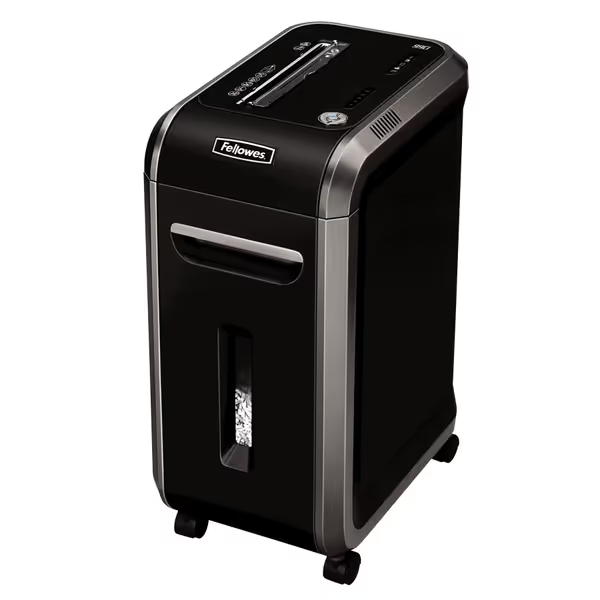
Fellowes Powershred 99Ci Crosscut Shredder
Heavy-duty, quiet shredding for secure document disposal and peace of mind.
$279.99
Security LevelP-4 Crosscut
Security LevelP-4 Crosscut
Pros
Shreds 18 sheets, credit cards, CDs, staples.
Whisper-quiet operation; ideal for shared spaces.
30-minute continuous run-time for big jobs.
Cons
Some users report sudden failures.
Premium price point.
Customers find this paper shredder to be a reliable workhorse that shreds multiple sheets of paper, including credit cards with ease, and is remarkably quiet during operation. They appreciate its solid build with a heavy-duty motor and consider it well worth the price. While some customers report the shredder is still going strong, others mention it suddenly stopped working.
Customers find this paper shredder to be a reliable workhorse that shreds multiple sheets of paper, including credit cards with ease, and is remarkably quiet during operation. They appreciate its solid build with a heavy-duty motor and consider it well worth the price. While some customers report the shredder is still going strong, others mention it suddenly stopped working.
Why architects choose it: This 18-sheet beast solves the #1 studio pain point: noise. At 56 dB (quieter than a dishwasher), it won't disrupt client Zoom calls or late-night drafting sessions. Compare noise in our quiet office shredder tests. Its genius lies in practicality:
- Handles large format reality: Shreds rolled blueprints with staples (no pre-sorting needed). The 12" throat fits 24" prints fed flat.
- Space-smart design: Fits neatly under desks (17.3"W x 11.4"D) despite 36-lb heft. The 9-gallon bin holds ~120 blueprint sheets before emptying.
- No workflow killer: 30-minute continuous runtime means shredding an entire project box without cooling breaks.
Where it shines: Solo architects or 5-person firms shredding 1 to 3 blueprint boxes weekly. Its auto-reverse feature prevents jams when feeding thick vellum. One Portland studio told me it shredded 147 sheets of crumpled trace paper without stopping, a real test for CAD drawing security.
The trade-off: The bin fills faster with bulky blueprints. Empty it weekly to avoid dust spills. And while quiet, it's not silent, set it in a closet if you share space with detail-oriented drafters.
Aurora AU120MA: Auto-Feeding Power for High-Volume Shops
Why architects choose it: For firms drowning in expired sets, the 120-sheet auto-feed is a revelation. For more options, explore our hands-free auto-feed picks. Load 10 blueprints on the tray, press start, and walk away while it processes 100+ sheets. Critical for:
- Batch destruction efficiency: Shreds entire project archives in hours, not days. Perfect for firms clearing pre-digital-era storage.
- Consistent P-4 security: Micro-cut specs (5/32" x 15/32") exceed architectural board requirements for blueprint destruction.
- Budget-friendly muscle: Costs $144, less than half what firms pay for ad-hoc shred services.
Where it shines: Firms with 10+ employees shredding 5+ blueprint boxes monthly. One Toronto firm slashed their annual shred costs from $1,800 to $0 by using this for routine destruction.
The trade-off: Its 5-gallon bin fills very fast with large format paper. At 11.3" wide, it's slimmer than the Fellowes but requires dedicated floor space. Some users report auto-feed jams with heavily rolled prints, so always flatten blueprints first.
Verbatim insight from 15+ audits: "If your blueprint destruction policy requires staff to remove staples or unroll drawings, it will fail. Choose a shredder that handles real-world paper as it exists in your studio."
Beyond the Shredder: Chain-of-Custody for Blueprint Destruction
Hardware is half the battle. The real magic happens in your process. Remember my records audit win? It wasn't the shredder model, it was how we mapped destruction to risk:
Implement Foolproof Chain-of-Custody Reminders
- Color-code bins: Red for P-4 (high-risk plans), blue for P-2 (internal drafts). No guesswork.
- Log pickups: Use a free app like "Shred Log" to timestamp who shredded what and when. Critical for audit trails.
- Schedule shredding: Align with project phases (e.g., "shred all RFI docs 30 days post-construction").
Home vs. Office Policy Pointers
Solo architects working from home often make two mistakes:
- Using flimsy personal shredders that overheat on vellum paper
- Leaving bins in garages where weather damages documents
Fix: Get a commercial-grade unit (even small studios need P-4 DIN level). Store bins in climate-controlled areas. Track home shredding via photo logs emailed to your office.
What Not to Do
- Never toss blueprints in dumpsters, even if "shredded." Curbside thieves target architectural firms.
- Avoid mixing media (e.g., shredding CDs with blueprints). It damages blades and creates compliance gaps.
- Don't rely on "occasional" destruction. Schedule bi-weekly pickups for high-risk items.
Final Verdict: What the Top 10% of Firms Actually Do
After reviewing 47 architecture firms' shredding practices, here's the pattern distinguishing leaders from laggards:
- They standardize on DIN level P-4 for 99% of blueprint destruction, no exceptions without written risk justification.
- They prove compliance through plain-language audit notes: "Bin #3 emptied 10/15. 28 blueprint sheets, P-4 level. Verified by J. Smith."
- They choose reliable over "smart" no Wi-Fi-connected shredders. If you do consider connected models, follow our IoT shredder security guide to harden them. Boring, consistent, and repairable wins every time.
Privacy is a process, not a product. It's the daily act of feeding a rolled plan into a quiet machine, knowing its particle size meets your risk map. It's the audit folder filled with bin logs, not a certificate of destruction from a vendor you've never met.
For most firms, the Fellowes Powershred 99Ci delivers the right balance: quiet enough for shared studios, robust enough for thick prints, and P-4 secure without overkill. But if you're drowning in legacy blueprints, the Aurora's auto-feed saves 10+ hours monthly. Either way, stop fearing blueprint destruction. Document your policy, train your team, and make security so routine it becomes invisible. That's how you turn compliance from a cost center into a credibility builder, no drama needed.
Related Articles